Grow Light Setup for a Plant Shelf or Rack
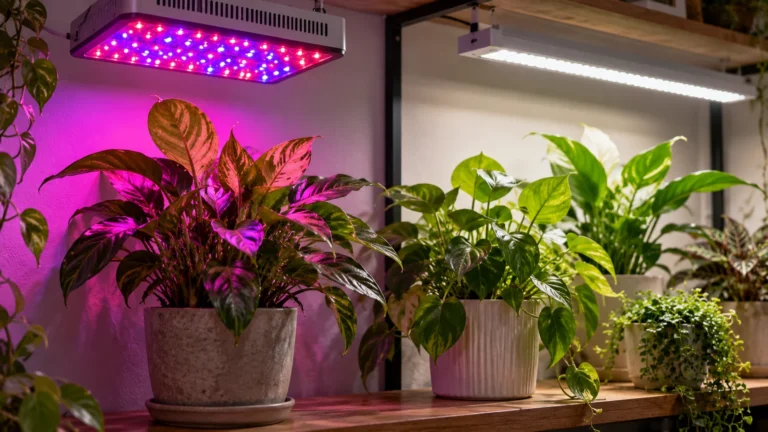
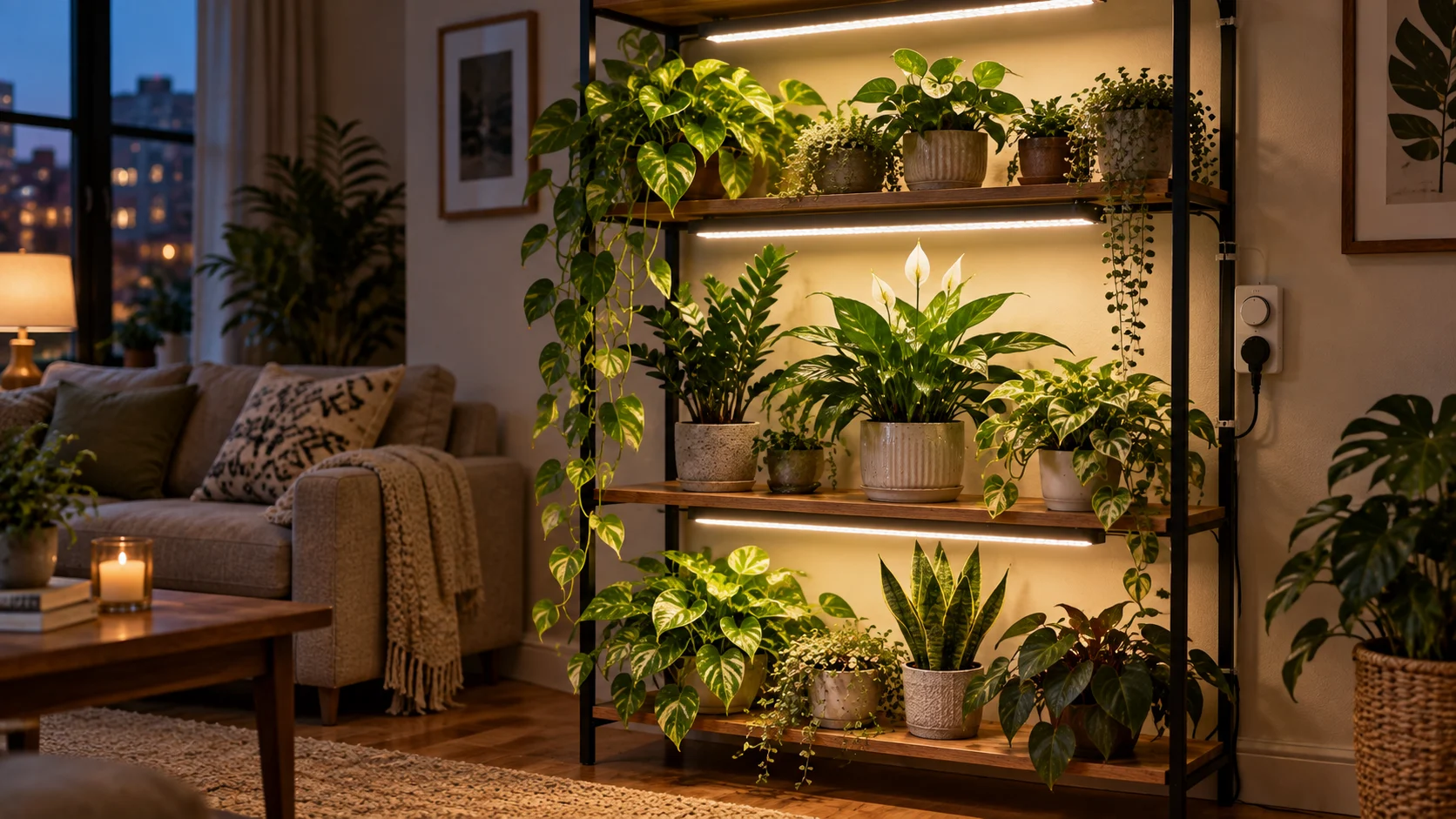
A shelf with four levels is not one lighting problem. It is four. Every level has a solid shelf directly above it, so light from the fixture two levels up never reaches the plants below, and each level needs its own light source and its own height. That single fact decides almost every other choice you make, including how many fixtures you buy and what shape they should be. The rest of the setup comes down to three things: putting the fixture close enough, putting the right plants under the brightest part of it, and running the whole rack on one timer so nothing depends on you remembering.
Start by Counting Levels, Not Plants
The most common mistake with a plant rack is buying one good fixture and mounting it at the top, on the reasonable-sounding theory that light travels downward. It does, until it hits a shelf.
Unless your rack is made of glass or open mesh with generous gaps, the level below the top one is in shadow, and the level below that is in deeper shadow. What reaches those plants is room light bouncing in from the sides, which is a fraction of what the fixture is putting out. If you have three levels holding plants, you are lighting three separate spaces that happen to be stacked.
This is why a rack setup usually ends up with more, smaller fixtures than people expect, rather than one large one. It is also why the total cost of a rack is easy to underestimate at the planning stage. Each fixture is another thing drawing power, and what grow lights actually cost to run is worth reading before you multiply by four.
Match the Fixture Shape to the Shelf Shape
Forget brands for a moment and think about geometry, because that is what actually decides this.
A shelf is a long, shallow rectangle. A plant standing on it is somewhere between a few inches and a couple of feet tall, and the space between one shelf and the next is fixed. So the question is not which fixture is best, it is which shape covers a long, shallow rectangle from a short distance.
| Fixture class | What it suits on a shelf | What it does badly |
|---|---|---|
| Linear or bar fixtures (tube-shaped, mounted along the length of the shelf) | Long, narrow shelves where plants sit in a row. The lit area follows the shelf shape, and the fixture can sit close because it is thin. | Deep shelves. A single line of light down the middle leaves the front and back of a deep shelf dimmer. |
| Flat panels (a broad rectangular face) | Deeper shelves and grouped plants, where you want an area lit rather than a line. | Short clearances. A panel needs some height above the plants to spread its light, and a low shelf may not allow it. |
| Clip-on or gooseneck spot fixtures (a single small head on an arm) | One plant, or a rack where only one or two plants are demanding. Easy to aim and easy to move. | Covering a whole shelf. A small head lights a small circle and falls away quickly outside it. |
| Integrated light-and-shelf units (fixtures built into the frame) | People who want the decision made for them and do not want to mount anything. | Flexibility. The height, the fixture and the shelf spacing all come as one decision, and you cannot change one of them later. |
What decides between them is honest and boring: the shape of the area you need to light, the clearance you have between shelves, whether you can fix anything to the underside of the shelf above, and whether the rack lives in a spare room or in the middle of a living room where it has to look like furniture.
None of these classes is better than the others. A bar fixture over a narrow shelf of small plants and a panel over a deep shelf of larger ones are both correct answers to different rectangles.
Where Each Plant Goes on the Shelf
This is the part that costs nothing and is skipped almost universally.
A fixture is brightest directly beneath itself. Move sideways toward the edge of the area it lights and the intensity falls, and move down and away from it and the intensity falls again. Mississippi State University Extension's measured example makes the vertical half of that concrete: for two 40 watt fluorescent lamps, output measured roughly 500 foot-candles at 6 inches and about 100 foot-candles at 30 inches. The horizontal half works the same way for the same reason, which is that light spreads out as it travels.
So a shelf is not one light level. It has a bright middle and dimmer ends, and that gives you a free tool:
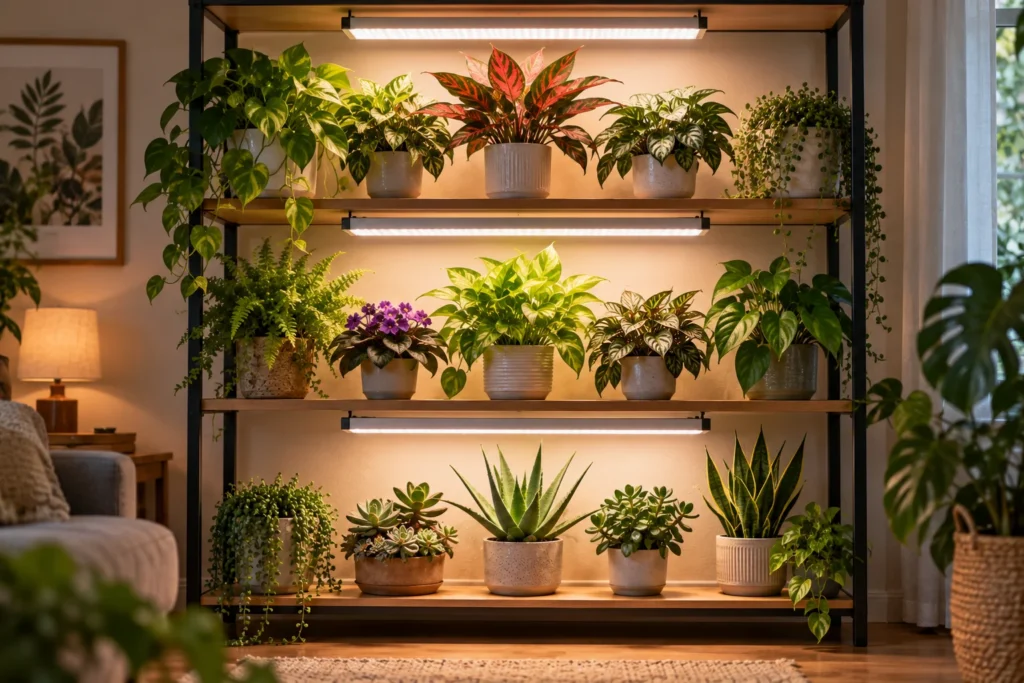
- Put the most demanding plant directly under the fixture, in the middle of the lit area and as close to the light as it can safely sit.
- Put the tolerant plants at the ends, where the light falls off. A pothos or a snake plant at the edge of a shelf is fine. A succulent there is not.
- Do not sort by height for looks. A tall plant at the end of a shelf is closer to the fixture than a short plant in the middle, and that changes its light more than its position in the row does.
- Turn plants a quarter turn when you water. A plant lit from directly above grows evenly. A plant at the edge is effectively lit from one side and will lean, exactly as it does toward a window.
The general rules that sit behind all of this are in our simple grow light setup guide, which covers the three decisions in isolation. This page is what happens when you have to make them for six plants at once.
Height Is the Only Free Lever, So Protect It
Everything else about a rack is fixed once you have built it. Height is not, and it is the strongest control you have over how much light a plant receives.
Mississippi State University Extension puts plants under artificial light within 1 to 3 feet of the source, and that is guidance rather than a setting: the right height depends on how much your particular fixture puts out, which is why an intensity figure without a distance attached tells you nothing. If your fixture's maker publishes an output figure at a stated height, use that height as your starting point. If it publishes nothing, start inside the extension range, nearer the closer end for a small fixture, and let the plant correct you. Grow light distance from plants goes through the method properly.
Practically, on a rack, that means:
- Mount so you can change it. Chains, hooks, adjustable brackets, anything that lets you move a fixture up or down in small steps. A fixture screwed permanently to the underside of a shelf has thrown away your best control.
- Move in small steps and wait. A plant that has lived in a dim corner has leaves adapted to a dim corner, and dropping a bright fixture close to it in one move can bleach the leaves it already has.
- Re-check as plants grow. On a rack, plants grow toward the shelf above them. The setting that was right in spring is a different setting by autumn.
One Timer for the Whole Rack
Hours are the second input to how much light a plant gets across a day, and consistency matters more than the exact number.
Iowa State University Extension and Outreach puts supplemental lighting at 12 to 14 hours a day, with 10 as a floor for home growers and no more than 16. Illinois Extension says 14 to 16 hours is sufficient and warns against exceeding 16, because plants need a rest period. Pick a figure inside the overlap, put every fixture on the rack on a single plug-in timer, and stop thinking about it. How long to run a grow light each day explains why the published ranges differ.
Running the whole rack on one timer has a second benefit: when the timer fails, everything fails at once and you notice. Fixtures on separate switches fail one at a time and quietly.
The Practical Half Nobody Mentions
A rack concentrates plants, water and mains electricity into one piece of furniture, which is worth a paragraph of care.
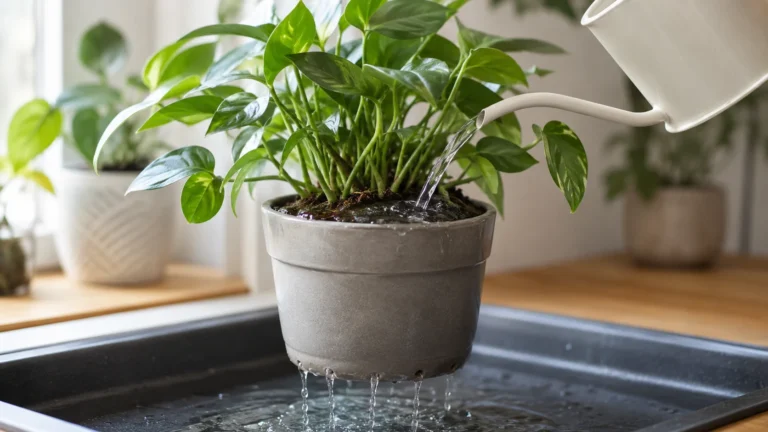
Keep water away from the fixtures, cords and any power strip. The simplest habit is to take plants off the rack to water them, or water them at a sink and let them drain before they go back. Pouring water on a shelf directly under a plugged-in fixture is the one routine worth changing.
Leave clearance for heat. LED fixtures run much cooler than the old incandescent bulbs, but they are not cold, and a leaf pressed against a housing will still cook.
Do not chain power strips or overload one outlet. A rack of fixtures on a timer is several devices on one circuit, and a rack is exactly the situation where a single extension cord quietly becomes the plan. If you are unsure whether the outlet can take it, that is a question for a qualified electrician rather than for a plant site.
Expect to water more. Plants under better light use more water, so the soil dries faster than it did before the rack existed. Go back to checking the soil rather than the calendar, which is what how often to water indoor plants covers.
What a Rack Setup Cannot Fix
A rack does not make a weak fixture strong, and it does not make a high light plant content in a low light level. If the plants on one shelf are not improving after several weeks of new growth, the answer is almost always quantity: the fixture is too far away, too small for the job, or running too few hours. How to tell if a grow light is actually working is the check to run before buying anything else.
Frequently Asked Questions
How many grow lights does a four-shelf rack need? Usually one per level that holds plants, because each shelf blocks the light from the fixture above it. A level used for storage or for tools needs nothing.
Can one long fixture light two shelves? Only if there is nothing solid between them. If the shelves are glass or open mesh with wide gaps, some light gets through, but it arrives much weaker and it is arriving from an awkward angle. Plan on one fixture per populated level.
Should the fixture be mounted under the shelf above or hung from the ceiling? Under the shelf above is usually simpler and keeps the light aimed straight down, which produces evener growth than a light coming in at an angle. What matters more than the mounting point is that you can adjust the height afterward.
Do the plants at the ends of the shelf need to be moved around? Rotating plants between positions is one way to even things out, but it is easier to put tolerant plants at the ends permanently and demanding plants in the middle. Turning each plant a quarter turn when you water handles the leaning.
Is a shelf with built-in lights worth it compared with buying the parts separately? It removes the mounting job and the decisions, which is genuinely worth something. The trade is flexibility: the fixture, the height and the shelf spacing arrive as one fixed package, and height is the control you are most likely to want later.