How to Tell If Your Grow Light Is Working
There are two checks, and most people only know about the slow one. The slow one is the plant: compare new growth with older growth and see whether the new leaves are bigger and more tightly spaced. The fast one is arithmetic. If your fixture publishes an output figure, you can work out in about a minute how much light it delivers per day at your hanging height, and compare that against the published requirement for your plant. That tells you whether the light is capable of working before you spend a season finding out.
The Paper Check
Two units do the work here. PPFD is instant intensity, in micromoles per square meter per second (µmol/m²/s). DLI, the daily light integral, is the day's total, in moles per square meter per day (mol/m²/day). DLI is the one that tracks with growth, because a plant does not care about any single moment.
Virginia Cooperative Extension gives the conversion in Calculating and Using Daily Light Integral (DLI): An Introductory Guide (publication SPES-720NP, Eric Stallknecht, August 2025):
DLI = (PPFD × 3,600 × operating hours) ÷ 1,000,000
And Iowa State University Extension and Outreach gives the targets:
- Low light foliage houseplants: 3 to 6 mol/m²/day
- Foliage and flowering houseplants, cuttings, seedlings: 6 to 10 mol/m²/day
- Flowering houseplants, succulents, herbs, vegetables: 12 to 16 mol/m²/day
- The most demanding edibles: 18 to 30 mol/m²/day
A worked example, using an assumed figure
The number below is invented to demonstrate the method. Substitute your own fixture's published figure for the distance you actually hang it at.
Say the maker publishes 150 µmol/m²/s at 12 inches, and you run it for 12 hours.
150 × 3,600 × 12 ÷ 1,000,000 = 6.5 mol/m²/day
That clears Iowa State's low light foliage band of 3 to 6 and sits at the bottom of the 6 to 10 band. For a pothos or a philodendron, that fixture at that height and those hours is genuinely working. For a succulent needing 12 to 16, it is roughly half of what is required, and no amount of waiting will change that.
Run the same sum for your own numbers and you will get one of three answers: comfortably inside the band, marginal, or nowhere near. Each has a different fix. Marginal usually responds to lowering the fixture or adding hours. Nowhere near usually means the fixture is too small for the job or the plant is too demanding for the fixture.
If your fixture publishes nothing
This is very common on consumer fixtures, and the honest answer is that you cannot do this calculation. We are not going to supply a conversion from watts or lumens, because neither can be turned into a photon count without knowing the fixture's spectrum, and any single conversion figure would be wrong for most products.
What you can do instead:
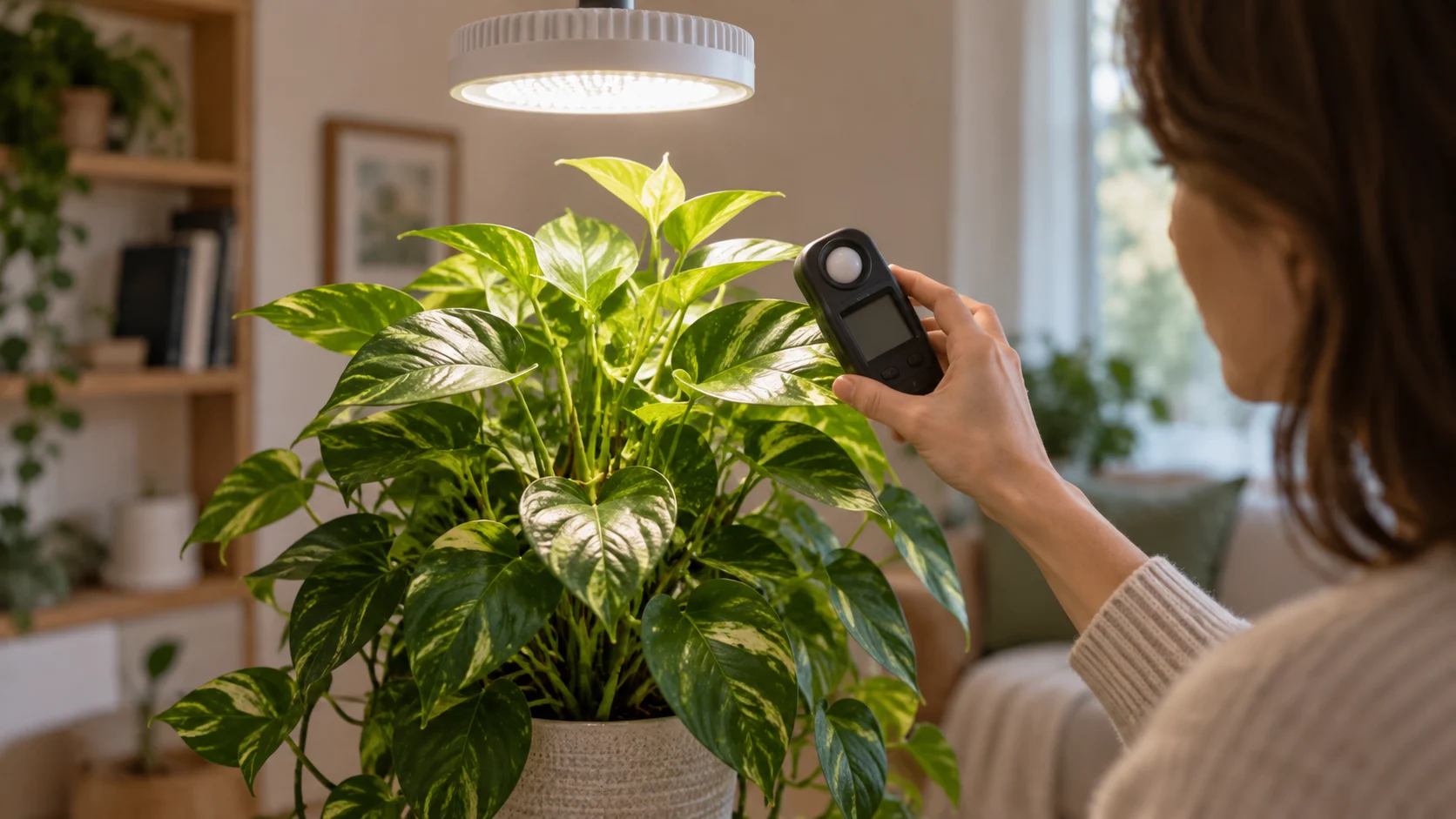
- Use a PAR meter if you want a real number. It reads µmol/m²/s directly at the leaf.
- Use a phone light meter for comparison, not for a verdict. It reads foot-candles or lux, which Virginia Cooperative Extension notes are based on human vision and do not always translate well to plant growth. It will still tell you honestly that the spot under your fixture is four times brighter than the corner it came from, which is worth knowing.
- Use the extension foot-candle bands as a rough sanity check. Illinois Extension puts low light houseplants around 75 foot-candles, medium at 150 and bright at 300. Mississippi State University Extension notes that below about 50 foot-candles light will not sustain plant life for very long.
- Fall back on distance and hours. Mississippi State puts plants within 1 to 3 feet of an artificial source. Iowa State puts the run time at 12 to 14 hours, no more than 16.
The Plant Check
The plant is slower but it is the only test that accounts for everything at once. The trick is knowing what to look at, because most of the plant will not change at all.
What will not change, ever: stretched stems from the dark period stay stretched, and leaves that grew small stay small. If you are waiting for the existing plant to improve, you are waiting for something that does not happen.
What to compare instead: the newest fully opened leaf against a leaf from before the light arrived.
Signs it is working:
- New leaves the same size as the older ones, or larger.
- Tighter spacing between leaves along the stem, so the new section looks more compact than the old.
- New growth appearing at all, on a plant that had stopped, during the growing season.
- On a variegated plant, variegation returning in new leaves rather than reverting to plain green.
- The soil drying faster than it used to, because a plant using more light uses more water.
That last one is easy to misread. It is a sign of success, not a problem, but it means your old watering routine is now wrong. Check the soil rather than the calendar.
Signs it is not working: the opposite of all of the above, and in particular continued stretching in new growth. The full set of signs a plant needs more light covers how to read them and which are most reliable.
How Long Before You Can Judge
Long enough for the plant to produce several new leaves, which depends entirely on the species and the season, so we are not going to attach a number of weeks to it. A fast pothos will answer far sooner than a slow snake plant, and neither will answer much at all in the middle of winter.
Two rules make the wait shorter and more informative:
Change one thing at a time. If you add a light, move the plant and repot it in the same week, you will not know which one caused what happened next.
Write down the date and take a photo. Memory is unreliable across weeks, and a photo of the plant on day one settles arguments that guesswork cannot.
The Common Reasons a Working Light Looks Broken
It is too far away. The most frequent cause by a distance. Mississippi State measured two 40 watt fluorescent lamps at roughly 500 foot-candles at 6 inches, falling to about 100 at 30 inches. The same fixture at two heights is effectively two different lights. Grow light distance covers how to find the right height without relying on a grow tent chart.
It is not running long enough, or not running consistently. A light that only runs when you remember is a much weaker light than the one you think you own. How long to run a grow light each day sets out the published ranges and the ceiling.
The plant is out of season. Growth slows or stops in winter for many houseplants regardless of light, so a fixture added in December may show nothing until spring. If the plant looks bare and lifeless rather than merely static, whether it is dead or dormant is the check to run first.
Something else is the actual problem. Light will not fix root damage, a pest infestation, or a plant recovering from a move. Why a houseplant stops growing works through the other causes, and it is worth ruling them out before blaming the fixture.
You are judging the wrong part of the plant. Worth repeating, because it accounts for a lot of unnecessary disappointment.
Signs the Light Is Working Too Well
Overshooting is less common than undershooting but it does happen, usually with a strong fixture hung close.
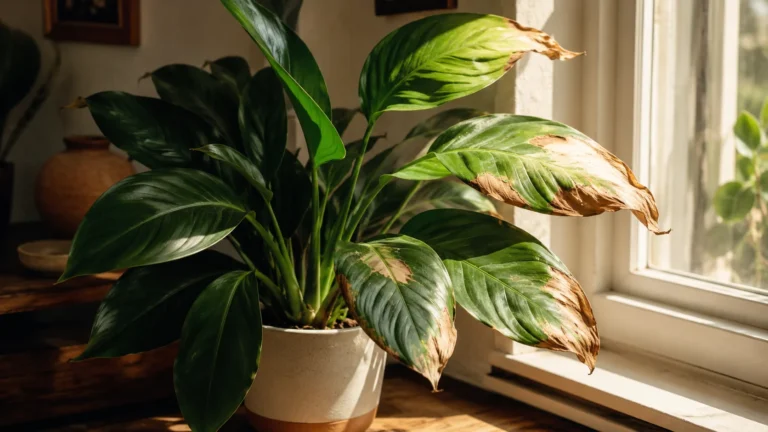
Look for pale, bleached or washed-out patches on the leaves nearest the fixture, sometimes with crisping at the tips and edges. The pattern is the diagnostic: it appears on the top of the plant, on the side facing the light, while lower leaves stay normal. Leaf scorch and sunburn on houseplants describes what it looks like and what to do about it.
The fix is to raise the fixture in small steps rather than switch it off, and to move a plant to a brighter position gradually rather than all at once, because leaves adapted to dim conditions cannot handle a sudden change.
Frequently Asked Questions
How can I tell if the light is on the right setting without a meter?
By the plant, over weeks, comparing new growth with old. Everything else is inference. If the fixture publishes a PPFD figure, the arithmetic above is faster and more definite than waiting.
The light is on but the plant looks worse. What happened?
Check watering first. A plant receiving more light dries out faster, and a routine that worked in a dim corner can leave it too dry now. Then check the top leaves for bleaching, which means the fixture is too close.
Does the light need to be on the plant, or just in the room?
On the plant. Intensity falls away quickly with distance, which is why a room that looks well lit to you can be very dim from a plant's point of view. A fixture lighting the room generally is not lighting the plant meaningfully.
Can I test it by turning the light off for a week?
It will tell you nothing in that time and it interrupts the consistency the plant needs. A better test is the photo and the date, then leaving the setup alone.
My fixture publishes PPFD but only at one distance. Can I estimate the rest?
Not reliably, because how quickly output falls depends on the shape and size of the fixture. A broad panel loses less over the same distance than a small bulb-style light does. Hang it at the distance the published figure refers to if you can, so the number you calculated is the number you are actually getting.