Can a Grow Light Replace Sunlight Completely?
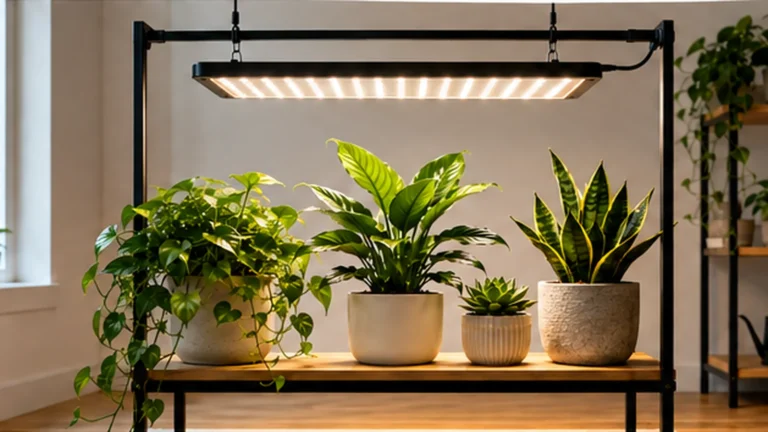
For most foliage houseplants, yes. A plant does not need a window. It needs a certain quantity of light, for a certain number of hours, followed by a period of darkness, and a fixture can supply all three. Nothing about a windowless room is fatal on its own. What decides the outcome is whether the fixture actually delivers enough light at the height you hang it, and whether it runs on a schedule you do not have to remember. The honest limits here are not about spectrum or about light being "natural." They are about quantity, about reliability, and about the fact that a window tells you when it has failed and a lamp does not.
A Window Is a Weaker Source Than It Looks
It helps to know what you are replacing, because the window in an average room is not delivering nearly as much as it appears to.
Nebraska Extension puts the differences between exposures plainly: if light intensity in a south window is 100 percent, an east or west exposure is about 60 percent and a north exposure about 20 percent. Mississippi State University Extension adds the part people underestimate most, which is how fast that light disappears as you step back from the glass. Its guidance describes intensity falling from around 1,000 foot-candles to around 100 across only a few feet, and notes that it is difficult to grow plants more than 8 to 10 feet from a window.
Read that again with your own room in mind. A plant sitting six feet inside a north-facing room is already living on a small fraction of what the window offers, and the window is doing far less of the work than you are giving it credit for. That is why a modest fixture placed close to a plant can genuinely outperform a window the plant sits several feet away from. You are not competing with the sun. You are competing with what is left of the sun by the time it reaches that corner. Whether you need a fixture at all is the fork our pillar on deciding whether you need a grow light works through first.
What a Fixture Has to Supply to Stand In
Four things, and they are separable.
Intensity at the plant. This is the one that decides everything, and it is also the one packaging is least honest about. The quantity that matters for a plant is photosynthetic photon flux density, usually shortened to PPFD, which counts the usable photons landing on a surface each second. Watts describe what the fixture pulls out of the wall. Lumens and foot-candles describe brightness as a human eye perceives it, and Virginia Cooperative Extension notes that lux and foot-candle readings are based on human vision and do not always translate well to plant growth. None of those three is the quantity a leaf responds to.
A distance, attached to that intensity. Light spreads out as it travels, so the same fixture is a strong light at a few inches and a weak one at three feet. Any claim of the form "equivalent to sunlight," or any PAR or PPFD figure quoted without saying at what height it was measured, cannot be checked and cannot be compared with anything else. Mississippi State's own measured example shows the scale of the effect: for two 40 watt fluorescent lamps, output measured roughly 500 foot-candles at 6 inches and about 100 foot-candles at 30 inches. Same lamps, same room, about a fifth of the light. How far a grow light should sit from a plant works through what to do with that.
Hours. Intensity and hours multiply into a daily total, which is why a weaker fixture running longer can land in the same place as a brighter one running less. Iowa State University Extension and Outreach puts supplemental lighting at 12 to 14 hours a day, with 10 as a floor for home growers and no more than 16. How long to run a grow light each day covers where those ranges come from.
Darkness. This is the part a windowless setup gets wrong most often, because there is no sunset to enforce it. University of Maryland Extension is direct about it: exposure should be limited to no more than 16 hours daily, because plants require a period of darkness for proper development. Leaving a fixture on around the clock is not a stronger version of a good idea. A plug-in timer removes the problem entirely.
Can a Grow Light Replace Sunlight for Your Particular Plant?
For quantity, yes, within the limits of the fixture you own. The realistic question is which plant you are asking it to support.
Iowa State University Extension and Outreach publishes daily light integral bands, measured in moles per square meter per day. Low light foliage houseplants sit at 3 to 6. The next band up, covering foliage plants, cuttings and seedlings, runs 6 to 10. Succulents, herbs and vegetables are put at 12 to 16, and the most demanding edibles at 18 to 30.
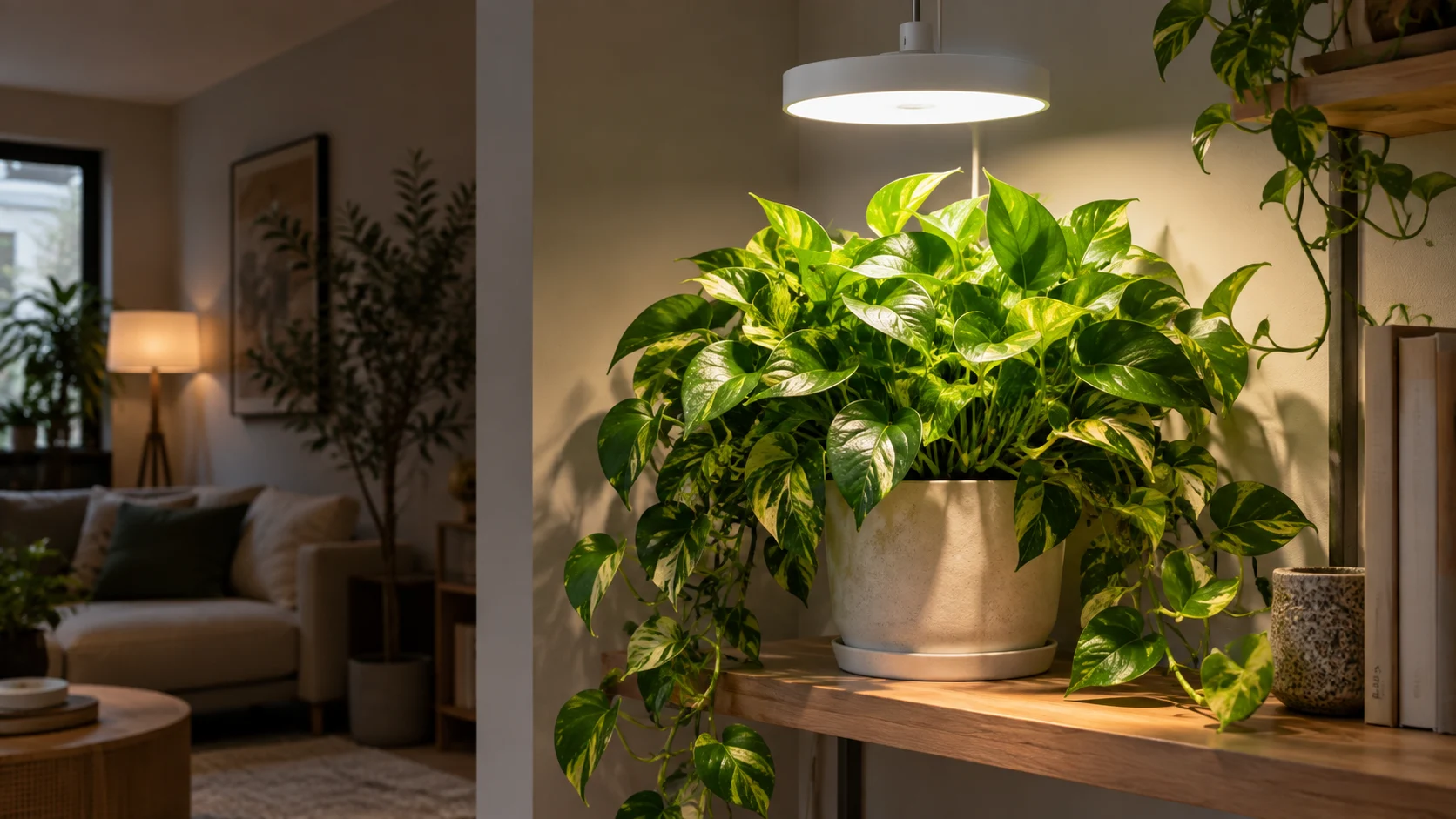
That spread is the whole answer. A pothos or a ZZ plant in a windowless room is a modest request, and an ordinary fixture close enough to the leaves will meet it. A succulent in the same room is asking for several times as much light, which usually means a larger fixture, a shorter hanging distance, longer hours, or all three. Nothing about that is impossible, but it is a different purchase and a different setup. Requirements vary by species, and no single number printed on a box covers both cases.
If you are not sure which end of that range your plant sits at, our guide to low light houseplants that genuinely tolerate a dim room is the honest version of that list, including the part most lists skip: tolerating low light is not the same as growing well in it.
The Four Things a Window Does That a Lamp Does Not
This is the part almost nothing written on the subject says out loud, and it matters more than spectrum does.
1. A window never needs to be switched on. A windowless setup has a single point of failure that a window does not have, and it is the schedule. A timer that gets unplugged, a switched outlet somebody flips, or a power cut while you are away means the plant's day length simply stops. The plant will not tell you for weeks.
2. Fixture output falls quietly over time. Illinois Extension notes that tube light output diminishes with use, and other fixture types decline too. A window that is 20 percent dimmer is just a cloudy day. A fixture that has dimmed by 20 percent looks identical to your eye, because your eye adapts continuously, and the only evidence is in the new growth.
3. The gap closes as the plant grows. A window stays where it is. A fixture sits at a fixed height above a plant that is getting taller, so the distance from lamp to leaf shrinks month by month without anybody deciding it should. Pale patches on the topmost leaves are the usual first sign, and they are worth looking for a few times a year.
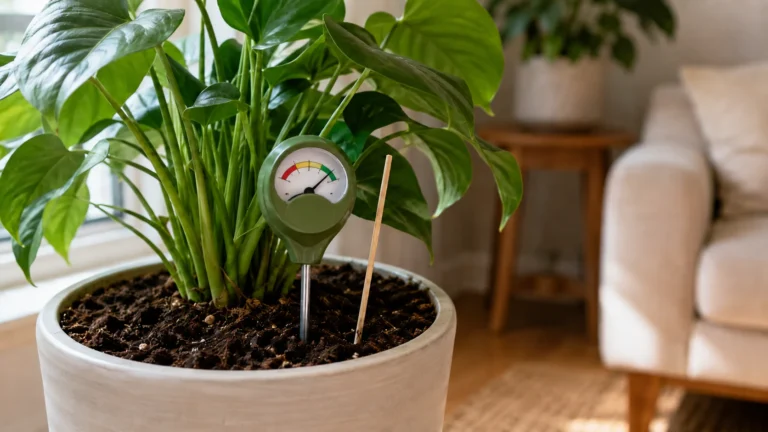
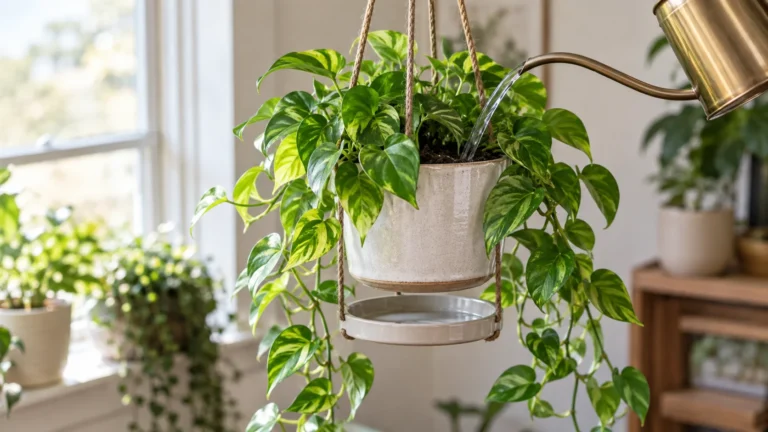
4. A window sets the watering clock. A plant in a windowless room under a timer has no seasons. It does not slow down in winter the way a plant beside glass does, so the watering habit you built next to a window will not transfer to it. Go back to checking the soil rather than the calendar, which is the point how often to water indoor plants makes at length.
None of the four is a reason to avoid a windowless setup. They are the reasons a windowless setup fails when it does fail, and every one of them is caught by looking at the plant occasionally.
When the Honest Answer Is No
There are cases where a fixture is not a replacement, and it is cheaper to know them now than in three months.
- The fixture publishes nothing measurable and the mounting position is fixed and far away. With no output figure at a stated distance, and no ability to get closer, you have no way to know whether the setup is capable and no lever to pull if it is not.
- The plant is a high light species and the fixture is a small accent lamp. A gap of several times the required light does not close with patience.
- Nobody is going to look at the plant. A windowless setup is more automatic than a window day to day and less forgiving across a season.
- The room is very cold, or very dry, or unheated. Light is one input. A fixture does not fix a storeroom.
If you want to check whether the setup you have already built is doing its job before spending anything else, how to tell if a grow light is actually working puts the arithmetic and the plant test side by side.
Frequently Asked Questions
Can a houseplant live with no natural light at all?
Many foliage houseplants can, provided the fixture delivers enough light at the plant for enough hours a day and the plant still gets a dark period. There is nothing a leaf requires that only arrives through glass. The constraint is quantity, not origin.
Is sunlight better quality than a grow light?
Sunlight covers a broader and more variable spectrum, and it is far more intense at its peak than a household fixture is. For a shade-adapted foliage houseplant, neither advantage is the limiting factor indoors, because that plant is not using anywhere near the intensity a bright window offers in the first place. For a high light species, the intensity gap is real and it is the thing to solve.
How many hours should the light run in a room with no window?
Iowa State University Extension puts supplemental lighting at 12 to 14 hours a day and no more than 16, and University of Maryland Extension makes the same point from the other direction by requiring a period of darkness. Set a timer rather than deciding each evening.
Does the light need to be full spectrum to replace a window?
Spectrum is the wrong place to spend your attention here. Quantity at the plant, hours and a dark period decide whether a windowless setup works, and a fixture with an impressive spectrum claim and no published output at a stated distance still cannot be evaluated.
My plant is under a light in a windowless room and it still looks bad. What now?
Check quantity first, which means distance and hours. Then check that light is actually the problem at all. A plant that is overwatered, root bound or cold looks unhappy under any light, and adding more light to a root problem does not help it.