How to Water a Hanging Plant Without Making a Mess
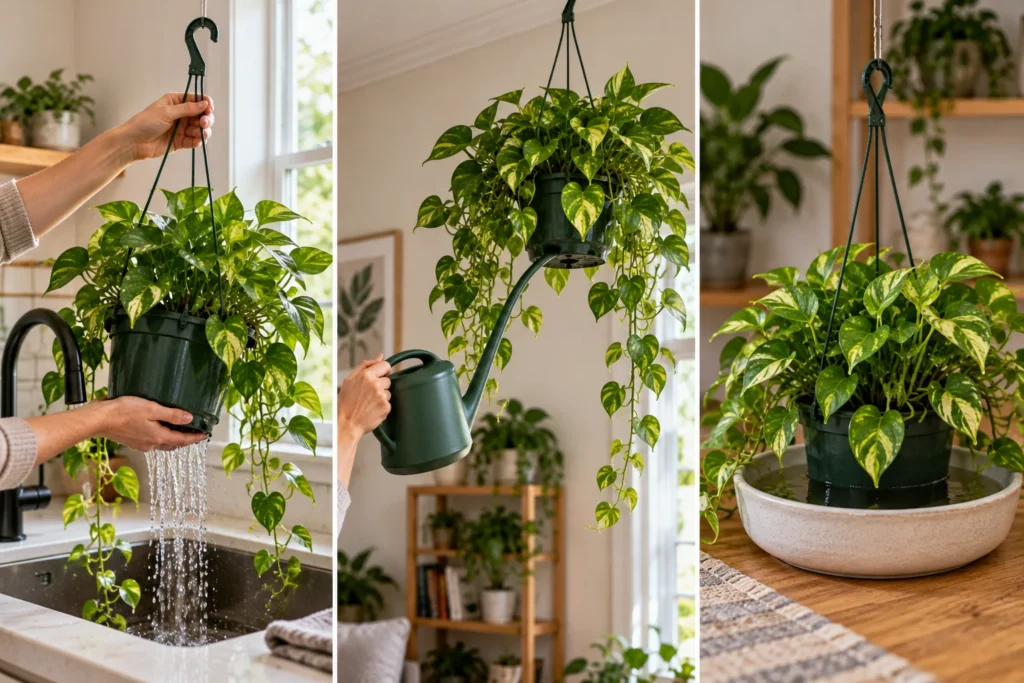
There are three ways to water a hanging plant that actually work: take it down and water it at a sink, water it in place with a long-spout can and a volume you have measured once, or set it in a basin and let it drink from the bottom. Which one you choose is a trade between effort and mess, and nothing else. The real problem with a hanging pot is not that it is high up. It is that hanging it removes almost every signal you normally use to tell whether the watering worked.
Why a hanging pot cannot be watered the way a pot on a shelf can
Watering a houseplant on a table is a loop with feedback in it. You push a finger into the soil, you pour, you watch water appear in the saucer, and you tip the saucer out. Every step tells you something.
Hang the same pot from the ceiling and you lose all of it at once. You cannot see the saucer, because it is above your eyeline and usually molded onto the base of the pot. You cannot comfortably reach the soil surface, so the finger check becomes a stretch on a stool. You cannot see runoff arriving, only hear it or feel it land on the floor. And you cannot judge weight by lifting, because the hook is carrying the load, not your hand.
So people do one of two things. They take it down every time, which is heavy, drippy and slow, and after a few weeks they quietly stop doing it properly. Or they pour a cautious splash from below and hope, which wets the top inch and leaves the bottom of the root ball dry. Gardening Know How puts it plainly in its indoor hanging basket guide: watering is the hardest part of keeping plants in hanging baskets indoors. That is a mechanical problem, and it has mechanical answers. The underlying method does not change, and if you want it from the beginning, how to water houseplants the right way covers the standard soak-and-drain routine that every option below is trying to reproduce.
There is one more thing working against you. Iowa State University Extension notes that the mixes used in hanging baskets are light, well drained and dry out quickly, and Gardening Know How points out that air near the ceiling in a home is warmer and drier than air at floor level. A hanging pot is therefore usually drying faster than the identical pot on your table, while being harder to check. That combination, not neglect, is what kills most of them.
Method 1: take it down and water at a sink
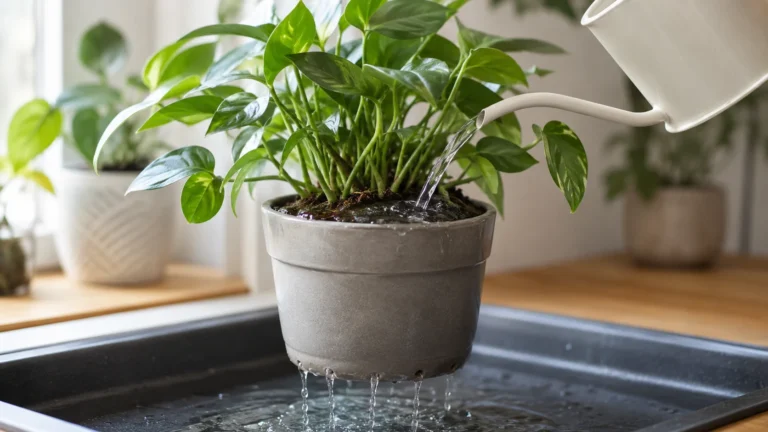
Unhook it, carry it to the kitchen sink, bath or shower, and water until it runs freely from the drainage holes. Let it sit and finish draining for several minutes before you carry it back.
This is the only method that gets everything right at once. You get a full soak through the whole root ball, you can see and feel the soil, runoff goes down the drain instead of onto your floor, and you flush accumulated fertilizer salts out of the mix, which nothing else on this list does as well.
What it costs is real. A pot that has just been watered is significantly heavier than the one you unhooked, and it drips the whole way back. That weight matters for whatever it is hanging from, so if you are not confident the hook and fixing are rated for a fully soaked pot, treat that as a question for whoever installed it rather than something to find out by trial. And the honest failure mode of this method is not mess, it is abandonment. It takes long enough that most people start skipping it.
Use it as the routine if the pot is small enough to carry easily, or as a monthly reset even if you use another method day to day.
Method 2: water a hanging plant in place, using a volume you measured once
This is the method most people want, and it works if you fix the one thing that makes it a guess: how much to pour.
Do this once. The next time you take the plant down to the sink, water it with a measuring jug instead of a running tap, and count how much liquid it takes before water starts running out of the bottom. That number is your pot's number. It is not a number we can give you, because it depends on the pot volume, the mix and how full of roots the pot already is, but you can measure it in about two minutes and then never think about it again.
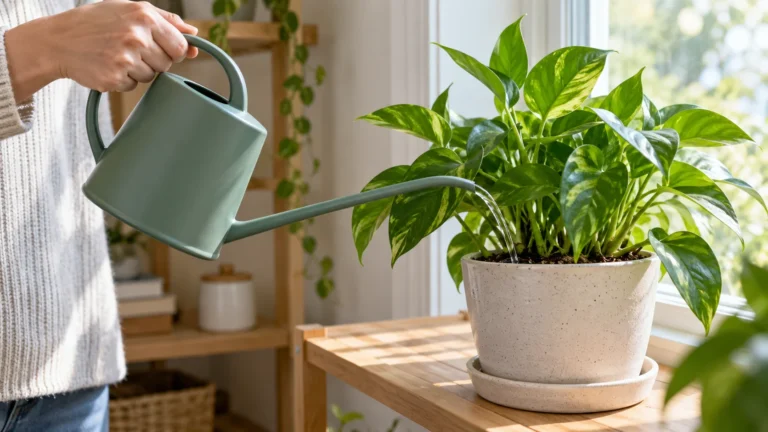
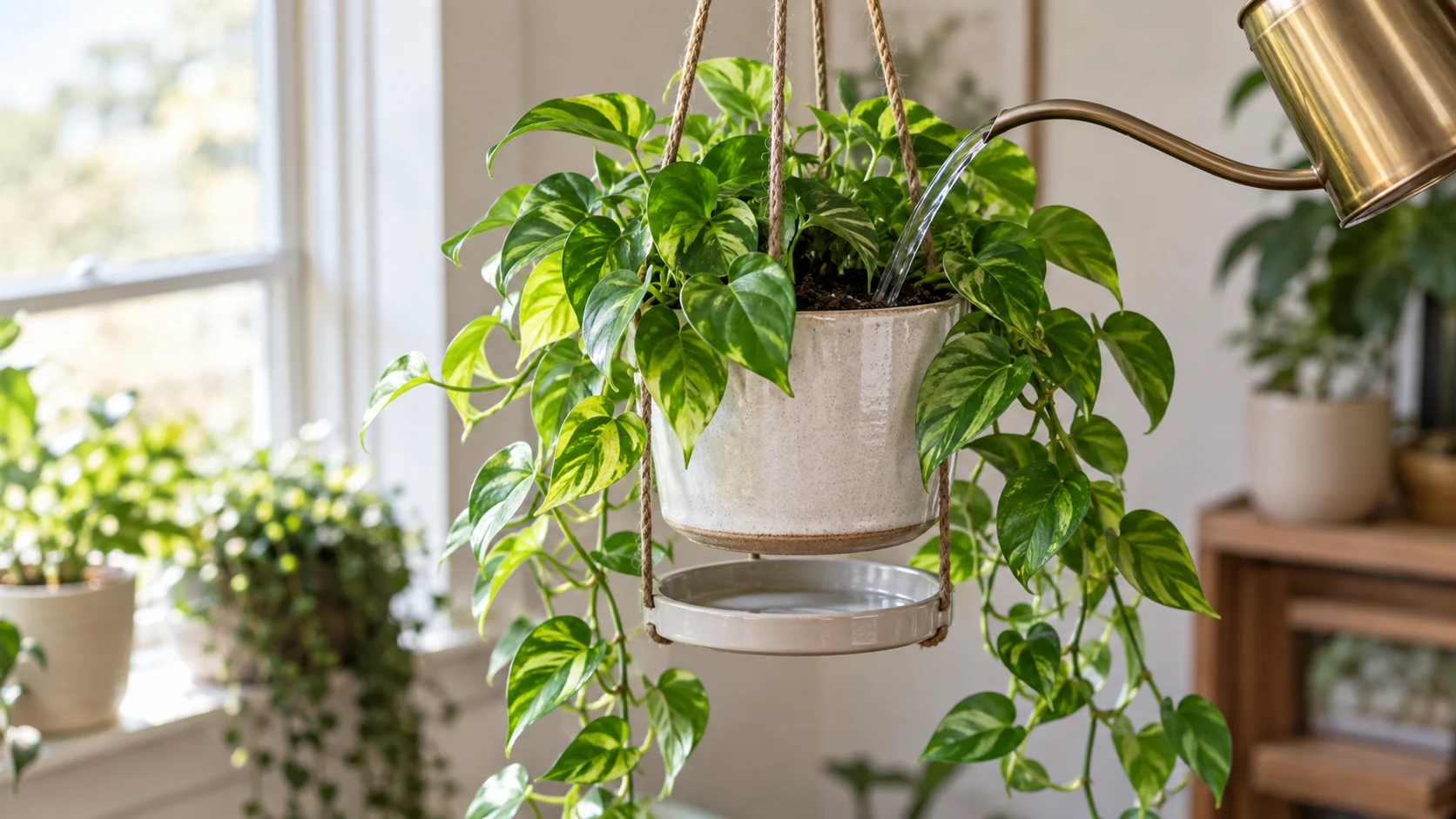
After that, watering in place is pouring slightly less than that measured amount, slowly, moving the spout around the rim rather than dumping it in one spot. Slightly less, because the point is to wet the root ball without producing runoff you cannot see or catch. A long spout is what makes this possible from ground level, since it puts the water on the soil rather than across the leaves and over the rim, and it is the one feature on a can that genuinely changes this job. If you are buying one for this, our guide to choosing an indoor plant watering can without overbuying covers which features earn their place.
Re-measure occasionally. As roots fill the pot there is less mix to hold water, so the number drifts down over time.
Method 3: bottom water in a basin
Take the pot down, stand it in a basin, bucket or sink holding a few inches of water, and let it draw moisture up through the drainage holes until the surface of the mix feels damp. Then lift it out and let it drain before rehanging.
University of Maryland Extension describes bottom watering as setting the container in water and letting it be absorbed up into the potting mixture, and says to empty out any excess afterward. It is genuinely good for a hanging pot for one specific reason: it is the reliable fix when the mix has dried so far that water poured on top just runs straight through. Iowa State Extension's advice for a basket in that state is to set it in a tub of water for one or two hours so water is absorbed slowly from the bottom, and it warns against leaving it submerged longer than that.
The trade is that it still requires taking the plant down, it does not flush mineral salts out of the soil, and it is slow. Most people use it as a rescue rather than a routine.
Which method to pick
| Effort | Mess risk | Full soak | Flushes salts | |
|---|---|---|---|---|
| Sink or shower | High, every time | Very low | Yes | Yes |
| Long spout in place | Low | Moderate until you have measured your volume | Yes, if the volume is right | No |
| Bottom watering in a basin | Medium to high | Low | Yes, slowly | No |
A reasonable pattern for most homes: long spout in place as the routine, sink soak once a month or whenever the mix stops absorbing.
How to tell it is thirsty without touching the soil
This is the part almost nobody writes, and it is the part that decides whether you keep the plant alive, because reaching the soil is the entire friction.
Weight, calibrated once. University of Maryland Extension recommends lifting the pot to judge weight, noting that a pot with dry mix weighs much less than the same pot with water in it. The catch on a hook is that you cannot lift it, so push up on the base of the pot with a flat hand until you take the load off the hook. You are feeling the same difference, from below. This only means something if you have felt it heavy: do the push right after a full soak, once, so you have something to compare against. Without that reference the test tells you nothing, which is why it fails for so many people.
The drip clock. When you water at the sink, notice roughly how long it takes before water appears at the bottom. Mix that is properly moist absorbs for a while first. Mix that has dried out hard produces runoff almost immediately, because, as Iowa State Extension describes, dry potting mix shrinks away from the sides of the container and water escapes down the gap instead of soaking in. So if you pour and hear it hit the tray in a couple of seconds, the plant is not watered. It is drier than you thought, and it needs the basin.
For the underlying physical checks and which one suits which pot, how to tell if your plant needs water covers the finger, lift and skewer tests in full.
What the leaves tell you, and why it is a late signal
Trailing plants hanging at eye level give you one advantage the shelf pot does not: you are looking at the foliage constantly. Learn to read it.
Leaves and stem tips that have lost their firmness and hang limper than usual are the visible stage of thirst, and Iowa State Extension notes plainly that plants wilt when the mix has been allowed to dry out excessively. Treat that as a late warning, not a routine cue. By the time a plant is visibly wilting it has already been dry for a while, and repeated cycles of drying to the point of wilting are hard on it. If wilting is how you find out every time, move to the weight check.
Watch for the opposite pattern too. Leaves yellowing and dropping from the inner and lower parts of the plant, with the mix staying damp, points at too much water rather than too little. A pothos, which is the most common plant in an indoor hanging pot by a distance, shows both patterns clearly, and pothos care for beginners walks through the routine it actually wants.
The hidden saucer, the cachepot and the macrame sleeve
Here is the trap specific to hanging pots. Most of them come with a drip saucer permanently attached to the base, which is exactly the right idea and exactly the thing you cannot see from underneath.
That saucer fills. On a table you would tip it out. Up on a hook, it becomes a small standing reservoir directly under the drainage holes, and the bottom of the root ball sits in it. University of Maryland Extension is unambiguous that excess water should be dumped from drainage saucers and that houseplants should never be left standing in water. A pot inside a decorative outer container or a solid liner inside a macrame hanger does the same thing more invisibly, because there is no visible saucer at all to remind you.
So whichever method you use, empty the saucer. Take the pot down for it if you have to, or use the measured-volume approach in method 2 precisely so that very little runoff is produced in the first place. If a hanging plant has been quietly standing in its own runoff for months, it is worth knowing the signs of root rot before you go looking for a light or fertilizer problem instead.
Why we will not tell you to water it every seven days
You will find pages that give a number. We are not going to, because the honest answer is that the interval depends on the pot size and material, the mix, how much light the plant gets, the temperature and humidity where it hangs, the season and the plant itself, and those vary enough between two homes that any single number is more likely wrong than right.
University of Maryland Extension states the principle directly: plants should not be watered on a schedule, but when they need it. That is more true for a hanging pot than for anything else you own, because a hanging pot in warm ceiling air is on a faster and less predictable clock than the same plant on a table. Check, then decide. How often to water indoor plants goes through the factors that actually move the timing so you can predict roughly when to check rather than guessing.
Frequently asked questions
Can I water a hanging plant without taking it down every time? Yes, with a long-spout can and a volume you have measured at the sink beforehand. Pour slowly around the rim, keep the amount slightly under the volume that produced runoff, and take the plant down periodically for a full flushing soak.
Why does water run straight through my hanging plant and out the bottom? Usually because the mix has dried out hard and pulled away from the sides of the pot, so water runs down the gap instead of soaking in. Iowa State Extension's fix is to stand the basket in a tub of water for one to two hours, no longer, so it absorbs from the bottom.
How do I stop a hanging plant dripping on the floor? Cut the runoff rather than trying to catch it. Water a measured amount slightly below the point where it starts to drain, or take the pot to a sink or basin when it needs a full soak. Empty the attached saucer whenever you do take it down.
How do I check the soil if I cannot reach it? Use weight instead. Push up on the base of the pot with a flat hand to take the load off the hook and feel how heavy it is, having felt it once right after a full watering so you have something to compare against.
Is it bad to leave water in the saucer attached to a hanging pot? Yes. University of Maryland Extension advises emptying drainage saucers and never letting houseplants sit in water. On a hanging pot that saucer is out of sight, so it is the easiest one in the house to forget.