Do Grow Lights Use a Lot of Electricity? The Real Math
No, not for a normal houseplant setup. A houseplant grow light draws tens of watts, not hundreds, and at the US average residential electricity price of 18.44 cents per kilowatt hour (US Energy Information Administration, May 2026 data), a 36 watt fixture run 12 hours a day works out to roughly 8 cents a day, about $2.39 a month, or about $29 a year. The arithmetic is one line: watts, times hours per day, divided by 1,000, times your rate. Everything below is how to run that line with your own numbers instead of ours.
How much electricity a grow light actually uses
Your utility bills you in kilowatt hours. One kilowatt hour is 1,000 watts running for one hour. That is the whole unit, and it is why the number 1,000 shows up in every version of this formula.
So:
(watts x hours per day) ÷ 1,000 = kilowatt hours per day
kilowatt hours per day x your price per kilowatt hour = cost per day
Multiply by 30 for a month, or 365 for a year. Nothing else is involved. There is no hidden multiplier and no efficiency percentage you need to look up.
Worked once, slowly, with a 36 watt fixture on for 12 hours:
- 36 x 12 = 432 watt hours per day
- 432 ÷ 1,000 = 0.432 kilowatt hours per day
- 0.432 x $0.1844 = about $0.08 per day
- $0.08 x 30 = about $2.39 per month
What that looks like across realistic run times
These are worked examples built from one published wattage and one published average rate. They are not a quote for your house. Substitute your own two numbers and the whole table changes.
| Setup | Hours per day | kWh per month | Cost per month | Cost per year |
|---|---|---|---|---|
| One 36 W fixture | 8 | 8.6 | $1.59 | $19.38 |
| One 36 W fixture | 12 | 13.0 | $2.39 | $29.08 |
| One 36 W fixture | 16 | 17.3 | $3.19 | $38.77 |
| One 36 W fixture | 24 (left on) | 25.9 | $4.78 | $58.15 |
| Six 36 W fixtures | 12 | 77.8 | $14.34 | $174.46 |
Wattage figure: Soltech publishes "Total Consumption: 36 Watts" for its Aspect Gen 2 fixture on that product's page, read 2026-08-26. Rate: $0.1844 per kWh, the US total residential average for May 2026 from the Energy Information Administration's Electric Power Monthly, Table 5.6.A, read 2026-08-26. The fixture is named as an example of a published specification, not as a recommendation.
For scale: the Energy Information Administration's own FAQ, using 2022 data, puts average US residential use at about 899 kilowatt hours a month. The 12 hour row above is about 13 kilowatt hours, which is roughly 1.4 percent of that. On most bills, that sits inside the month to month noise.
The rate in that table is an average, and an average is not your bill
This is where published cost estimates quietly go wrong. The same Energy Information Administration table that gives the 18.44 cent national figure for May 2026 also shows the spread across states, and the spread is enormous: Idaho at 12.35 cents and Hawaii at 52.00 cents per kilowatt hour.
Run the same 36 watt fixture for 12 hours a day for a year in both places and you get about $19 in Idaho and about $82 in Hawaii. Same light, same schedule, four times the cost.
Your own rate is printed on your electricity bill, usually as a price per kWh. Use that number, not ours. If your bill uses tiered or time of use pricing, the rate that matters is the one applying to the block your usage actually lands in.
The catch nobody mentions: the wattage on the box may not be the draw
Every calculation above depends on one input, and it is the input most likely to be wrong.
Listings for grow lights routinely show a wattage that is not the power the fixture pulls from the wall. Two versions of this are common. The first is an "equivalent" figure, which describes how bright the light supposedly is next to an older bulb, not how much electricity it uses. The second is a number baked into the model name, where a product called something like a 1000W panel is describing a category rather than its consumption.
So before you calculate, find the phrase that actually names consumption. On a spec sheet the useful wording is power consumption, actual power draw, or total consumption. That is the number that goes in the formula. Soltech, for example, states "Total Consumption: 36 Watts" in the specification block for its Aspect Gen 2, which is exactly the kind of figure you want, though even there the collection listing page shows no wattage at all and you have to open the individual product page to find it.
Two honest caveats. Actual draw can sit slightly below rated draw if the fixture is dimmable and you run it dimmed. And if a seller publishes no consumption figure anywhere, a plug in energy monitor measures it directly in an evening, which settles the question better than any estimate on this page.
One check is worth doing before any of this: make sure a fixture is the answer at all. A plant that is stretching, dropping its lower leaves, or pushing out small pale growth is telling you something, and it is worth reading the signs a plant needs more light before you buy hardware to solve a problem you may not have. Plenty of houseplants are genuinely fine in a dim corner, and their electricity cost is zero. A ZZ plant will sit happily in a low light room for years, and a peace lily is another that tolerates far less light than most people assume.
Run time is your real lever, not wattage
Watts and hours multiply, so doubling either one doubles the cost. What makes hours the number worth managing is that hours are the number that actually varies in a real home.
Houseplant fixtures live in a narrow band. In one manufacturer's published lineup the range runs from about 11.4 watts on its smallest ambient lamp to 36 watts on its main pendant, and that company's own guidance suggests 20 to 40 watts covers most houseplants. Going from a small fixture to a large one moves the monthly figure by roughly a dollar at the US average rate: a 20 watt fixture at 12 hours is about $1.33 a month, and a 36 watt fixture on the same schedule is about $2.39.
Run time swings much harder, because it is set by habit rather than by a purchase. Eight hours a day is $1.59 a month on that 36 watt fixture. Sixteen hours is $3.19, exactly double. Leaving it on around the clock is $4.78, and it is also bad for the plants: Soltech's own FAQ tells owners not to exceed 18 hours of light, on the grounds that plants need a dark period.
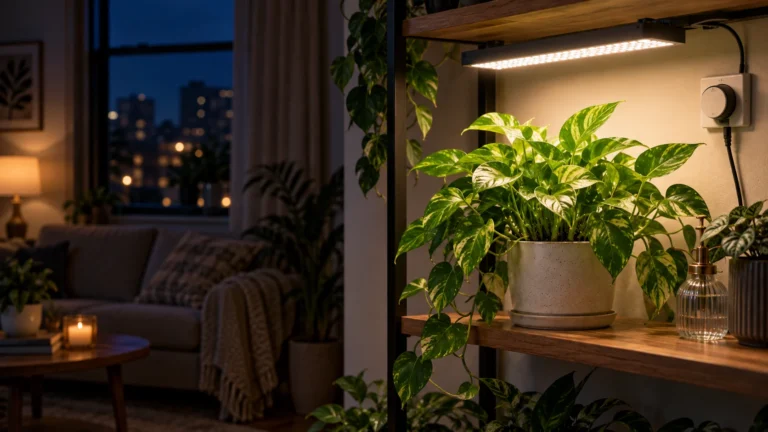
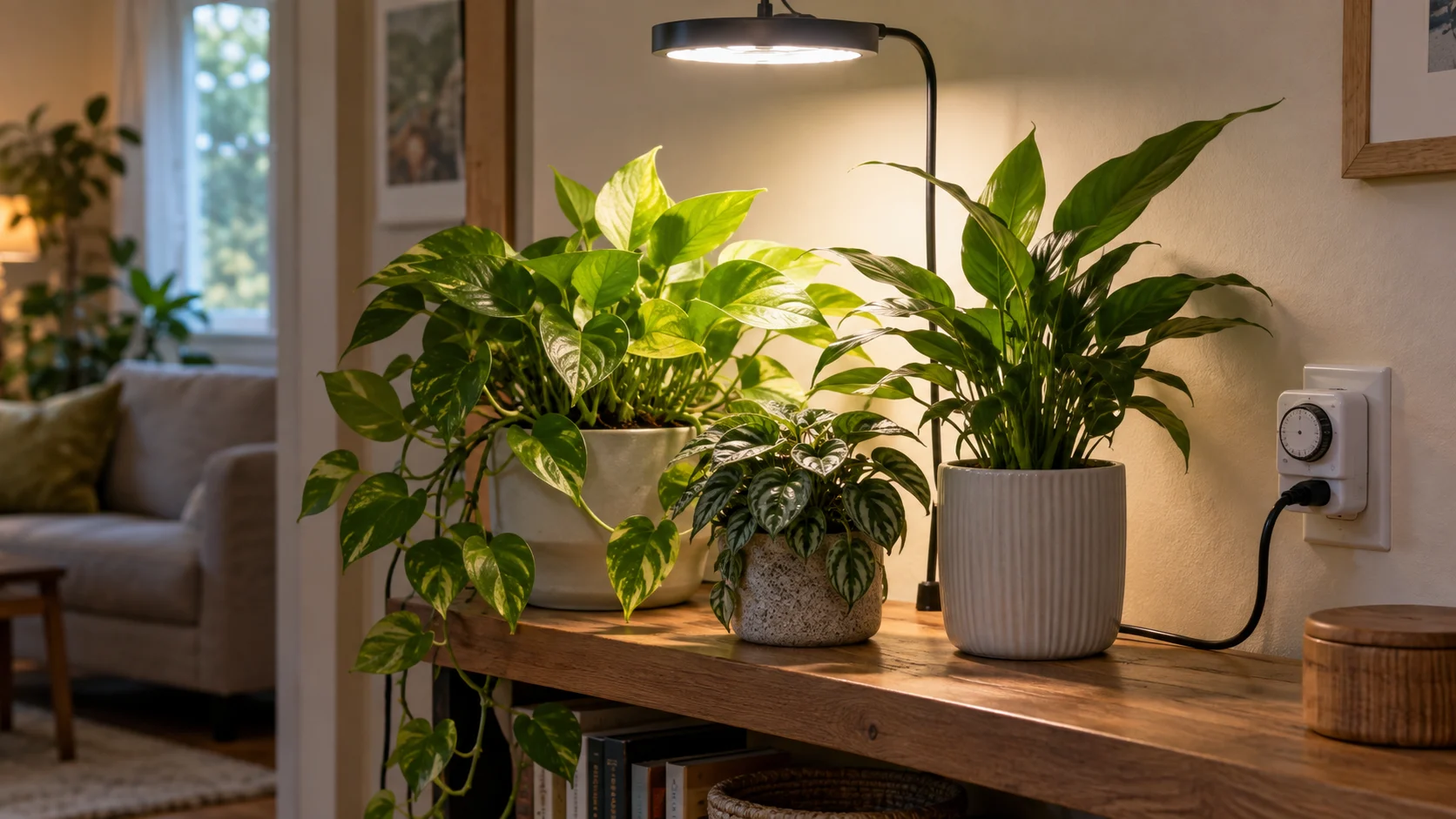
Which makes a plug in timer the cheapest control in this entire article. It is one of the least expensive things in the setup, it removes the single most expensive failure mode, and it fixes the plant problem at the same time. Buy the light, then buy the timer, then stop thinking about it. If you use a mechanical or digital outlet timer, check that its rating covers the load you are plugging into it, which for a single houseplant fixture is a very low bar.
Winter is when all of this matters most, because that is when people add lights, run them longest, and change several things at once. If you are extending day length through the dark months, remember that watering houseplants in winter follows different rules, and the two changes interact: a plant under a light is still growing and still drinking, while an unlit plant in the same room is not.
What you are paying for is usable light, not watts
Watts measure electricity going in, not light coming out. Two fixtures of identical wattage can deliver different amounts of light a plant can actually use, which is a separate question from cost. It is worth knowing what full spectrum actually means before comparing fixtures, because a cheaper light that draws the same power and delivers less usable light is not a saving.
For the purposes of your bill, though, this changes nothing. The formula only cares about the watts going in.
When this stops being a rounding error
Being honest about where the reassuring answer runs out:
- A few houseplants, one or two fixtures, on a timer. Single digit dollars a month at the US average rate. Genuinely a rounding error on a household bill.
- A shelf or plant rack with several fixtures. The six fixture row above is about $14 a month and about $174 a year. Still modest, but now it is a visible line item worth deciding on rather than ignoring.
- A room of fixtures, or high wattage panels meant for growing food or flowers indoors. This is where the cost pages written for grow tents apply, and their numbers are much larger because their fixtures are much larger. The formula on this page still works, but the answer to the headline question becomes yes.
- A high rate area. In a state near the top of the range, the same setup costs several times the national average figure. Your rate is a multiplier on every row in that table.
The short version: for most people reading this, the light itself is not what moves the bill. The number of fixtures does, and so does forgetting to turn them off.
FAQ
How much does it cost to run a grow light for 12 hours a day?
For a 36 watt fixture at the US average residential rate of 18.44 cents per kilowatt hour (Energy Information Administration, May 2026 data), about 8 cents a day, $2.39 a month, or $29 a year. Substitute your fixture's actual wattage and the rate on your own bill for a figure that applies to you.
Do LED grow lights use less electricity than other grow lights?
A fixture rated at 36 watts uses 36 watts, and an older fixture that draws 400 watts uses 400 watts, whatever the technology. The reason LED setups usually cost less to run is that the fixtures a houseplant owner needs are rated in tens of watts. Compare the published consumption figures directly rather than comparing technologies.
Is it cheaper to leave a grow light on all the time?
No, and it is the most expensive thing you can do with one. Running a 36 watt fixture 24 hours a day instead of 12 doubles the cost, from about $2.39 to about $4.78 a month at the national average rate. Soltech's published guidance says not to exceed 18 hours, because plants need a dark period.
Will a grow light noticeably change my electricity bill?
For one or two houseplant fixtures, usually not. Thirteen kilowatt hours a month is about 1.4 percent of the roughly 899 kilowatt hours a month the Energy Information Administration reports as average US residential use (2022 data). For a shelf of six fixtures it becomes visible, but still modest.
How do I find my grow light's real wattage?
Look on the specification sheet for "power consumption", "actual power draw" or "total consumption". Ignore any figure labeled as an equivalent, and ignore numbers that appear only in the model name. If no consumption figure is published anywhere, a plug in energy monitor will measure it directly.
Sources
- US Energy Information Administration, Electric Power Monthly, Table 5.6.A, "Average Price of Electricity to Ultimate Customers by End-Use Sector, by State", May 2026 data. US total residential 18.44 cents per kWh; Idaho 12.35; Hawaii 52.00. Read 2026-08-26.
- US Energy Information Administration, FAQ "How much electricity does an American home use?", which reports about 899 kWh per month per residential customer using 2022 data. Read 2026-08-26.
- Soltech, Aspect Gen 2 LED Growlight product page, specification block: "Total Consumption: 36 Watts". Read 2026-08-26.
- Soltech, FAQ page: published wattages elsewhere in the lineup (approximately 11.4 watts for the Aura, 12 watts for the Grove, 20 watts for the first generation Aspect), the suggested 20 to 40 watt range for most houseplants, and the instruction "Do not exceed 18 hours of light for any plant". Read 2026-08-26.
- Every cost figure on this page is calculated from those published inputs. They are worked examples, not quotes.