How Much Water Does a Houseplant Actually Need?
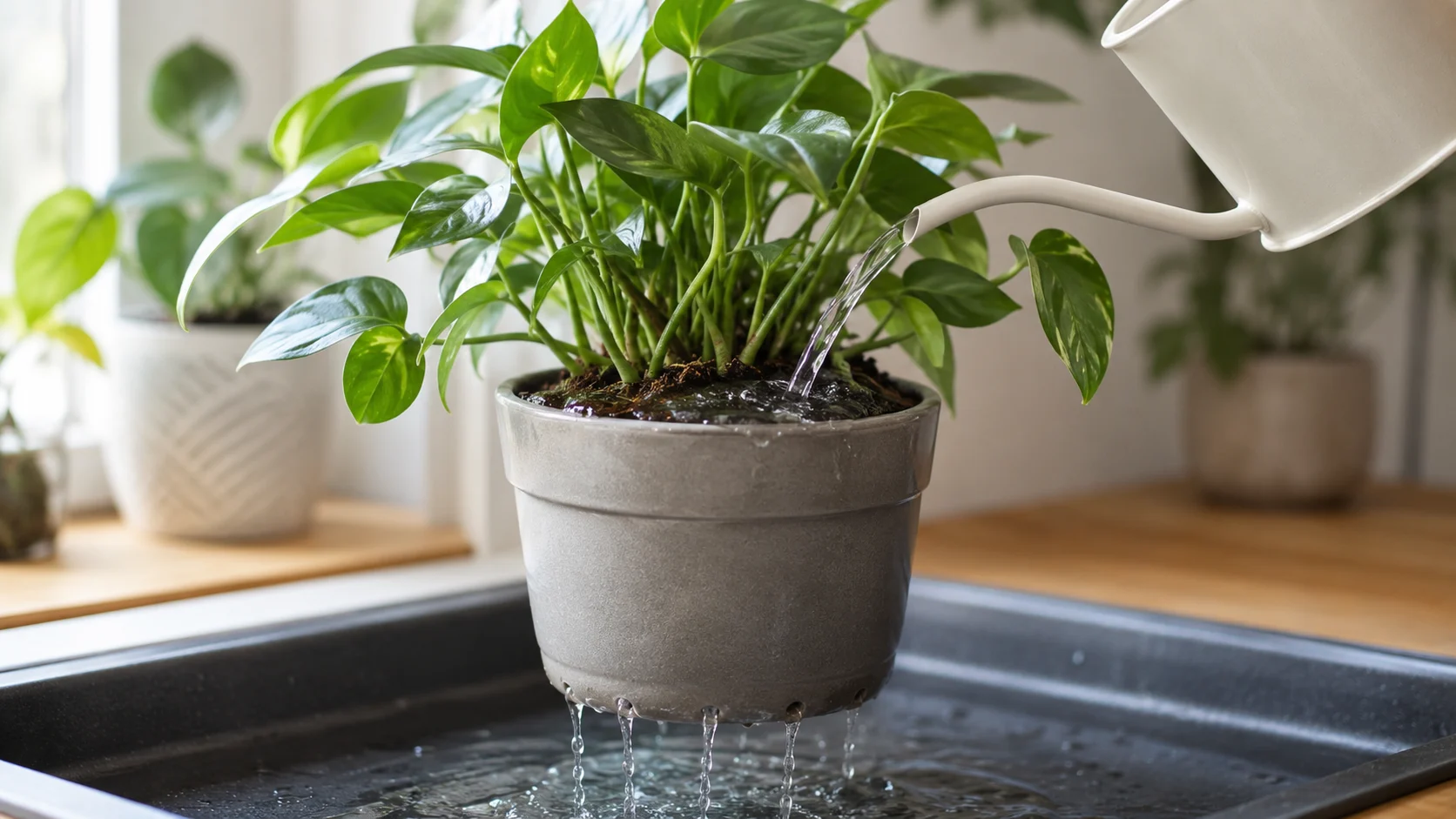
There is no fixed cup measurement, because the right amount depends on the pot, not a formula. Once the soil has actually dried out, checked with a finger rather than a calendar, pour slowly and evenly until water runs freely from the drainage holes, then let the pot finish draining. In a pot that has dried out normally, that single pass wets the entire root ball. The one exception: a pot that has gone bone dry can repel water and let it run around the edges instead of soaking in, which looks like a complete soak but is not. That failure mode, and how to fix it, is below.
The real measurement: soak the whole root ball, not a cup
The University of Connecticut Home & Garden Education Center puts the goal plainly: apply enough water that, after about a minute, you see excess "seeping out of the drainage holes," aiming for a "thorough deep watering" so that "the whole root system of the plant" ends up moistened, not just the top layer. University of Maryland Extension gives the same instruction from a different angle: water when the plant needs it, not on a schedule, and water until it drains from the bottom of the container.
Notice what neither source gives you: a number. Not a cup count, not an ounce figure, not a percentage of the pot. That is deliberate. The amount of water that produces "drains from the bottom" changes with the size of the pot, the type of mix, and how dry the soil actually was to begin with. The drainage, not a volume, is the signal that tells you the job is done.
Why a fixed amount like "one cup" is the wrong question
Plenty of plant-care pages hand you a specific number, something like "give your plant a cup of water twice a week." Treat that kind of instruction with suspicion. A 4-inch nursery pot and a 10-inch floor pot hold wildly different volumes of soil. A cup that thoroughly soaks the small pot barely dents the large one, and a cup that seems reasonable for the large pot can drown the small one before it has absorbed a fraction of it.
The better question is not "how many cups" but "has the whole pot gotten wet." That is a yes-or-no check you can run on any container, in any size, without doing math. If you are still working out how often to run that check in the first place, how often to water indoor plants covers the factors, light, pot material, season, plant type, that change the timing.
How pot size actually changes the amount
Pot size does not change the rule, it changes how long the rule takes to satisfy. A small pot needs less total water to reach full saturation and reaches "draining from the bottom" quickly, often within a single steady pour. A large or deep pot holds far more soil and usually needs a slower, staged pour, sometimes two or three passes a few minutes apart, because dry soil at depth does not absorb water instantly and a single fast pour can channel straight through without fully wetting the middle.
Pour around the base of the plant rather than in one spot, and give the water time to soak in as you go rather than racing to fill the pot. How to water houseplants the right way walks through the full pouring method if you want the complete technique, not just the amount question this article is answering.
The mistake that fakes a good soak
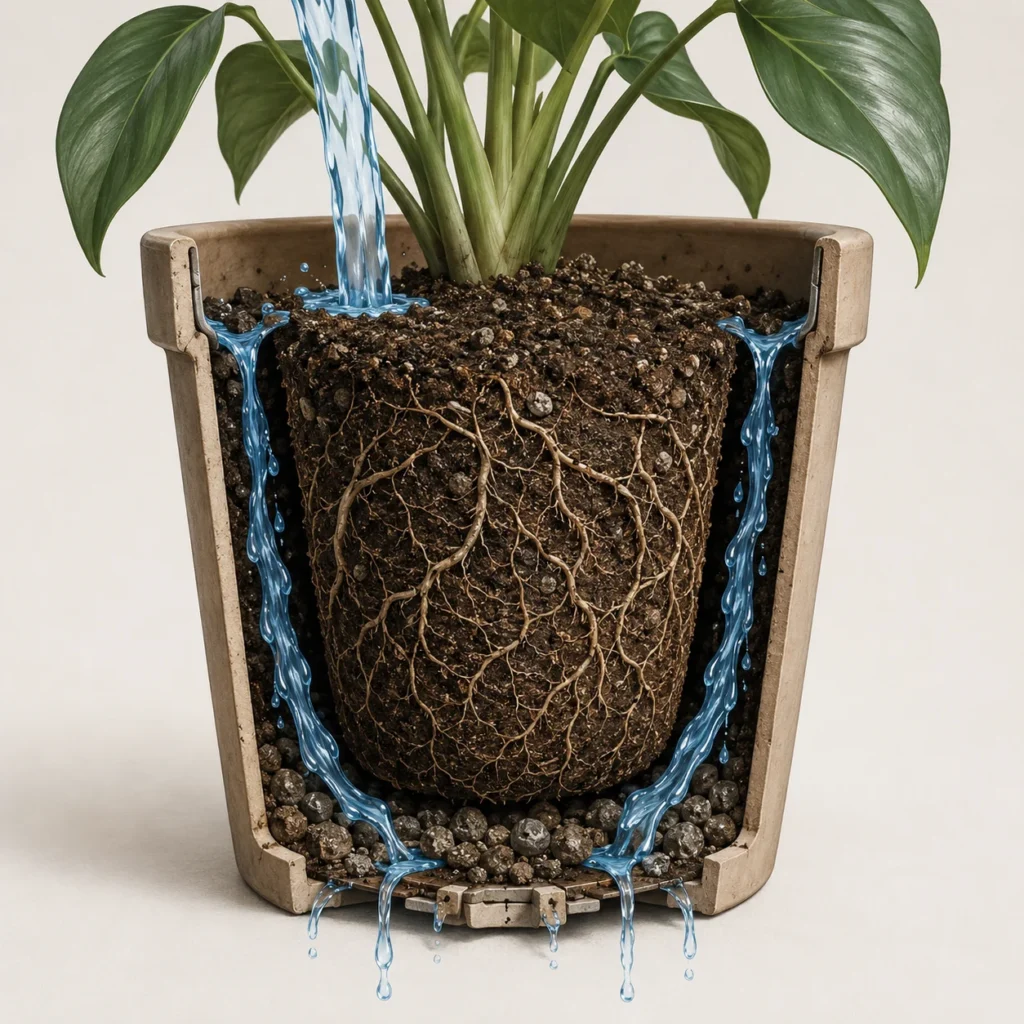
Here is the part most watering guides skip entirely, and it is the reason "water until it drains" is not always proof of a real soak.
When potting mix, especially a peat-based one, dries out completely, it can become genuinely water-repellent. As reported by UC Master Gardeners of Santa Clara County (University of California Cooperative Extension), "when peat moss dries out it is very difficult to re-wet." As the mix dries, the whole root ball can shrink slightly and pull away from the sides of the pot, leaving a narrow gap around the edge. Pour water in at that point and, as the same source describes it, "water might be running between the side of the pot and the hydrophobic root ball instead, barely wetting the outer surface and leaving the center of the root ball dead dry." Watch closely the next time you water a plant that has gone very dry: if the water disappears in seconds and drains almost immediately, rather than taking its usual time, that speed is itself a warning sign, not a good one.
So water draining out is not automatically proof of a good soak. On a badly dried-out plant, it can mean the water simply found the easiest path around the edge and left, while the center of the pot is still bone dry.
The fix, per the same source, is one of three: submerge the whole pot in a basin or sink of water until air bubbles stop rising and the pot feels noticeably heavier, bottom-water it by setting it in a shallow container of water so the mix draws moisture up gradually, or, for a large container that cannot be moved, water slowly in several short passes a few minutes apart so the dry mix has time to absorb before more arrives. Once the mix has been properly rewetted, it accepts water normally again at the next watering.
Small sips vs a deep soak
A daily light splash, just enough to darken the surface, feels responsible but usually only wets the top half inch or so of soil. Roots follow the water, and roots that only ever find moisture near the surface stay shallow, which makes the plant more vulnerable the next time you miss a day. A less frequent, fully thorough soak, water until it runs from the drainage holes, encourages roots to grow down and out through the whole pot, which is a sturdier plant in the long run.
This is also why "how much" and "how often" are genuinely two different questions rather than one blurred together. Water thoroughly every time you water, and let the interval between waterings, not the amount within a single watering, be the thing that changes with the season, the light, and the plant. What is actually dissolved in the water itself, chlorine, chloramine, fluoride, and dissolved minerals, is a third, separate question again; tap water vs filtered water for houseplants covers when that genuinely matters and when it does not.
What about pots with no drainage hole?
A pot without a drainage hole cannot give you the "runs out the bottom" signal at all, which makes the amount question harder to answer by feel alone. The safest approach is smaller, more careful pours, checked with a finger, rather than aiming for the volume that would normally drain through. Because standing water at the bottom of a hole-less pot has nowhere to go and no way to be confirmed or drained, it is easy to overwater this kind of container without realizing it. This is a genuine full topic on its own and gets a fuller treatment in a future guide; the short version here is to water less at a time and check more often than you would in a pot with drainage.
Amount vs frequency: two different questions
It is worth separating these clearly, because most beginner confusion comes from treating them as one thing. "How much" is a measurement question: pour until the whole root ball is wet and water runs from the drainage holes, adjusted only by how slowly you need to pour for the pot size, and corrected for the hydrophobic-mix case above. "How often" is a completely different, calendar-adjacent question that depends on light, pot material, humidity, and the time of year. Watering houseplants in winter covers exactly how that second question changes across the seasons, while the amount rule in this article stays the same no matter what month it is. If you have not yet nailed down when to water in the first place, how to tell if your plant needs water covers the finger, lift, and skewer tests for different pot sizes.
Frequently asked questions
How much water should I give a houseplant each time? Enough to wet the entire root ball and see water run freely from the drainage holes, then let the pot finish draining. There is no reliable fixed cup or ounce figure, because the same amount behaves completely differently in a small pot versus a large one.
Does pot size change how much water a plant needs? It changes how long a thorough soak takes, not the underlying rule. Small pots reach "draining from the bottom" quickly in one pour. Large or deep pots often need a slower pour or two or three passes to fully wet the middle of the soil.
Why did water drain out but my plant is still dry inside? This usually happens when the potting mix dried out completely and became hard to re-wet, sometimes pulling away from the sides of the pot. Water can run down that gap and out the bottom without soaking the center of the root ball. Submerging the pot, bottom-watering, or watering in several slow passes fixes it.
Is it possible to give a plant too much water at once? A single thorough soak that drains properly is not the same as overwatering. Overwatering is almost always about frequency, watering again before the soil has dried, not about pouring too generously during one watering that then drains and finishes.
Should I water a little every day instead of a lot occasionally? No. Frequent light splashes tend to wet only the surface and encourage shallow roots. A less frequent, fully thorough soak that reaches the whole root ball builds a healthier, deeper root system.