Signs Your Plant Needs More Light (and the Watering Trap)
Not enough light almost never announces itself. It arrives as a plant that seems fine but is not growing, or as symptoms that look exactly like a watering problem, which is why people spend months adjusting their watering schedule for a plant that only needed to move three feet.
The reliable signs are not about leaf color. They are about the shape of new growth compared with old growth, and that comparison is the fastest way to settle it.
The Six Signs, in Order of Reliability
1. Stretched stems with big gaps between leaves
This is the most definitive sign and the one worth learning to recognize.
In good light, leaves grow close together along the stem. In poor light, the plant invests in reaching instead of in leaves, so the stem lengthens and the spacing between leaves widens. Set a section of new growth next to a section of older growth and the difference is usually obvious.
This is not reversible. The stretched section stays stretched. Moving the plant fixes what grows next, not what already grew, which is why acting early matters more here than with most plant problems.
2. New leaves smaller than old leaves
Look at the newest fully opened leaf and compare it to a mature leaf lower down. Consistently smaller new leaves mean the plant is producing less than it used to, and light is the most common reason on an otherwise healthy plant.
This one is easy to miss because each new leaf is only slightly smaller than the last. Comparing newest against oldest, rather than against the one before it, makes it visible.
3. Leaning hard toward the window
All houseplants lean toward light a little. A plant that is noticeably angled, or that goes back to leaning within days of being turned, is telling you the light on the far side is not worth growing toward.
Rotating a quarter turn each time you water fixes the lopsided shape. It does not fix the underlying shortage, and a plant that leans severely is asking for a better position rather than a rotation schedule.
4. Variegation fading toward plain green
Variegated leaves have less chlorophyll in the pale sections, so they need more light to make the same amount of food. In poor light, a variegated plant often produces new leaves with less variegation or none at all, because plain green is more efficient.
A plant reverting to green is a plant economizing. It is one of the clearest signals, and it is specific to light rather than to anything else.
5. Lower leaves yellowing and dropping while the top still grows
The plant is choosing. Lower leaves are the shaded ones and the least productive, so a plant short on light sheds them and keeps the newer growth at the top.
The pattern is the diagnostic. Yellowing spread randomly across the plant is usually something else, and why houseplant leaves turn yellow covers the other causes. A steady loss from the bottom upward, with the top still producing, points at light. So does the version in why is my plant losing leaves.
6. It has simply stopped
No new leaves for months during the growing season, on a plant that is otherwise not sick. Stalled growth is the most common form of a light problem and the least likely to be recognized, because nothing looks wrong. Why is my plant not growing works through the full list of reasons, and light is at the top of it.
The Watering Trap, Which Is Why This Gets Missed
Here is the connection nobody mentions, and it causes a great deal of confusion.
A plant in low light uses less water. Less light means less photosynthesis, which means less transpiration, which means the soil stays wet far longer than it used to.
So the sequence goes like this. The plant is moved somewhere darker, or the season turns and the light drops. Its water use falls. The soil stays damp for a week and a half instead of five days. Watered on the old schedule, it is now sitting wet, and it develops the yellowing, drooping and soft stems that come with roots kept too wet.
Every symptom now points at overwatering, and every fix is aimed at the water. But the water only became a problem because the light changed. Correcting the watering alone leaves you with a plant that is not dying and not growing either.
This is worth checking against overwatered versus underwatered, and it is the single biggest reason watering houseplants in winter has to be a different schedule from the rest of the year. If the plant has already gone past damp into damage, root rot signs and a soft mushy stem are the things to rule out first, because those need attention before any move.
A useful rule: if your soil is staying wet noticeably longer than it did a month ago, and you have not changed anything, check the light before you change the watering.
What "More Light" Actually Means
The most common mistake after correctly diagnosing this is undercorrecting.
Light falls off dramatically with distance from a window. A spot a few feet back from the glass receives far less than a spot right beside it, and much less than most people assume by eye. Human vision adjusts to a huge range of brightness, so a room that looks well lit to you can be very dim from a plant's point of view.
Two practical consequences:
Moving a plant a short distance usually does nothing. If it is three feet from the window, moving it to two is unlikely to change the outcome. Put it at the window and see what happens.
Which window matters more than which room. An unobstructed window facing the brighter aspect of your home does more than any amount of rearranging within a dim room. What the phrase everyone repeats actually means in practice is set out in bright indirect light.
Move It Gradually, Not All at Once
A plant that has been in low light for months cannot handle full sun immediately. Its leaves are adapted to what it had, and a sudden move to a much brighter spot burns them, which looks like a new disaster on top of the old one. That damage is described in leaf scorch and sunburn.
Move it in stages over a week or two, and watch the leaves rather than the calendar. Some drooping or a dropped leaf after a move is ordinary adjustment and overlaps with transplant shock.
And reset your watering after the move, because a brighter plant will start drinking faster. Going back to the old schedule immediately is how people swing from too wet to too dry in two weeks.
When the Answer Is a Different Plant
Some rooms genuinely cannot support some plants, and no placement fixes that. A plant that keeps stretching in the best spot you have is in the wrong home, and swapping it for something suited to the conditions is a better outcome than managing a decline.
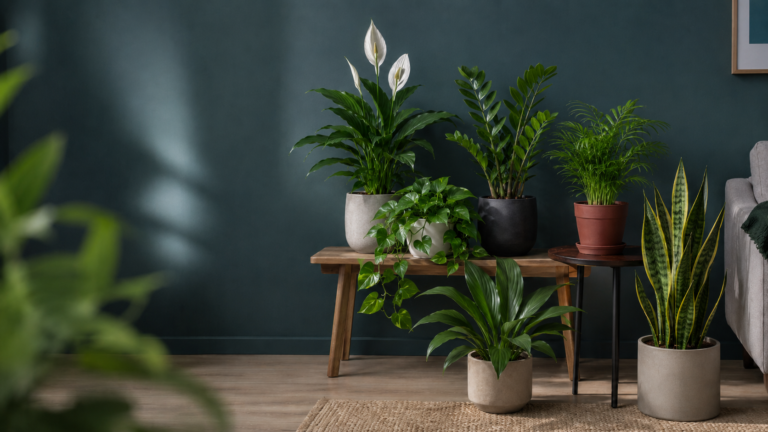
Which plants tolerate genuinely low light is covered in best low light indoor plants for beginners, and two of the most forgiving have their own guides in snake plant care and ZZ plant care.
The Short Version
- Compare new growth with old growth. Stretched stems and smaller new leaves are the two most reliable signs.
- Variegation fading to green is a light signal specifically, not a general health one.
- Bottom-up leaf loss with a healthy top points at light. Random yellowing does not.
- Low light looks like overwatering, because a plant in low light drinks less and the soil stays wet.
- Soil staying wet longer than it used to means check the light first, not the watering can.
- Move it properly or do not bother. A foot closer to the window rarely changes anything.
- Stretched growth does not straighten. Only what grows next will be better.