Do I Need a Grow Light? How to Answer It Honestly
The question people ask is "is my room too dark." The question that can actually be answered is narrower: how much light does this particular spot get, and is that enough for the particular plant standing in it.
Those are not the same question, and the reason most advice on this subject is unsatisfying is that it answers the first one with a word rather than the second one with a measurement. This page is the pillar for our grow light material, and it starts with the thing almost nobody says out loud: the words used to describe indoor light levels do not have an agreed meaning.
"Low light" is not one thing, and the published scales disagree
If you look at what university extension services actually publish, you find the same three words attached to very different numbers.
Illinois Extension puts the boundaries for low, medium and bright light at roughly 75, 150 and 300 foot-candles.
Mississippi State Extension classifies the same three words as 50 to 500 foot-candles for low, 500 to 1,000 for medium, and 1,000 and above for bright.
Read those twice. Mississippi State's low band runs up to 500 foot-candles. Illinois's bright band starts at 300. A spot that Illinois would call bright, Mississippi State would still call low. Neither is wrong; they are describing plant tolerance from different starting assumptions, and both are more careful than the average houseplant page. But it means that when two websites tell you a plant needs "medium light," they may be telling you two things that do not overlap at all.
This is the single most useful thing to carry away from this page. The disagreement is not between a good source and a bad one. It is between two good sources, and it is wider than the difference between most rooms in most homes. Any page that quotes one scale as though it were the standard is hiding that from you.
So the practical advice is: stop trying to match a word, and get a number instead, even a rough one. Then check that number against whichever published scale you are reading, and read the scale's own bands rather than assuming.
Getting a number, and the honest caveats on it
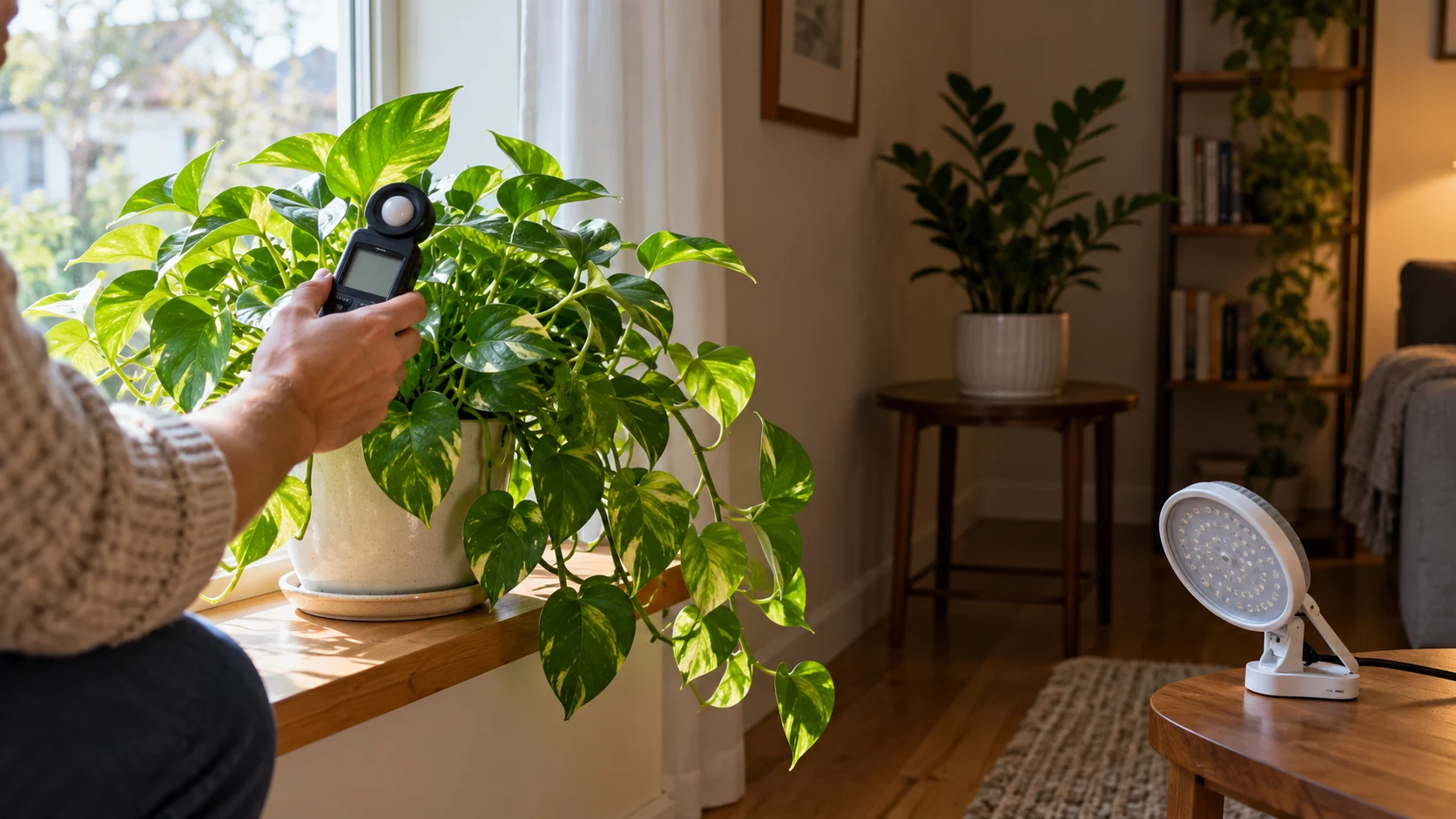
A light meter reads in foot-candles or lux, and there are phone apps that do a passable version of the same thing using the phone's ambient light sensor.
Two caveats, both from Virginia Cooperative Extension's guidance and both worth taking seriously.
Foot-candles and lux are weighted for human vision. They measure brightness as an eye perceives it, not as a leaf uses it. Plants respond to a different slice of the spectrum than our eyes weight most heavily, which means two light sources that read identically on a meter can be quite different for a plant.
Which makes a meter honest for comparison and dishonest as a verdict. Comparing the spot by the window against the spot by the bookcase, with the same meter at the same time of day, tells you something real: one is several times brighter than the other. Reading a single number in one spot and declaring the plant's fate from it does not.
There is a floor, though, and it is useful. Mississippi State Extension notes that below roughly 50 foot-candles will not sustain plant life for long. That is not a threshold for thriving, it is a threshold for surviving, and a spot that reads consistently under it is not a plant spot no matter which species you put there.
If you have never measured, take readings at the same hour on a few different days, in the actual position the plant sits in, at the height of its leaves rather than at the height of your hand. The variation between days will tell you as much as the absolute value.
The three questions, in the order that saves you money
A grow light is the third answer, not the first. Work through these before you buy anything.
1. Can the plant move?
The cheapest fix for a dark spot is a brighter one. Light levels indoors fall off very quickly with distance from a window, far faster than they look like they should, because our eyes adjust continuously and disguise it. Moving a plant a couple of feet closer to its light source is frequently a larger change than anything a small fixture would add.
This is worth exhausting properly before spending. Measure two or three candidate positions, compare them against each other, and move the plant to the best one for a few weeks.
2. Can the plant change?
If the spot genuinely cannot be improved, the other free answer is to put a plant there that is adapted to it. Species differ enormously in what they will tolerate, and some of the most forgiving houseplants are forgiving precisely because they evolved under a canopy. Our guide to low-light plants that actually survive a dim room is the honest version of that list, including the part most lists skip: tolerating low light is not the same as growing well in it, and a tolerant plant in a dark corner will usually hold rather than grow.
While you are at it, be sure the phrase you have been working from means what you think. "Bright indirect light" is the single most repeated instruction in houseplant care and one of the least defined, and what bright indirect light actually means unpacks it.
3. Is light actually the problem?
This is the step people skip, and it is the reason a fair number of grow lights get bought and then make no difference.
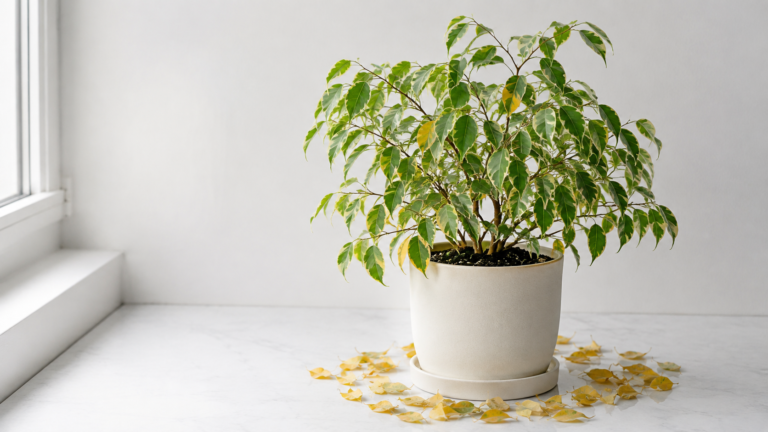
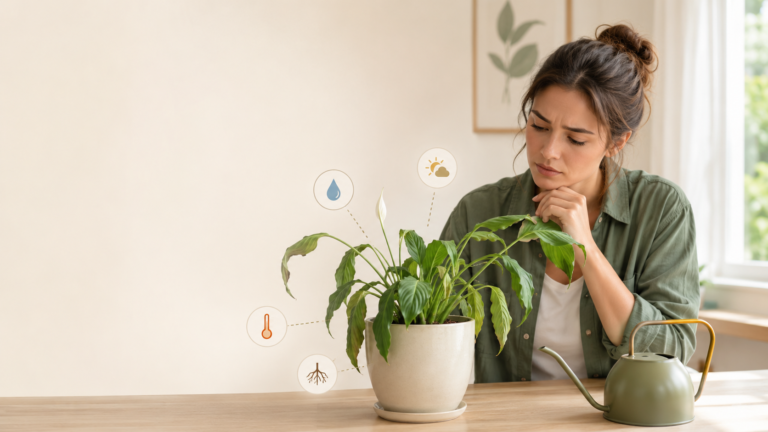
A plant that is not growing, dropping leaves, or looking generally unhappy can be short of light. It can also be overwatered, root-bound, sitting in exhausted soil, recovering from a move, cold, or simply dormant for the season. Adding light to a plant whose actual problem is root rot does not help it and can stress it further.
If your plant is stalled rather than obviously light-starved, work through why a plant stops growing before you buy a fixture. And if the leaves are pale or bleached rather than dark and reaching, consider the opposite possibility: too much direct light does its own damage, and leaf scorch on houseplants is what it looks like.
When the answer is genuinely yes
There are situations where a grow light is the right call and no amount of rearranging will substitute.
- The spot reads below the survival floor and cannot be improved. An interior room, a windowless office, a north-facing space blocked by a building.
- You want the plant to grow rather than to hold. A tolerant plant in a dim spot stays alive. If you want new leaves at a normal rate, it needs more than tolerance level.
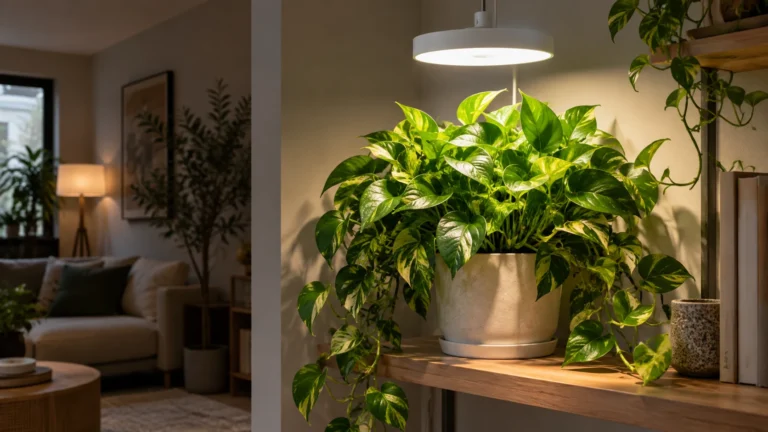
- Winter shortens your usable day dramatically. Some homes are perfectly adequate in summer and genuinely dark for four months. A seasonal light is a legitimate answer to a seasonal problem.
- You are growing something with a real light demand, rather than a shade-adapted foliage plant.
The arithmetic that tells you whether the light is doing anything
Once you have a fixture, the question changes from "do I need one" to "is it working," and that question does have a real answer rather than a feeling.
Virginia Cooperative Extension publishes the daily light integral formula in its extension publication SPES-720NP: DLI = (PPFD x 3,600 x hours) / 1,000,000. PPFD is the photosynthetic photon flux density the fixture delivers at the plant, hours is how long it runs, and the result is the total light the plant receives across a day, in moles per square meter per day.
Iowa State publishes target bands, and for foliage houseplants gives roughly 6 to 10 moles per square meter per day.
Together those two things let you check a fixture with arithmetic instead of hope: take the PPFD the maker publishes at the distance you are actually mounting it, multiply by the hours you run it, and see where it lands against the target.
And here is the honest part. If the manufacturer does not publish a PPFD figure, or publishes one without saying at what distance it was measured, you cannot do this calculation, and no amount of reading the box will change that. That is not a failure on your part. It is a gap in what the seller chose to tell you, and it is worth treating as information about the product. A fixture whose maker publishes a PPFD at a stated distance can be evaluated. One that leads with a wattage number and a spectrum claim cannot.
The short answer
You need a grow light if the spot you have cannot be improved by moving the plant, cannot be matched to a plant that suits it, and is genuinely short of light rather than short of something else.
Before you buy, get a rough number for the spot rather than a word, and remember that the published scales for those words disagree with each other by more than most rooms differ. Below about 50 foot-candles, per Mississippi State, nothing is going to do well for long, and that is the clearest line available.
Common questions
Will a normal lamp work instead?
That is its own question with a longer answer, and it turns on the same PPFD problem described above: an ordinary bulb is sold on how it looks to you, not on what it delivers to a leaf, and most are not specified in a way that lets you find out.
How many hours should I run it?
The hours figure is one of the two inputs to the DLI calculation above, so the answer depends on how much light your fixture actually delivers. There is no universal number, and any page that gives one without knowing your fixture is guessing.
Do I need a special color of light?
Plants use more of the spectrum than the pink-and-purple fixtures suggest, and full-spectrum white fixtures are widely used for houseplants. The more useful question than color is whether the maker publishes a measurable output figure at a stated distance.
Can a grow light replace a window completely?
There are real limits, and they are worth understanding before you commit to a windowless room. That is a separate question from this one and it deserves its own answer rather than a line here.