Why Do Some Grow Lights Look Pink or Purple?
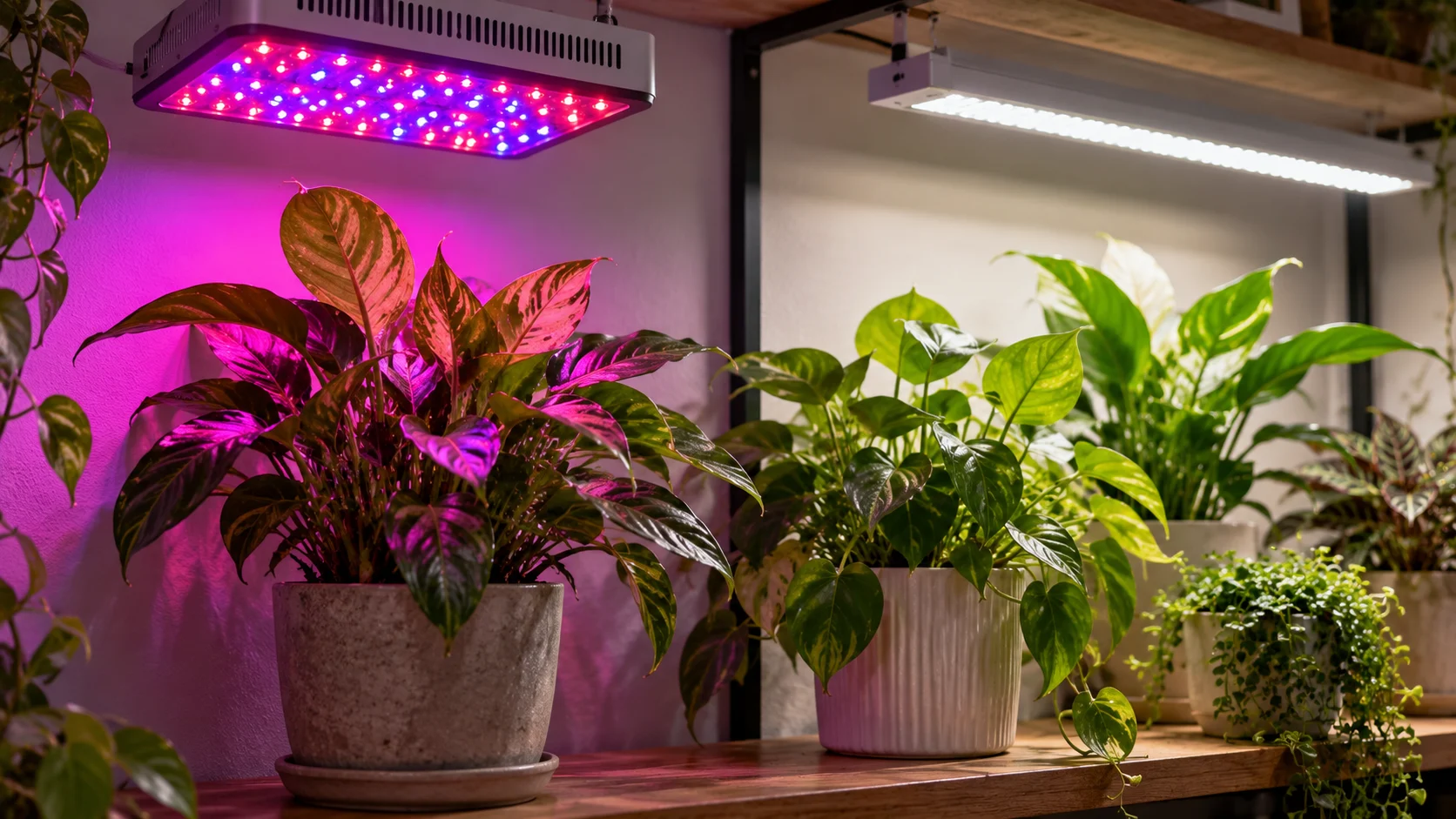
A grow light looks purple because it contains blue LED chips and red LED chips and almost nothing in between, and your eye blends the two into pink or violet. It is a decision about which chips the maker put in the fixture, not a requirement for growing plants. White fixtures grow plants too. When researchers compared the two designs at the same light intensity, the plants came out much the same, and the differences that did show up were mostly about how the light looks to people rather than how it works on leaves.
Where the Purple Comes From
Iowa State University Extension and Outreach states plainly that plants primarily use red and blue wavelengths in the visible light spectrum. Early horticultural LED designers took that literally: build a fixture out of blue chips and red chips, skip everything else, and none of the electricity is spent on light the plant is least likely to use.
The result is a fixture emitting two narrow bands with a gap where green and yellow would be. Human vision has no way to represent that as anything except a blend, so a mixture of blue and red reads to us as purple, magenta or pink depending on the ratio. Nothing is dyed. There is no purple wavelength in there at all.
Photosynthetically active radiation, the band plants use, runs from 400 to 700 nanometers by the Illuminating Engineering Society's definition. Blue chips and red chips sit near the two ends of it. A purple fixture is not covering less of the plant's needs than the marketing implies; it is covering the two parts most heavily used and leaving out the middle.
Where the White Comes From
Here is the part that reframes the whole comparison, and it is rarely mentioned.
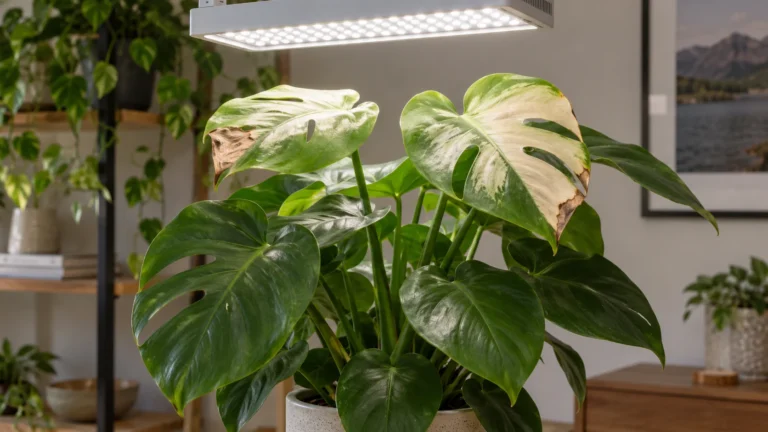
Michigan State University horticulture researchers describe white LEDs as blue LEDs coated with phosphors, which absorb some of the blue light and re-emit it as green and red, and to some extent far red. Practically every white LED in the world works this way, in a ceiling fitting or in a horticultural fixture.
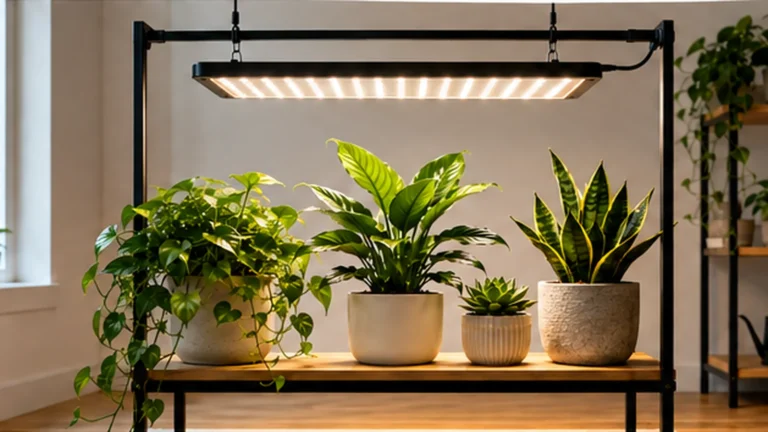
So a white grow light is not a fundamentally different technology from a purple one. It starts from the same blue chip. The phosphor coating converts part of that blue into the rest of the visible range, filling in the gap that makes a red-and-blue fixture look purple. Many white horticultural fixtures then add extra red chips on top, which is why they often look slightly warm rather than neutral.
That is also why the phrase full spectrum on a package tells you so little. It is describing the presence of that filled-in middle, not the amount of light coming out. What full spectrum actually means on a grow light label goes through the units that do carry information.
What Happened When Someone Compared Them Properly
Yujin Park and Erik S. Runkle, of the Department of Horticulture at Michigan State University, published a direct comparison in PLOS ONE on 16 August 2018, titled Spectral effects of light-emitting diodes on plant growth, visual color quality, and photosynthetic photon efficacy: White versus blue plus red radiation. They grew ornamental seedlings under six LED treatments, every one delivering the same 160 µmol/m²/s PPFD.
Their results, in their own terms:
- Growth. Total leaf area and fresh and dry weight were similar among treatments in all species at the transplant stage.
- Efficiency at the chip. Blue plus red radiation had the higher photosynthetic photon efficacy, at 2.25 µmol/J. That means it produced more usable photons per unit of electricity.
- Efficiency at the plant. Dry weight gained per unit of electric energy consumed was similar between the blue plus red treatment and three of the white-based treatments in three species. The advantage at the chip did not translate into a plant-growth advantage in this experiment.
- Appearance. The white-based treatments rendered color better, with color rendering index values of 72 and 77, higher than the others.
They concluded that white radiation had generally similar effects on seedling growth at the same PPFD with similar electric energy consumption, and improved the visual color quality of the lighting.
What that does and does not settle. It was ornamental seedlings, at one intensity, up to transplant stage, under research-grade fixtures. It is not a universal ruling that spectrum never matters, and research on light quality is very much ongoing. What it does support is the modest claim this article is making: at the same amount of light, the color of the fixture was not the thing deciding the outcome, and neither design is a mistake.
So Which Should You Buy?
For a houseplant in a home, the honest answer is that this is close to a preference question, and the reasons to prefer white are mostly reasons about you.
You have to look at it. A purple fixture turns the whole area purple. Furniture, walls, and the plant itself. In a grow tent nobody cares. In a living room, many people do, and this is a legitimate reason to choose rather than a frivolous one.
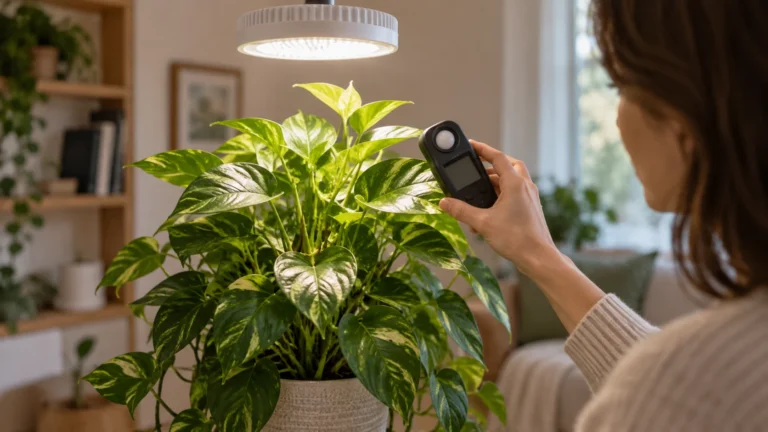
You have to see the plant. This is the practical argument, and it comes from commercial growing rather than from decor. The Michigan State work notes that blue plus red fixtures create pink or purple hues that are unsuitable for workers to inspect crops under. The same applies at home: under strongly colored light you cannot judge whether a leaf is yellowing, whether new growth is pale, or whether there is fine speckling or webbing on the underside. Those are the early warnings, and identifying common houseplant pests depends on seeing color and texture accurately. Turning the fixture off before you inspect the plant solves it, but only if you remember.
Efficiency is a smaller edge than it looks. The photon efficacy advantage for blue plus red is real and measured. In the comparison above, it did not show up as more plant per unit of electricity. For one or two houseplants running 12 to 14 hours a day, the difference is not the thing to optimize.
Neither is doing something the other cannot. If you already own a purple fixture and your plant is growing well under it, there is no reason to replace it.
What Actually Decides the Outcome
Color is the most visible property of a grow light and one of the least important for a beginner. The three that matter are the ones you can control:
Quantity. Iowa State Extension's daily light integral bands run from 3 to 6 mol/m²/day for low light foliage houseplants up to 18 to 30 mol/m²/day for the most demanding edibles. Nothing about the color of a fixture moves a plant between bands.
Distance. Mississippi State University Extension puts plants within 1 to 3 feet of an artificial light source, and its measurements show output from two 40 watt fluorescent lamps falling from about 500 foot-candles at 6 inches to about 100 at 30 inches.
Hours. Iowa State says 12 to 14 hours a day, and no more than 16. Illinois Extension says 14 to 16 is sufficient and warns against exceeding 16 because plants need a rest period. How long to run a grow light each day works through why those two ranges differ.
The same logic explains why the household bulb question is not really about spectrum either, which is the point of whether a regular LED bulb can work as a grow light.
Frequently Asked Questions
Is purple light better for plants than white light?
On the evidence from the Park and Runkle comparison, at the same PPFD the two produced similar growth in the species tested. Blue plus red was more efficient at producing photons per unit of electricity, but that did not translate into more plant growth per unit of electricity in that experiment.
Is purple light harmful to people or pets?
The visible light itself is ordinary blue and red light, not ultraviolet. The practical complaints are glare and discomfort from looking at it, so position the fixture so nobody is looking straight into the chips, and be aware that a strongly colored light makes it harder to notice a problem on a plant or anywhere else in the room.
My grow light is white. Is it a real grow light?
Color is not what makes a fixture horticultural. What separates a horticultural fixture from a lamp is that the maker publishes an output figure, usually PPFD at a stated distance, which lets you check it against your plant's requirement.
Why do some fixtures have a purple mode and a white mode?
They contain both chip types and switch between them. Running the white mode when you are in the room and the blue plus red mode otherwise is a reasonable way to use it, and it does not change the plant's requirement.
Will purple light make my plant grow faster?
Not by itself. Speed of growth follows the daily light integral the plant receives, which is set by intensity, distance and hours rather than by the color mix.