Do Succulents and Cacti Need a Grow Light Indoors?
Usually yes. Succulents and cacti are the houseplants most likely to run short of light indoors, because they want several times what an ordinary foliage plant does. Iowa State University Extension's daily light integral table puts succulents in the high light band at 12 to 16 moles per square meter per day, while low light foliage plants manage on 3 to 6. Its succulent guide asks for ten or more hours of bright light, and South Dakota State University Extension asks for a southern or western exposure with at least six to eight hours. If your plant is not sitting in an unobstructed south or west window, a grow light is usually the honest answer.
The number that explains why succulents run out of light first
Most people meet this problem as a mystery. The pothos on the same shelf is fine. The philodendron is fine. The little rosette that came home tight and gray is now a green spiral leaning at the window, and nothing about the care changed.
The explanation is one table. Iowa State University Extension, in its guidance on supplemental light for indoor plants, sorts plants into light bands measured in daily light integral, the total amount of usable light a plant receives across a day. Low light foliage houseplants sit at 3 to 6 moles per square meter per day. Medium light plants sit at 6 to 10. Succulents are listed in the high light band, 12 to 16.
Read that as a ratio and the mystery disappears. A succulent is asking for roughly two to four times the light of the foliage plant beside it. A room that is comfortably adequate for one is a shortage for the other, and the shortage is not marginal. This is why succulents and cacti are almost always the first plants in a home to show a light problem, and why they show it as a change in shape rather than as a slow decline.
If you want to work out what your own room actually delivers before you buy anything, our walkthrough of whether you need a grow light at all covers the measurement, the published brightness scales and the honest caveats on both. This article answers the narrower question sitting underneath it: what changes when the plant in question is a succulent or a cactus.
Which ones genuinely need a light, and which will forgive you
Not every plant sold as a succulent has the same appetite. The gap between the fussiest and the toughest is wide enough to change the answer.
| What you own | What the sources ask for | Honest verdict indoors |
|---|---|---|
| Desert cacti (barrel, mammillaria, opuntia) | Clemson Extension: bright sunlight, a south or west window with several hours of direct sun each day | A light unless you have that window, unobstructed, and are not in a dark winter |
| Tight colored rosettes (echeveria, sempervivum, sedum, graptopetalum) | The high light band, and they are grown for a compact shape that only strong light maintains | The group that stretches first and most visibly. A light in almost any room without direct sun |
| Aloe, haworthia, gasteria | Bright light, but they tolerate less than the rosettes do | Often survive a bright sill. May fade and lean without ever collapsing |
| Snake plant, ZZ plant | Sold as low light survivors and genuinely are | A light is optional. Without one they mostly stop growing rather than deform |
| Rain forest cacti (holiday cactus, rhipsalis) | Clemson Extension: bright but filtered light, and they "may sunburn if in direct sun" | A light can help, but a strong one placed close is the wrong move for this group |
The last row is worth pausing on. Two plants both called cactus can want opposite things, because one evolved in desert sun and the other on a shaded branch in a forest. Treating a holiday cactus like a barrel cactus is a common and avoidable mistake.
What stretching looks like before it is permanent
Every page you will find on this topic describes an already stretched succulent. That is too late to be useful. The change happens in a sequence, and the early stages are visible weeks before the plant looks obviously wrong.
1. It leans. South Dakota State University Extension puts it simply: succulents "tend to lean towards the sun or light source." A rosette that used to sit square in its pot and now tilts is telling you the light is directional and thin. This stage costs you nothing if you act, and rotating the pot regularly is worth doing anyway. Iowa State notes that growth becomes lopsided when plants are not turned.
2. The color drains. Iowa State's phrasing for a light-starved succulent is "lanky and pale." The reds, purples and chalky blue-gray tones that made you buy the plant fade back toward plain green. Nothing is wrong with the plant yet. It is redirecting what it has.
3. The center opens. This is the tell that matters most and the one almost nobody names. Look down at the rosette from directly above. In good light the newest leaves are packed tightly into the center. As light drops, each new leaf emerges slightly further from the last, and the tight spiral starts to loosen and show gaps. Compare it against a photo from the day you bought it if you have one.
4. Stem appears, leaves angle up. Now the spacing between leaves is obvious, bare stem is visible between them, and the leaves point upward rather than sitting out flat. On a cactus the same thing shows as a narrower, paler column of new growth sitting on top of the older, wider body, so the plant looks slightly pinched at the shoulders.
5. It is a different plant. Long, thin, pale, reaching, and nothing like the picture on the tag.
Here is the part that changes what you should do about it. A stem that has already elongated does not shrink back. Adding light changes what the plant grows next. It does not repair what it has already grown. That is why stages one to three matter so much more than stage five: everything up to there is a warning, and everything after it is a repair job.
Two honest limits on that sequence. The order is reliable and it matches what both extension services describe, but the speed is not something we can pin to a published figure, so treat it as an order of events rather than a schedule. And stretching is not the only sign a plant needs more light. The broader set of signs your plant needs more light covers what the non-succulents on your shelf do instead, which is usually much subtler.
What to do about one that has already stretched
You have three options and none of them is a repair.
Accept it and stop the spread. Give the plant the light it was missing and the new growth comes in compact again. The stretched section stays stretched, and it sits there permanently as a record of a dim winter. Plenty of people are fine with this.
Take a cutting from the top. For most rosette succulents you can cut the compact top off with a clean blade, leave a short piece of stem attached, let the cut surface dry and callus for a few days, then set it on dry soil to root. The original base often pushes new offsets from the remaining stem. This is standard succulent propagation rather than a rescue technique, and it is not guaranteed.
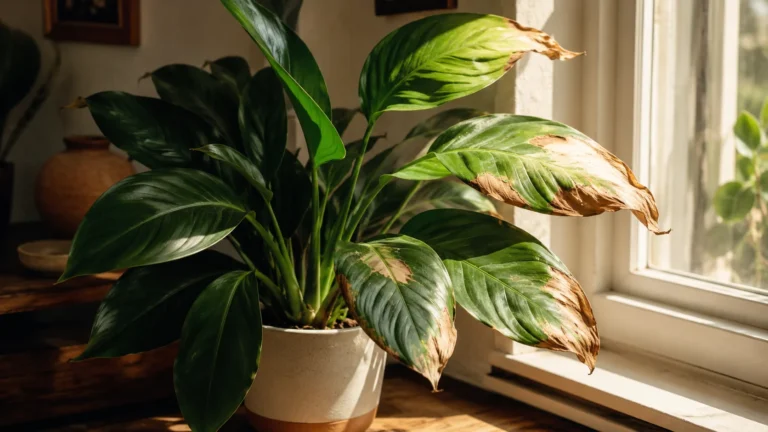
Move it up in light gradually, not all at once. This is the step people skip. A plant that has spent months in dim light is not adapted to strong light, and jumping it straight into intense light can scorch it. Clemson Extension gives exactly this advice for cacti moved outdoors for summer: place them in partial shade for the first few weeks so they can adjust to brighter light. The same reasoning applies to a fixture. Start further away or on fewer hours and build up over a couple of weeks, because leaf scorch on a houseplant looks nothing like a light shortage and does not fade.
Setting up a grow light for succulents indoors, without guessing
Four settings decide whether this works, and none of them requires special equipment.
Hours. Iowa State's supplemental light guidance is that it is best to supply light 12 to 14 hours a day, and that for home gardeners the lights can be on for as little as 10 hours and no more than 16. Its succulent page asks for ten or more hours of bright light. Put the fixture on an outlet timer and set it once. Our full breakdown of how long to run a grow light each day explains why the published ranges land where they do.
Intensity, which mostly means distance. Hours alone will not carry a succulent into the high light band, because the band is a total and the total depends on how much light actually arrives at the plant. That pushes people to move the fixture closer, which is the right instinct and the one most likely to be overdone. Work through how far a grow light should sit from your plant and adjust in steps rather than jumps.
Rotation. A quarter turn whenever you water. Both Iowa State and South Dakota State name uneven growth as the cost of skipping it.
Water, which does not automatically go up. More light usually means the soil dries faster, but that is a reason to check the soil more often, not a reason to water more often on a schedule. South Dakota State's guidance is a succulent can be watered once a week or less depending on how fast the soil dries, and there is no need to water again until the soil is completely dry. A succulent that goes soft and translucent at the base after you added a light has a water problem, not a light problem, and root rot in houseplants is the page to read next.
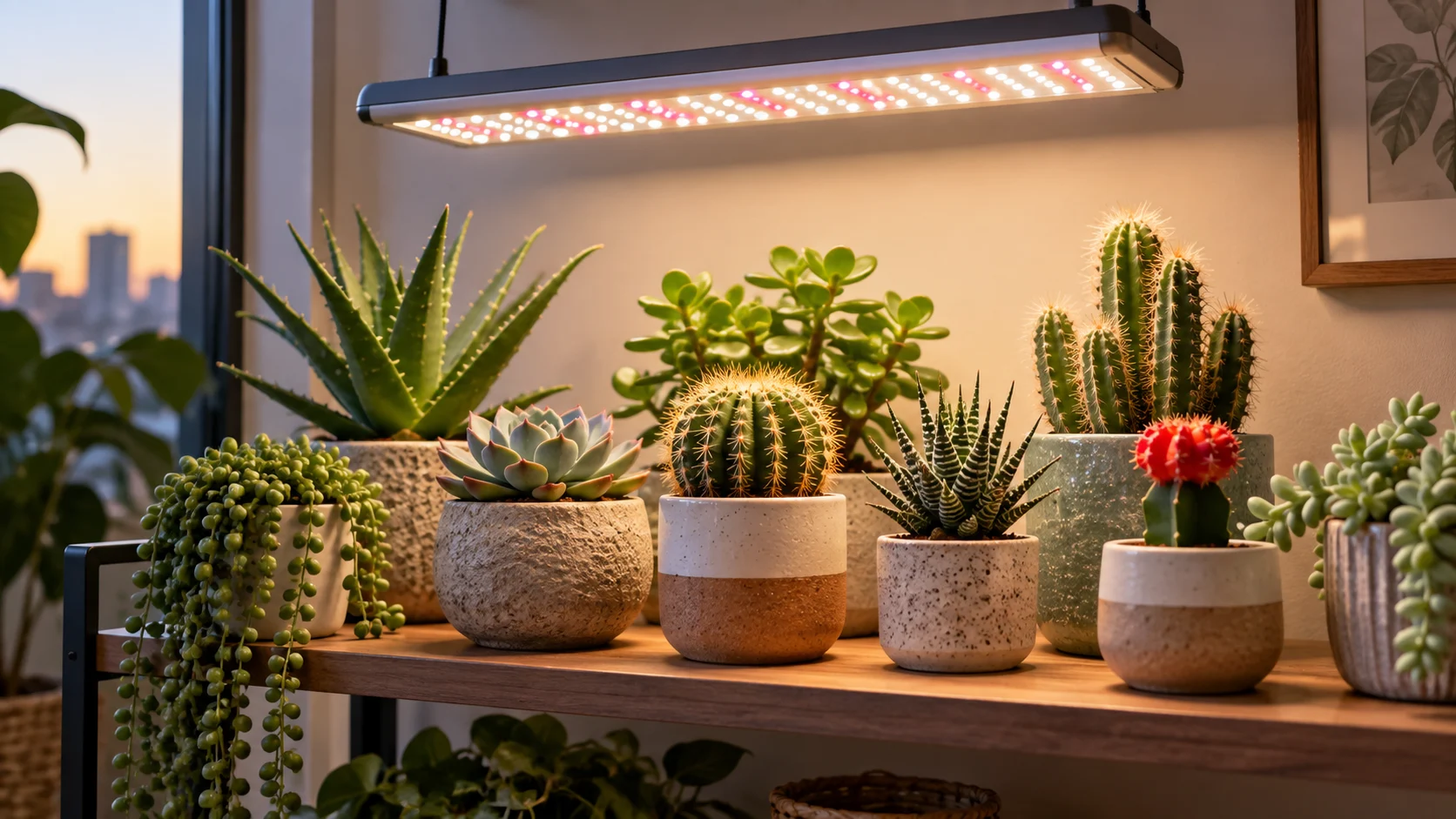
What we will not do here is name a fixture. This site has not tested grow lights, and pretending otherwise would be worth less to you than the sentence you are reading. On the category question, Iowa State names the two types that suit succulents: high output, full spectrum fluorescent fixtures, or LED fixtures. Either can deliver what the high light band asks for, and both are sold in clip, bar and panel shapes that change none of the four settings above.
The half nobody selling a fixture mentions
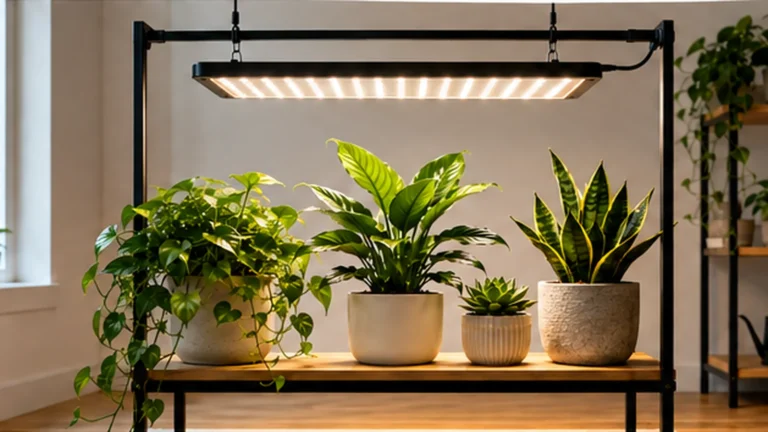
A grow light for succulents is a mains powered appliance that runs for 12 to 14 hours a day, unattended, usually above a windowsill, often within reach of a curtain, and frequently fed by an extension cord. Succulents get the brightest and longest running setup in the house, which makes this worth two minutes. The guidance below is for the United States, where household circuits run at 120 volts under the National Electrical Code. Readers elsewhere follow their own national wiring rules, which in the UK means BS 7671 and Part P.
The timer has its own rating. Outlet timers are marked with a maximum load. One small fixture is far below it, but check the marking rather than assume, especially if you intend to run a shelf of fixtures through one timer.
Extension cords are temporary by design. The Electrical Safety Foundation International is blunt about it: an extension cord is a temporary solution and should not be used as a substitute for permanent wiring, it should not be overloaded, and one cord should not feed more than one appliance. A light that has lived in the same window for two years on a cord run across the floor is the arrangement that advice exists for.
Clearance from fabric. Windowsills have curtains and blinds. Follow the manufacturer's stated clearance and keep fabric off the fixture. LEDs run cooler than the lamps they replaced, but the housing and driver still get warm and a fixture on a timer never gets a long cool down.
Look for a certification mark from a recognized testing laboratory such as UL or ETL on the fixture and on the timer.
Where to stop. If the plug, cord or outlet is warm to the touch, if the light flickers, or if the circuit trips, unplug it and stop using it. If the fix you are picturing involves adding an outlet, wiring a fixture into a ceiling box or opening the breaker panel, that is work for a licensed electrician and in most of the United States it is permitted work rather than a homeowner job. It is also no longer plant care.
When a light is not the answer
A grow light solves a light shortage. It does not solve the other three things that make a succulent look bad indoors.
If the plant is soft, translucent or mushy at the base, that is water sitting where it should not, and more light will not drain it. If the plant is a rain forest cactus, more intense light aimed closer is the wrong direction entirely. And if the plant has already stretched, the light stops the next stage rather than undoing the last one.
The honest summary is that succulents and cacti are the plants a grow light helps most and the plants people notice needing one last, because the signal is a slow change of shape rather than a dramatic collapse. Look down at the center of the rosette this week. That is where the answer is.
FAQ
Can succulents survive indoors without a grow light?
Some can, in the right window. Clemson Extension describes a south or west facing window with several hours of direct sun as ideal for arid climate cacti, and South Dakota State University Extension asks for a southern or western exposure with at least six to eight hours of light. If you have that window and nothing blocking it, a fixture is optional. Anywhere dimmer, the plant usually survives but stops looking like itself.
How many hours a day should a grow light be on for succulents?
Iowa State University Extension's supplemental lighting guidance is 12 to 14 hours a day as the best setting, with 10 hours as a floor and 16 hours as a ceiling for home growers. Its succulent guidance asks for ten or more hours of bright light. Use a timer rather than your memory.
Will a stretched succulent go back to normal?
No. The stretched section of stem stays stretched however much light you add afterward. What good light does is make the new growth compact again. If you want a tight plant back, the usual route is cutting the compact top off and rooting it as a new plant.
Do my succulents need more light in winter?
They need the same amount, and in most homes the window supplies less of it, which is why stretching so often shows up between autumn and spring. A fixture on a timer keeps the total steady through the season instead of letting it collapse and recover.
Is a grow light better than a sunny window for a cactus?
Not better, just more reliable. A bright unobstructed south window is excellent when it exists. A fixture is what you use when it does not, or when the window's output drops for half the year. Whichever you use, move a plant up in light gradually so it does not scorch.
Sources
- Aaron Steil, Iowa State University Extension and Outreach, "Important Considerations for Providing Supplemental Light to Indoor Plants", December 2023. Read 2026-09-02.
- Aaron Steil, Iowa State University Extension and Outreach, "Growing Succulents Indoors", December 2024. Read 2026-09-02.
- Kristine Lang and Cindy Schnabel, South Dakota State University Extension, "How to Care for Succulents Indoors", updated 2022-04-04. Read 2026-09-02.
- Karen Russ and Al Pertuit, revised by Barbara H. Smith, Clemson Cooperative Extension Home and Garden Information Center, "Indoor Cacti", HGIC 1502, updated 2015-11-16. Read 2026-09-02.
- Electrical Safety Foundation International, extension cord safety guidance. Read 2026-09-02.