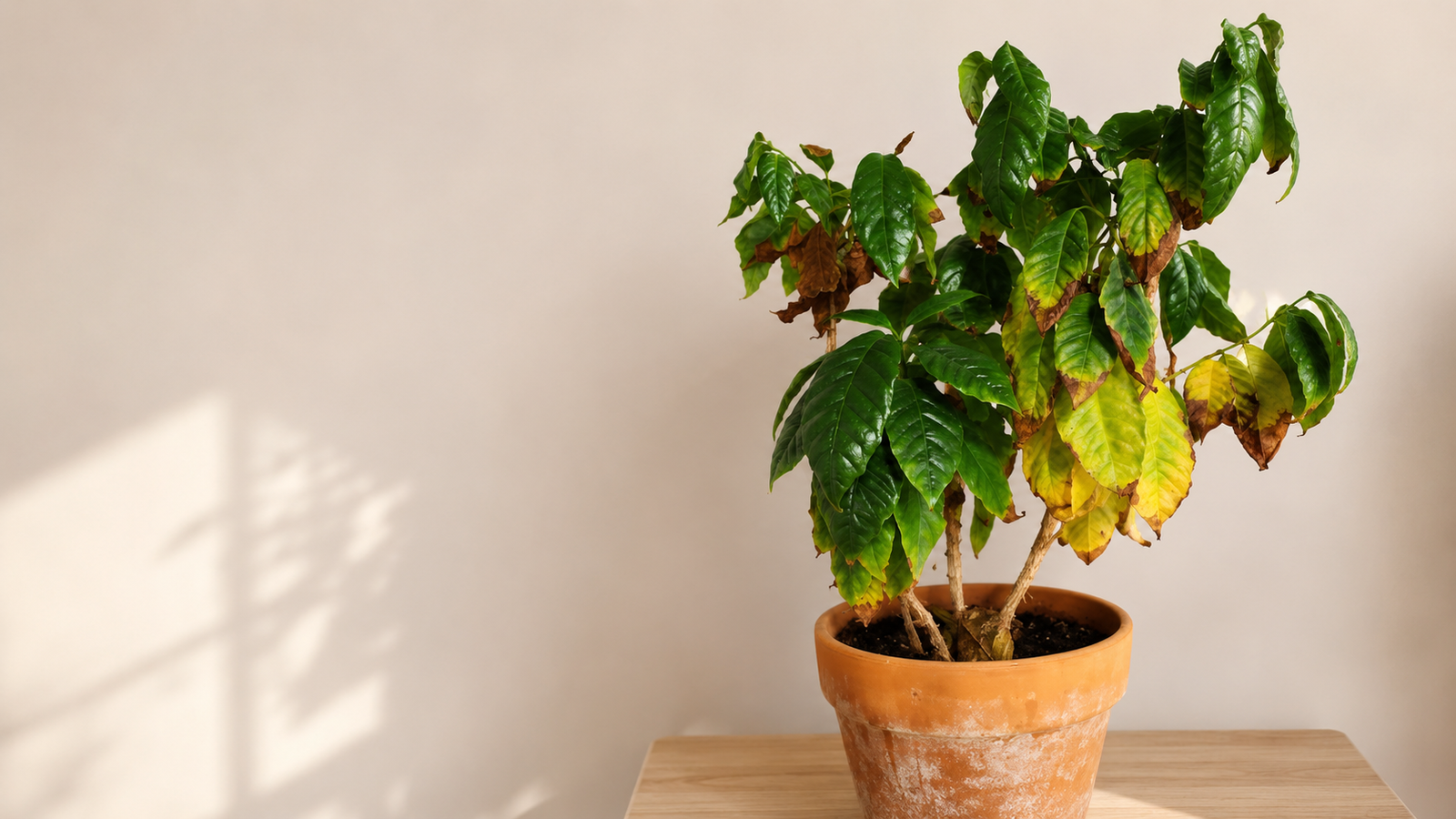
Brown Tips on Plant Leaves: Causes and Fixes
Brown leaf tips usually come down to one of five things: dry air, inconsistent watering, fertilizer salts built up in the soil, minerals in tap water, or heat. Iowa State University Extension names low humidity as the most likely cause in homes, noting that indoor humidity is often low and particularly so in winter. The pattern narrows it further. A thin brown rim running all around the leaf points toward water chemistry or fertilizer salts, while dry, papery tips on the newest leaves point toward dry air.
The reassuring part first: tip browning on a plant whose leaves are otherwise green and firm is a cosmetic problem, not an emergency. It is worth fixing the cause, but it does not mean the plant is dying.
Read the pattern first
Every guide on this subject gives you the same list of causes and leaves you to guess which is yours. The leaf itself narrows it down, if you look at four things: where the brown is, which leaves have it, how fast it appeared, and whether there is a yellow band between the brown and the green.
| What you see | Most likely cause | Next check |
|---|---|---|
| Dry, papery tips on the newest leaves, worse in winter | Dry air | Is a heat source or vent nearby? |
| Brown tips plus a white or yellow crust on the soil surface or pot rim | Fertilizer salts | Have you fed it recently, or often? |
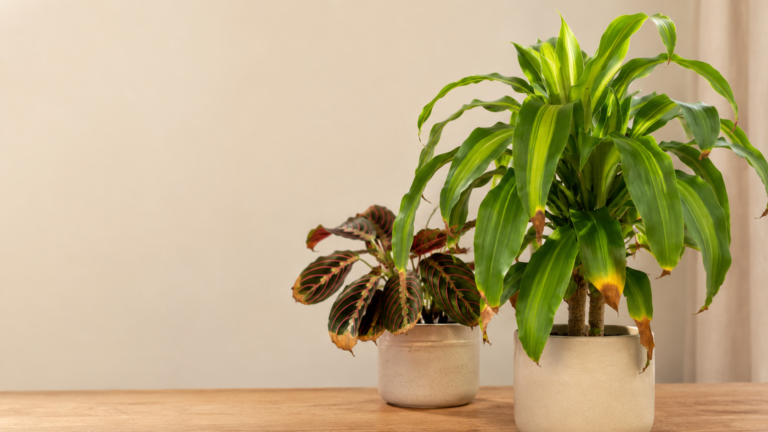
| A thin brown rim right around the leaf edge, often with a yellow halo just inside it | Water chemistry or salt buildup | Is the plant a spider plant, dracaena, prayer plant or calathea? |
| Brown tips on older, lower leaves while new growth is clean | Past watering swings that have since settled | Has your routine changed recently? |
| Brown tips appearing quickly on the side facing a window or radiator | Heat | Move it and watch for two weeks |
| Brown tips accompanied by whole leaves going brown and dropping | Not this problem | See the boundary section below |
Nothing about a brown tip is reversible, so the point of the diagnosis is to stop new leaves from doing the same thing.
Cause 1: dry air
Iowa State University Extension calls low humidity the most likely cause of brown leaf tips and edges, and points out that home humidity is often low, especially in winter when heating runs. The mechanism is simple: leaves lose moisture to dry air faster than the roots can replace it, and the tips and edges are the furthest points from the stem, so they run out first.
Signs it is humidity: browning shows up on new leaves as well as old, it gets worse in the heating season, and it is worst on thin-leaved tropical plants such as calatheas, prayer plants and ferns. Plants with thick or waxy leaves rarely complain about ordinary room air.
What actually helps is raising the humidity in the air the plant lives in, or moving the plant to a naturally more humid room such as a bathroom or kitchen with a window. Grouping plants together also raises local humidity slightly. Misting is popular but only lifts humidity for a few minutes at a time, which is why plants that need genuinely moist air keep browning despite it.
Cause 2: inconsistent watering
Iowa State's second named cause is inconsistent watering, and specifically "allowing plants to dry out too long between waterings." The plant runs short of water, the extremities of the leaf die back, and the damage stays visible long after the routine improves.
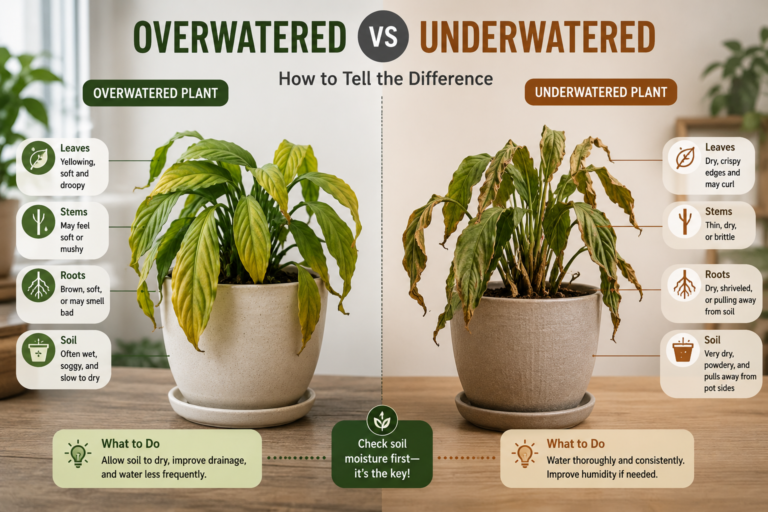
The confusing part is that overwatering can produce brown tips too, by a different route. Roots damaged by sitting in wet soil cannot take up water properly, so the leaf ends up short of water even though the pot is full of it. That is why the soil check matters more than the leaf here.
The fix is consistency rather than volume: check the soil at the same time each week and water thoroughly when the top one to two inches are dry, rather than giving small amounts often or forgetting for a fortnight and then flooding it. How often to water indoor plants covers the rule, and how to tell if your plant needs water covers the checks themselves.
Cause 3: fertilizer salts in the soil
Iowa State names this directly: excess salts can build up in the soil when too much fertilizer is applied, and that can lead to brown leaf tips. Fertilizer that the plant does not use does not vanish. It stays in the mix, and as water evaporates, those salts concentrate.
The giveaway is visible: a whitish or yellowish crust on the soil surface, around the drainage holes, or along the rim of the pot. If that crust is there along with brown tips, you have your answer.
What helps is stopping the feeding first, then watering thoroughly so that water runs freely out of the drainage holes and carries some of the accumulated salts out with it, letting the pot drain fully and emptying the saucer each time. If the crust is heavy and the plant is otherwise healthy, repotting into fresh mix removes the problem outright.
Then feed more carefully in future: only in spring and summer, only on soil that is already damp, only on healthy plants, and only at the strength stated on the product's own label. Never increase a dose to try to fix a plant that looks unwell, which is one of the most common beginner errors and is covered in 7 beginner houseplant mistakes.
Cause 4: what is in your tap water
Iowa State's fourth cause is water chemistry: too much chlorine and other chemicals in the water, such as fluoride, can cause brown leaf tips, especially over an extended period and especially on sensitive species. The species it names are worth knowing, because they account for a large share of the brown tips people worry about: spider plant, ti plant, dracaena, prayer plant and calathea.
If you own one of those, and the browning is a thin, even rim rather than a ragged patch, and everything else about the plant looks healthy, water chemistry is a strong candidate.
Sensible responses, in order of effort: let tap water stand uncovered for several hours before using it, which allows some chlorine to dissipate, though it does not affect fluoride; collect rainwater if that is practical where you live; or use distilled water for the few sensitive plants rather than for everything. Do not overhaul your watering for a plant that is not sensitive, because for most houseplants ordinary tap water is fine.
Cause 5: heat and hot spots
Heat produces browning by accelerating water loss from the leaf. The pattern is usually one-sided, which is what distinguishes it: the tips facing a radiator, a heating vent, a hot appliance or a sun-baked pane brown while the sheltered side of the plant stays clean.
The fix is placement, not care. Move the plant away from the heat source, or further back from the glass, and watch what new growth does over the following weeks. Old damage will not reverse.
Should you cut the brown tips off?
The honest answer is that trimming is cosmetic and nothing more. Iowa State University Extension states it plainly: trimming the brown portions off with scissors can improve appearance, but new browning will occur if the root cause is not addressed.
So trim if it bothers you, with these caveats:
- Use clean, sharp scissors. A ragged tear invites more dieback.
- Cut just inside the brown, following the leaf's natural outline. A leaf cut straight across looks worse than the browning did. Leaving a hairline of brown at the new edge is normal and preferable to cutting into live green tissue.
- Do not remove a whole healthy leaf because part of its tip is brown. The green part is still working for the plant, and a plant that is already stressed cannot afford to lose functioning foliage.
- Fix the cause in the same week you trim, or you will be doing it again in a month.
Plants that get brown tips easily and are not sick
Some species brown at the tips in ordinary homes as a matter of course. Spider plants, dracaenas, ti plants, prayer plants and calatheas are all named on the sensitive list, and thin-leaved ferns join them on the humidity side. If you own one of these and it is otherwise growing well, a degree of tip browning is close to the species norm in an average living room rather than a sign that you are failing.
Perfect foliage is a greenhouse standard, not a home standard. A plant that is putting out healthy new leaves is winning, even if some of the older ones have brown ends.
When brown tips are not the problem you have
This page is about browning confined to the tips and edges of leaves that are otherwise green and firm. Two related symptoms are different problems:
- Whole leaves going brown, dry and crisp, and often falling is more serious and has a different cause list. See why plant leaves turn brown and crispy.
- Leaves turning yellow rather than brown, whether at the tips or over the whole leaf, points in a different direction again. Why houseplant leaves turn yellow has the location-based decision map.
If more than one is happening at once, treat the more serious symptom as the real one and work from there. And if you are still building the basics, indoor plant care for complete beginners sets out the whole sequence.
Frequently asked questions
What causes brown tips on houseplant leaves?
Iowa State University Extension names four causes: low humidity, which it calls the most likely one in homes; inconsistent watering, particularly letting a plant dry out too long between waterings; excess fertilizer salts in the soil; and chemicals in tap water such as chlorine and fluoride. Heat from a nearby source is a fifth common trigger.
Will brown leaf tips turn green again?
No. Browned tissue is dead and will not recover. The purpose of diagnosing the cause is to keep new leaves from developing the same damage, and to stop existing browning from spreading further down the leaf.
Should I cut off brown leaf tips?
You can, but only for appearance. Iowa State University Extension notes that trimming improves how the plant looks while new browning will occur if the underlying cause is not addressed. Use clean scissors, follow the leaf's natural shape, and leave a hairline of brown rather than cutting into green tissue.
Is tap water really causing my brown tips?
It can, on sensitive species. Iowa State names spider plant, ti plant, dracaena, prayer plant and calathea as species where chlorine and fluoride in water can produce brown tips over time. For most other houseplants, ordinary tap water is not the culprit and there is no need to change it.
Are brown tips a sign my plant is dying?
Usually not. If the leaves are otherwise green and firm and the plant is producing new growth, tip browning is a cosmetic symptom of a condition worth correcting rather than a sign of decline. Whole leaves browning, crisping and dropping is a more serious picture.