7 Beginner Houseplant Mistakes That Kill Plants
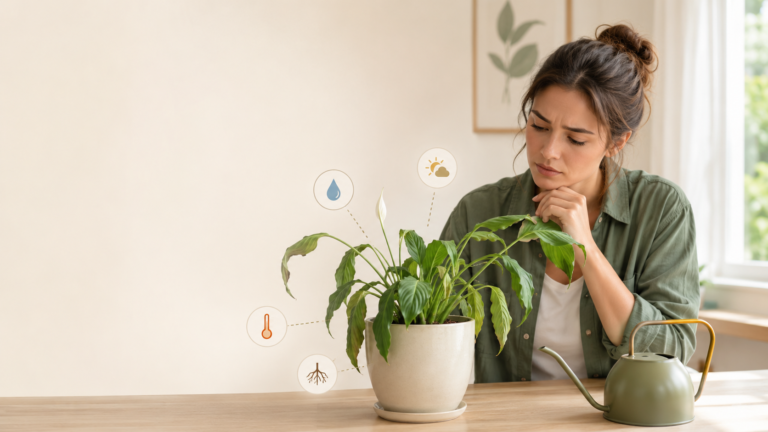
Seven mistakes account for most beginner houseplant losses, and they are worth knowing in order of how often they are fatal: watering on a schedule instead of checking the soil, using a pot with no drainage hole, putting a plant in far less light than it needs, fertilizing a plant that is already stressed, repotting into a container much too large, treating every symptom as thirst, and buying a plant before checking whether the room can support it. Five of the seven are watering or drainage in disguise.
Other lists run to seventeen or nineteen items. That is not helpful when you have one plant on a windowsill looking unhappy and you need to know where to start. These seven are ordered by consequence, so the first three are where the real risk sits.
Mistake 1: watering on a schedule
What it looks like: Sunday is watering day, so every plant gets water on Sunday. The soil is never consulted.
Why it kills: the same pot dries out at wildly different speeds depending on the season, the light, and how warm and dry the room is. A pothos in a bright July window might empty its pot in five days. That identical plant in January, in a dim corner with the heating running, can still be damp two weeks later. A fixed weekly schedule drowns it in winter and starves it in summer.
The University of Maryland Extension puts the principle plainly: houseplants should not be watered on a schedule but rather when they need it. Iowa State University Extension gives the memorable version: check on a schedule, do not water on a schedule.
What to do instead: keep the weekly habit, but make it a check rather than a watering. Push a finger two inches into the soil. Dry at that depth means water. Damp means walk away and check again in a couple of days. The full method is in how often to water indoor plants.
Mistake 2: a pot with nowhere for water to go
What it looks like: a beautiful ceramic or basket pot with a solid base. The surface soil dries out normally, so nothing seems wrong.
Why it kills: water that goes in has no way out, so the bottom of the root ball stays saturated indefinitely. Worse, this mistake actively defeats the finger test, because the top two inches genuinely do dry while the roots sit in a swamp. You test, you get "dry", you water, and the problem compounds.
The University of Wisconsin-Madison Plant Disease Diagnostics Clinic is explicit: the fungi that cause root rot prefer wet soil conditions, so the recommendation is to use a pot with drainage holes, not to over-water, and never to let plants sit in drainage water.
What to do instead: you can keep the pretty pot. Leave the plant in its plastic nursery pot, sit that inside the decorative one, and lift it out over a sink to water. Let it finish draining, then put it back and tip out anything that has collected. If a plant is already in a sealed pot and struggling, this single change fixes more beginner plants than anything else on this list.
Mistake 3: misjudging the light
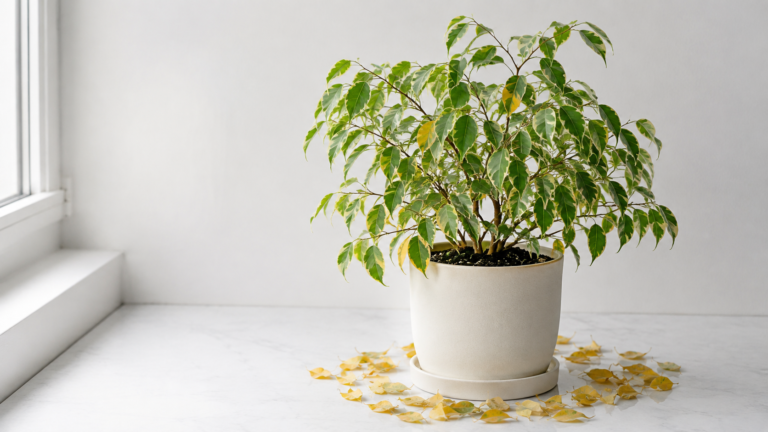
What it looks like: a plant that never quite dies but never grows either. Stems stretch toward the window, new leaves come in smaller than the old ones, and lower leaves yellow and drop.
Why it kills: slowly, and invisibly. Human eyes adapt to dim rooms far better than plants do, so a corner that reads as "quite bright" to you can be well below what most foliage plants need. Low light also compounds mistake 1: a plant in a dim spot uses less water, so soil stays wet longer, so scheduled watering becomes overwatering.
What to do instead: judge by shadow, not by feel. At midday on a clear day, hold your hand a foot above the spot. Crisp-edged shadow means direct sun; soft-edged shadow means bright indirect light; barely visible shadow means low light. Bright indirect light explained covers the test and what each window direction actually delivers. If the spot really is dim, change the plant rather than the room and pick from the best low-light indoor plants for beginners.
Mistake 4: fertilizing a plant that is already stressed
What it looks like: the plant looks poorly, so it gets fed. It is the most natural reflex on this list and the least intuitive mistake.
Why it kills: fertilizer is not medicine. A plant that is struggling is not actively growing, and a plant that is not growing cannot use the nutrients. If the roots are damaged, which is exactly the case with overwatering, they take up even less. The fertilizer does not disappear. It stays in the soil as salts, and Iowa State University Extension names excess salt buildup from too much fertilizer as a direct cause of brown leaf tips. So the plant that was struggling now has burnt leaf tips as well.
What to do instead: feed only healthy, actively growing plants, only in spring and summer, only on soil that is already damp, and only at the strength on the product label. Never increase a dose to try to revive something. When a plant looks wrong, diagnose first: overwatered vs underwatered is usually the fastest place to start.
Mistake 5: repotting into a pot that is far too big
What it looks like: a small plant is moved straight into a large pot to "save doing it again later".
Why it kills: a big pot holds a big volume of soil, and roots only occupy a small part of it. The rest of that soil holds water with nothing drawing it out, so it stays wet for weeks. That is precisely the waterlogged condition root-rot organisms need. The plant also puts its energy into filling the pot with roots rather than into visible growth, so it looks stalled while it is at it.
What to do instead: step up gradually. One size larger than the current pot is the usual guidance, and there is rarely a reason to jump more. And do not repot a plant that has just come home, or one that is currently sick. A struggling plant has one problem; repotting gives it two.
Mistake 6: reaching for the watering can at every symptom
What it looks like: drooping leaves, so it gets water. Yellow leaves, so it gets water. Brown tips, so it gets water.
Why it kills: because the symptoms of too much water and too little water overlap almost completely. Drooping, yellowing and general limpness all appear in both. A plant with rotting roots cannot take water up, so it wilts exactly like a thirsty one, and watering it again accelerates the rot.
What to do instead: check the soil before responding to any leaf symptom. It takes ten seconds and it splits the diagnosis in half. Wet soil plus a wilting plant points toward roots, not thirst, and root rot signs and how to save your plant is the next step. Dry soil plus wilting is genuine thirst and usually recovers within hours.
Mistake 7: buying the plant before checking the room
What it looks like: falling for a fiddle leaf fig, a calathea or a maidenhair fern in a shop, then finding a spot for it at home.
Why it kills: shops light and humidify their display areas far better than most homes, and plants are sold on appearance rather than on suitability. Some of the most tempting plants are also the least tolerant of ordinary living-room conditions, particularly thin-leaved tropicals that need steady humidity.
What to do instead: decide on the spot first, assess its light with the shadow test, and shop for that spot. Also check that the plant has a label with a name on it. An unlabeled plant cannot be looked up, and you will be guessing about its needs for as long as you own it.
Ranked by consequence
| # | Mistake | Typical damage | How fast |
|---|---|---|---|
| 1 | Watering on a schedule | Root rot | Weeks to months |
| 2 | No drainage hole | Root rot | Weeks |
| 3 | Too little light | Slow decline, no recovery in place | Months |
| 4 | Feeding a stressed plant | Salt buildup, burnt leaf tips | Weeks |
| 5 | Pot far too large | Soil stays wet, roots suffer | Weeks to months |
| 6 | Watering at every symptom | Turns a fixable problem into rot | Days to weeks |
| 7 | Wrong plant for the room | Steady decline whatever you do | Months |
Three habits that are not actually mistakes
Beginner lists tend to inflate the count, and some of what gets listed as an error is simply normal plant behavior. Three worth taking off your worry list:
Losing a few lower leaves. Plants shed old leaves as they grow. One or two lower leaves yellowing slowly and dropping is routine. Many leaves yellowing at once, or new leaves yellowing, is a real signal. The difference is covered in why houseplant leaves turn yellow.
Not misting. Misting raises humidity around a leaf for a few minutes at most. Skipping it is not neglect, and a plant that genuinely needs more humidity than your room provides needs a real change of conditions, not a spray bottle.
Not repotting on a schedule. Plants are repotted when they need it, not annually. Many houseplants are perfectly content slightly snug, and an unnecessary repot is a shock with no upside.
If you are starting from scratch and want the whole sequence rather than the failure list, indoor plant care for complete beginners sets out the four decisions in the order they matter.
Frequently asked questions
What is the single most common beginner houseplant mistake?
Watering on a fixed schedule rather than checking the soil. It is the root cause behind a large share of beginner plant losses, because scheduled watering ignores season, light and pot size, all of which change how fast a pot dries out.
Is overwatering really worse than underwatering?
In practice, yes. A thirsty plant usually recovers within hours of a proper soak. Sustained overwatering causes root rot, and roots that have rotted cannot take up water at all, so the damage is often done before the leaves look wrong. Erring slightly dry is the safer instinct.
Should I fertilize a houseplant that looks sick?
No. A stressed plant is not growing and cannot use the nutrients, and unused fertilizer builds up in the soil as salts, which Iowa State University Extension identifies as a cause of brown leaf tips. Diagnose the problem first and feed only healthy plants in spring and summer.
How big a pot should I repot into?
One size up from the current pot is the usual guidance. A much larger pot holds far more soil than the roots can use, and that surplus soil stays wet long enough to encourage root rot.
My plant dropped several leaves after I brought it home. What did I do wrong?
Probably nothing. Leaf drop in the first few weeks is a common response to the change from greenhouse conditions to a home. Keep the light and watering steady, resist repotting or feeding it, and give it a month before changing anything.