Can Any LED Bulb Work as a Grow Light?
Partly, and the honest answer depends on which half of the question you mean. An ordinary white LED bulb does emit light that plants can photosynthesize with. It is not the wrong kind of light, and the common claim that household bulbs produce the wrong spectrum is overstated. What an ordinary bulb usually cannot supply is enough light, across enough area, to change what a plant does. For one undemanding foliage plant sitting close to a lamp that runs 12 hours a day, a regular bulb is not nothing. For a succulent, a seedling or a shelf of plants, it will not get there.
What a Regular LED Bulb Actually Emits
Photosynthetically active radiation, the band plants use, is defined by the Illuminating Engineering Society as 400 to 700 nanometers, which is very close to what your own eyes see. Any light source that looks bright and white to you is emitting across a good part of that band.
There is a detail here that most product pages do not mention, and it undercuts the usual sales pitch. Michigan State University horticulture researchers describe white LEDs, including horticultural ones, as blue LEDs with a phosphor coating that absorbs some of the blue light and re-emits it as green and red. That is how essentially all white LEDs are made. A white LED bulb in your ceiling fitting and a white LED horticultural fixture are built on the same underlying technology.
So the difference between them is not that one emits plant light and the other does not. The difference is how much, over what area, and whether anyone measured it.
Why the Spectrum Argument Is Weaker Than It Sounds
The standard argument against household bulbs is that plants need red and blue, and grow lights supply them. The first half is right. Iowa State University Extension and Outreach states that plants primarily use red and blue wavelengths in the visible spectrum.
But white light already contains both, and the research comparing the two designs did not find the gap the pitch implies. Yujin Park and Erik S. Runkle of Michigan State University's Department of Horticulture published Spectral effects of light-emitting diodes on plant growth, visual color quality, and photosynthetic photon efficacy: White versus blue plus red radiation in PLOS ONE on 16 August 2018. Growing ornamental seedlings under six LED treatments all delivering 160 µmol/m²/s PPFD, they reported that total leaf area and fresh and dry weight were similar among treatments in all species.
That study is about ornamental seedlings up to transplant stage, at one intensity, under purpose-built research fixtures. It does not prove that any bulb equals any grow light. It does show that once the quantity of light is equal, the color mix was not what separated the results. Which points the question where it belongs: at quantity.
The Three Real Limits
1. The box tells you nothing useful
An LED bulb's packaging gives you watts and lumens. Watts describe what it draws from the wall. Lumens describe brightness as a human eye perceives it, and Virginia Cooperative Extension, in Calculating and Using Daily Light Integral (DLI): An Introductory Guide (SPES-720NP, Eric Stallknecht, August 2025), notes that units based on human vision do not always translate well to plant growth.
Neither number can be converted into a photon count for plants without knowing the bulb's spectrum, which is not printed. So there is no honest way to calculate the daily light integral of a household bulb from its packaging. We are not going to give you a conversion figure, because any single number would be wrong for most bulbs. If you want to know what your lamp delivers, that requires a meter.
2. Intensity falls away fast, and a bulb starts narrow
Mississippi State University Extension Service's publication Care and Selection of Indoor Plants (P1012) measured two 40 watt fluorescent lamps at roughly 500 foot-candles at 6 inches, falling to about 100 foot-candles at 30 inches. A single bulb behaves worse than a pair of long tubes over distance, because a small source spreads its light in all directions and loses intensity faster as you move away.
Set that against the targets. Illinois Extension puts low light houseplants at around 75 foot-candles, medium at 150 and bright at 300. Mississippi State adds that below about 50 foot-candles, light will not sustain plant life for very long.
The pattern that emerges is specific rather than dismissive. A bulb a few inches from one plant may well clear the low-light bar. The same bulb three feet up, lighting a corner of a room, almost certainly does not.
3. Coverage
A grow fixture is usually built wide, to light an area evenly. A bulb in a lamp lights a cone, brightest directly beneath and falling off quickly to the sides. One plant can sit in the good part of that cone. Four plants on a shelf cannot, and the ones at the edges are receiving a fraction of what the middle one gets.
What a Household Bulb Can Plausibly Do
Being fair to the bulb, here is where it has a genuine case.
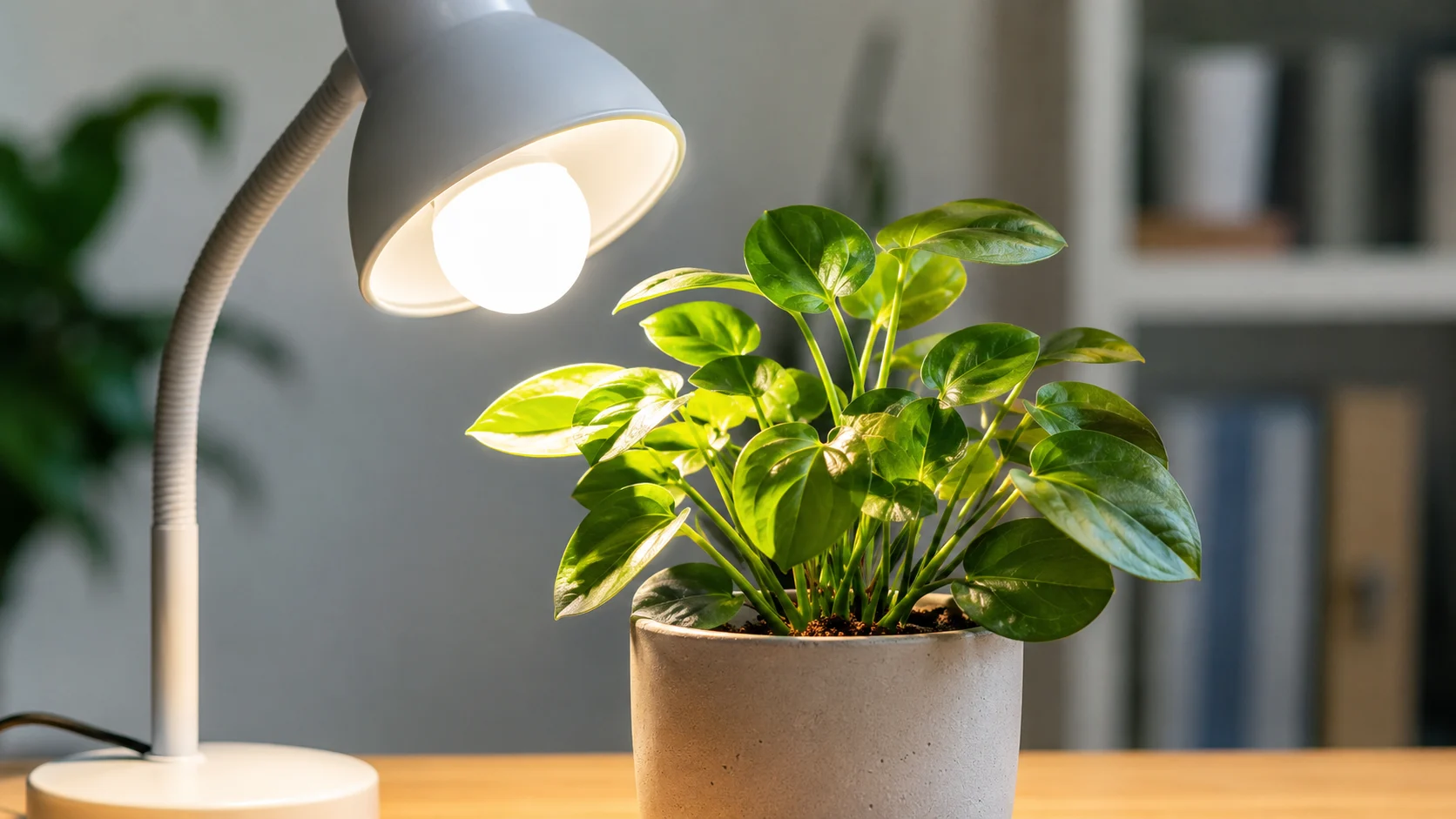
Iowa State Extension's daily light integral band for low light foliage houseplants is 3 to 6 mol/m²/day, the lowest band it publishes. These are undemanding plants. Combine a bright white LED bulb, placed close, running the 12 to 14 hours Iowa State recommends, over a single plant of that type, and you have a setup that can reasonably be expected to contribute something real, particularly as a top-up to existing window light rather than as a replacement for it.
Plants in that band include the ones most beginners already own. The low light plants that genuinely tolerate a dim room covers the list, and snake plant care is a good example of a plant that asks very little.
What we cannot tell you is whether your bulb at your distance reaches that band, because no household bulb publishes the figure. That is an honest gap in the answer, not a hedge.
Where It Definitely Does Not Work
- Anything in the higher bands. Iowa State puts flowering houseplants, succulents, herbs and vegetables at 12 to 16 mol/m²/day, and demanding edibles at 18 to 30. That is several times the low light band and beyond what a lamp bulb realistically delivers to a plant.
- Seedlings. They sit in the 6 to 10 mol/m²/day band and stretch dramatically when short of light. Purdue University's Starting Seed Indoors (HO-14-W, Rosie Lerner) keeps seedlings 3 to 4 inches from fluorescent tubes for exactly this reason.
- More than one plant. See coverage, above.
- A windowless room. Replacing daylight entirely is a much larger ask than topping it up.
One more practical point. If the bulb in question is incandescent or halogen rather than LED, heat becomes the limiting factor before light does. Those bulbs put out a great deal of heat for the light they give, and a plant close enough to receive useful light is close enough to be damaged by it.
How to Find Out for Your Own Setup
Run it as an experiment and read the plant. Put the plant as close to the bulb as is safe, put the lamp on a timer for 12 to 14 hours, change nothing else, and then compare new growth with old growth over the following weeks. Closer leaf spacing and new leaves that are not smaller than the previous ones mean it is doing something. Continued stretching means it is not.
Watch your watering. A plant receiving more light drinks more, so the soil will dry faster than it used to. This is the most common way a lighting experiment turns into an unrelated plant problem.
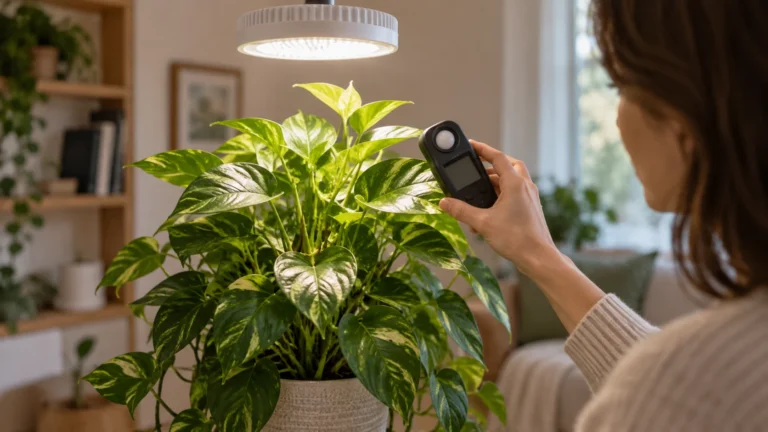
If you want a number, you need a meter. A PAR meter reads µmol/m²/s directly. A phone light meter reads foot-candles or lux, which are weighted to human vision, but is still useful for comparing the spot under the lamp with the spot by the window.
If the experiment says the bulb is not enough, the two things to change before buying anything are distance and hours. Grow light distance and how long to run a grow light each day cover how far each of those levers actually reaches.
Frequently Asked Questions
Do I need a bulb that says grow light on it?
Iowa State Extension's position is that fixtures manufactured as grow lights will provide the necessary wavelengths. The advantage of a purpose-built fixture is not usually mystical spectrum, it is that the maker publishes an output figure at a stated distance, which lets you calculate whether it meets your plant's needs instead of guessing.
Is a brighter bulb better for plants?
Brighter to your eye correlates loosely with more light for the plant, but lumens are weighted to human vision, so it is a rough guide rather than a measurement. Distance changes the result more than a step up in bulb brightness usually does.
What about the daylight or 5000K bulbs?
Kelvin describes the color temperature, meaning how cool or warm the light looks. It is not a measure of quantity. A cooler-looking bulb is not automatically better for a plant than a warmer one at the same output.
Will a regular bulb keep a plant alive even if it does not make it grow?
Possibly, for an undemanding plant, and that is a real distinction worth making. Surviving and growing are different outcomes, and a plant that holds its leaves for months without producing new ones is in the first category.
Is it cheaper to use bulbs I already have?
In the short term, obviously. Whether it works is a separate question from whether it saves money, and the answer above is that it depends on the plant, the distance and the hours, none of which cost anything to test.