Fertilizer Burn on Houseplants: Signs and the Fix
Browning or dieback right at the leaf tips and margins, paired with a white, crusty buildup on the soil surface or the outside of the pot, is the signature of fertilizer burn. University of Maryland Extension describes the leaf symptoms as "browning or dieback of the leaf tips and margins," along with "reduced growth, lower leaf drop," and "yellowing or stunting," and notes the root system takes damage too, showing "dieback and decay," including "dead root tips, and wilting."
The cause, per the same source, is straightforward: "the excessive use of fertilizers, frequent applications of fertilizer, and the incorrect use of fertilizer concentrates." The fix depends on the size of the pot. A larger pot can be flushed thoroughly with plain water; a smaller pot is usually better served by simply replacing the soil.
What fertilizer burn looks like, above and below the soil
Fertilizer burn is really a salt problem, not a chemical burn in the way the name suggests, and its signs show up in a few places at once:
On the leaves:
- Browning that starts at the very tip and margins and works inward, rather than appearing as scattered spots.
- Yellowing or an overall stunted look to newer growth.
- Wilting even though the soil feels moist, since the excess salt interferes with the roots' ability to take up water regardless of how much is actually there.
- Lower leaves dropping.
On the soil and pot:
- A white, crusty buildup on the surface of the potting mix.
- A similar white crust visible on the outside of a porous pot, where salts have migrated through with evaporating moisture.
On the roots, if you check them: University of Maryland Extension notes the root system shows "dieback and decay," with dead root tips being one of the visible signs, which is part of why a plant recovering from this can take a while to bounce back even after the soil itself is corrected.
How it differs from other tip-browning causes
Brown tips on houseplant leaves already covers several causes of tip and margin browning, including low humidity and inconsistent watering. Fertilizer burn is one of those causes, and this article is the deep dive on it specifically. The distinguishing features are the white crust on the soil or pot, and a recent history of feeding: especially feeding more often than recommended, at a stronger dilution than directed, or feeding through a season when the plant wasn't actively growing. If those two things line up with the leaf symptoms, fertilizer burn is the more likely explanation over humidity or watering inconsistency alone.
The fix: flush a large pot, replace a small one
University of Maryland Extension gives a pot-size-dependent answer, rather than treating every container the same way.
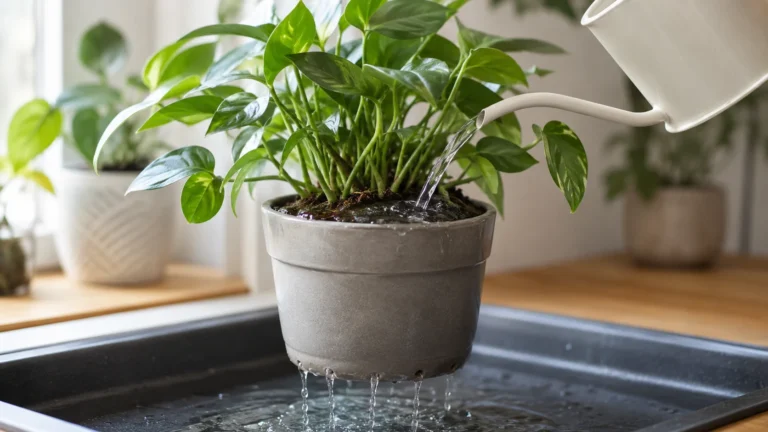
For a larger pot: flush the growing media by irrigating thoroughly with clear water, letting "the water to run out the bottom of the pot," and repeating "the several irrigations with a volume at least that of the pot size" each time. In practice this means watering, letting it fully drain, and repeating several times in one sitting rather than a single light watering.
For a smaller pot: replacing the growing media is the more effective option. A small volume of soil doesn't flush as cleanly, and starting with fresh mix is more reliable than repeated irrigation in a small container. Gently remove the plant, shake off the old soil, and repot into fresh mix, checking the roots for any dead or decayed sections while you're at it.
In either case, hold off on any further feeding until the plant shows clear signs of recovery.
How long recovery takes
Because the roots themselves take damage, not just the leaves, recovery isn't instant even after the excess salt is dealt with. Existing damaged leaf tips won't reverse; what you're watching for is new growth coming in normally, which confirms the roots are functioning again. Depending on how severe the damage was, this can take anywhere from a few weeks to longer, and it's reasonable to trim off the worst of the damaged leaf tissue for appearance once new growth has clearly resumed, rather than doing so immediately.
If growth still isn't resuming after a flush or repot, revisit the checklist in why is my plant not growing. There may be more than one factor at play, or the root damage may be more extensive than a first flush addressed.
Preventing it
The prevention list follows directly from the cause University of Maryland Extension names:
- Follow label dilution and frequency, rather than feeding stronger or more often on the assumption that more will help the plant grow faster. Extension's own fertilizing calendar recommends feeding "from March through September" with monthly diluted liquid fertilizer for most houseplants, and explicitly not during the winter, since "fertilizing at this time could harm some plants."
- Don't fertilize a stressed or recovering plant. A plant recovering from transplant shock, root rot, or any other setback isn't using nutrients efficiently, and feeding it adds a second problem on top of the first. This same caution appears in root rot signs and rescue steps and 7 beginner houseplant mistakes, both of which name overfeeding a struggling plant as a common error.
- Don't fertilize in response to stalled growth, which is the single most common trigger for this problem. A plant that isn't growing usually isn't going to grow faster with more food, and unused fertilizer simply accumulates as salt instead.
- Flush occasionally as routine maintenance, even without visible symptoms, if you fertilize regularly through the growing season, since salts can build up gradually before symptoms appear.
For the full beginner routine that keeps watering and feeding in proportion from the start, indoor plant care for complete beginners covers where fertilizing fits into the bigger picture.
Frequently asked questions
What does fertilizer burn look like on houseplant leaves?
Browning or dieback starting at the leaf tips and margins, often with yellowing or stunted new growth. University of Maryland Extension also notes lower leaf drop and wilting despite moist soil, since the excess salt interferes with the roots' water uptake.
How do I fix fertilizer burn?
It depends on the pot size. Larger pots can be flushed with several thorough waterings of clear water, letting each one drain completely through the bottom, using at least the pot's own volume of water per irrigation. Smaller pots are usually better served by replacing the potting mix entirely rather than trying to flush a small soil volume.
How long does it take a plant to recover from fertilizer burn?
It varies, since the roots take damage along with the leaves and don't recover instantly. Existing damaged leaf tips won't reverse, but new, normal-looking growth is the sign the roots are functioning again, which can take a few weeks or more depending on severity.
Should I fertilize a plant that isn't growing, to help it along?
No. This is the most common cause of fertilizer burn in the first place. A plant that isn't actively growing isn't using nutrients efficiently, and added fertilizer builds up as salt in the soil instead of helping.
How can I tell fertilizer burn apart from other causes of brown leaf tips?
Look for a white crust on the soil surface or the outside of the pot, and think back on recent feeding: has it been fed more often, or more strongly, than the label recommends, or fed during a slow-growth period? If those line up with tip and margin browning, fertilizer burn is the more likely cause over humidity or watering-related tip browning.