Best Soil for Indoor Plants: How to Read the Bag
The best soil for indoor plants is not soil at all. It is a light, soilless potting mix built from a water-holding base (peat moss or coconut coir) and an air-making ingredient (perlite, bark or coarse sand), and the right one for your plant is simply the right balance of those two. Clemson Cooperative Extension's fact sheet on indoor plant soil mixes (read September 11, 2026) says a good mix must be dense enough to support the plant, hold nutrients, let water and air pass through readily while still retaining adequate moisture, and be free of insects, diseases and weed seeds. Once you can read a bag in those terms, choosing one stops being guesswork.
What a Potting Mix Actually Has to Do
Roots need water and air at the same time. A mix that holds too much water pushes the air out, and roots sitting without oxygen are how root rot starts. A mix that holds too little dries out before the plant can use it.
That tension is the whole subject. Every ingredient in a bag sits somewhere on a line between "holds water" and "makes air space," and a houseplant mix is a blend chosen to land at a particular point on that line.
Virginia Cooperative Extension's publication on properly watering container houseplants (read September 11, 2026) puts the rule in one sentence worth keeping: potting soils with fine particles or fibrous structures like peat moss and coconut coir often hold more water and less air, while potting soils made of coarser materials like bark or perlite drain readily after watering.
That is the lever. Fine and fibrous means wetter. Coarse and chunky means drier.
Why Garden Soil Is the Wrong Answer
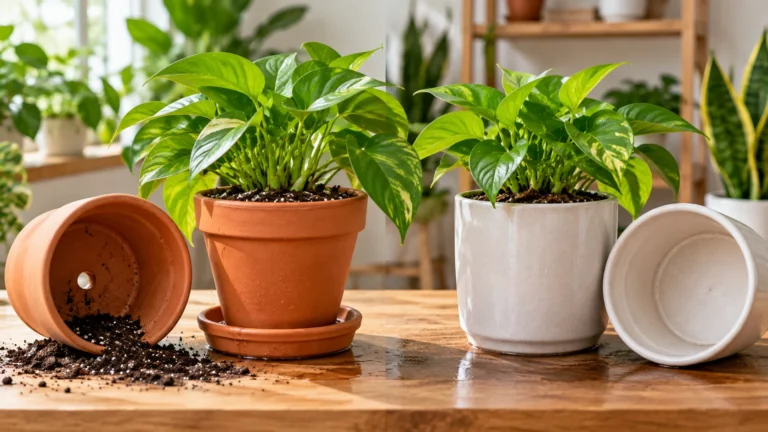
Garden soil works in the ground because there is a whole soil profile below it for water to move into. A pot is a small box with one exit. Soil from the yard compacts under repeated watering, and compacted soil holds water and shuts out air.
It also brings along things you do not want indoors. Clemson's fact sheet states that garden soils contain too many bacteria and are generally not recommended for container plants, and that native soil, if used at all, must be sterilized by heating it to 180 degrees Fahrenheit for 30 minutes. For most people that settles it: buy a bagged potting mix.
How to Read a Potting Mix Bag
The front of a bag sells. The ingredient list informs. Here is how to get the useful part out of it.
1. Find the base ingredient. Nearly every indoor mix starts with peat moss or coconut coir. Either one is the bulk of the bag and most of its water holding. The University of Wisconsin-Madison Division of Extension, in Healthy Roots, Healthy Houseplants (read September 11, 2026), describes typical soilless mixes as several organic materials combined with inorganic ones such as perlite and vermiculite, with the organic part holding water and perlite keeping pore space open so roots get oxygen.
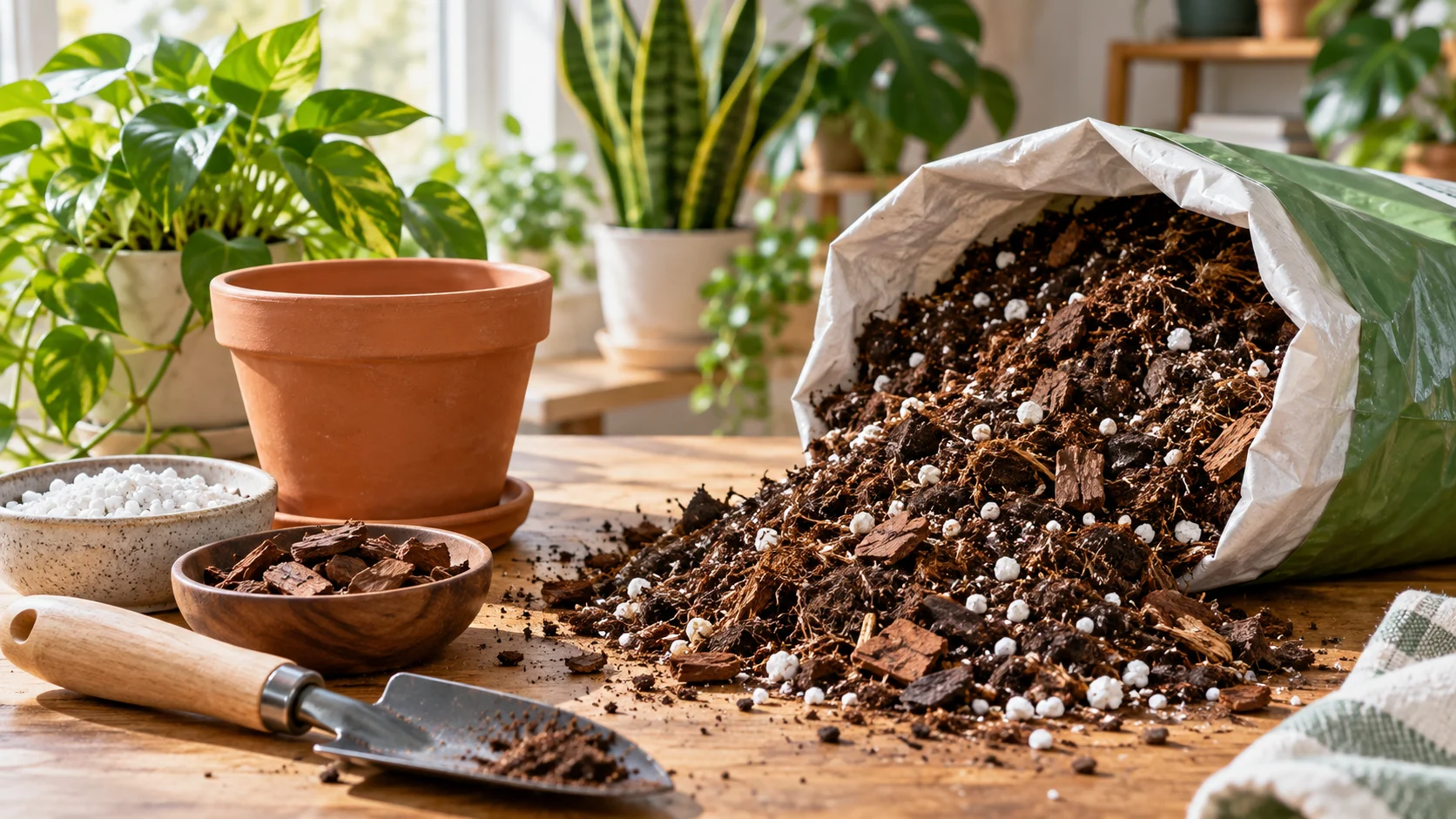
2. Look for the air-maker, and how visible it is. Perlite is the white, lightweight, gritty material. Bark shows up as brown chips. If you open a bag and see very little of either, the mix will behave on the wet side.
3. Note any added fertilizer. Some bags include a starter fertilizer. That is not a problem, but it matters later: it means you should hold off on feeding a freshly potted plant until you have read the product's own label for how long the included feed lasts.
4. Treat marketing phrases as hints, not recipes. Words on the front of the bag describe a goal. The ingredient list tells you how the bag reaches it. A bag promising to hold moisture longer usually contains more fine, water-holding material, which is useful for some plants and risky for others.
What Each Ingredient Does
| Ingredient | What it looks like | What it adds | Too much of it means |
|---|---|---|---|
| Peat moss | Dark, fine, fibrous | Water holding, bulk | Stays wet a long time; hard to rewet once bone dry |
| Coconut coir | Brown, fibrous, similar to peat | Water holding, bulk | Same as peat; Clemson advises rinsing it thoroughly before use to avoid salinity problems |
| Perlite | White, light, gritty | Air space, faster drainage | Dries fast, needs watering more often |
| Vermiculite | Soft, flaky, golden brown | Holds water and nutrients | Adds wetness where you may not want it |
| Pine bark | Brown chips | Structure, air space | Coarse and low in water holding on its own |
| Coarse sand | Gritty, heavy | Weight, drainage | Heavy pots; fine sand can do the opposite of what you intended |
Tuning One Bag for Different Plants
You do not need a different bag for every plant. You need one decent all-purpose mix and a way to push it wetter or drier.
Clemson publishes several foliage-plant recipes by volume, which show the range: two parts peat, one part perlite and one part coarse sand; one part peat, one part pine bark and one part perlite; or one part peat, one part coarse sand and one part pine bark. Its own Clemson Plant Mix is two parts pine bark, one part peat and one part sand. Notice how much of every recipe is the air-making half. That is the reminder most beginners need.
In practice, that gives you three settings:
| Plant type | Setting | How to get there from an all-purpose bag |
|---|---|---|
| Snake plant, ZZ plant, succulents, cacti | Dry | Add a generous share of perlite, bark or coarse sand so the mix drains fast. Snake plant care for beginners shows why this group hates sitting wet |
| Pothos, philodendron, most easy foliage plants | Middle | Use the bag as is, or add a little perlite if you tend to water generously |
| Ferns, calatheas, thin-leaved tropicals | Wetter | Use the bag as is, without extra grit, so it holds moisture between waterings |
The goal is not a perfect mix. It is a mix that dries out on a schedule that suits both the plant and your habits.
The First Watering of a Fresh Mix
A detail that trips people up: a peat-based mix that has dried out in the bag can shed water at first. You pour, it runs straight down the sides and out the hole, and the middle stays dry.
Clemson's repotting fact sheet, Indoor Plants: Transplanting and Repotting (read September 11, 2026), addresses this directly: after potting, water thoroughly and repeat many times, especially if the mix contains peat. The simple fix is to moisten the mix before you pot with it, working water in by hand until it feels evenly damp, not dripping. Then the first watering in the pot soaks in instead of running past.
What the Right Mix Cannot Fix
This is the part that gets left out when a bag is the thing being sold.
A good mix does not fix a watering schedule. A fast-draining mix will still rot a plant that gets water every few days whether it needs it or not. The mix sets how fast the pot dries. You still decide when to water, which is the point of how often to water indoor plants.
A good mix does not fix a pot with no drainage hole. Wisconsin's guidance is plain: to ensure good drainage, containers should have holes in the bottom.
A good mix does not stay good forever. Organic material breaks down over time, the mix settles and compacts, and it drains less well than it did on day one. That is one reason plants eventually need fresh mix even when the pot size is fine.
A good mix does not neutralize what your water carries. If a white crust builds up on the surface over months, that is usually minerals from the water or fertilizer, and hard water and mineral buildup on houseplant soil explains what to do about it.
Signs Your Current Mix Is the Problem
You can often read a mix from how the plant and pot behave:
- The surface stays damp for well over a week in a warm, bright room. The mix is holding more water than the plant uses, or the pot is too large for the roots.
- White fuzz or mushrooms appear on top. Usually a sign of constant surface moisture rather than a disaster. White mold on houseplant soil covers what it means.
- Water runs straight through in seconds and the plant wilts soon after. The mix has either dried out and become water-repellent, or roots have filled the pot so completely there is little mix left.
- The mix has shrunk away from the pot's sides. Old, broken-down or fully dried peat does this. A thorough, slow soak helps; replacing it at the next repot helps more.
Frequently Asked Questions
What is the best soil for indoor plants?
A bagged soilless potting mix, not garden soil. Look for a peat or coir base with visible perlite or bark. Then adjust it: more perlite or bark for plants that like to dry out, less for plants that prefer to stay lightly moist.
Is cactus mix OK for other houseplants?
It can be, for plants that tolerate drying out between waterings, such as snake plants and ZZ plants. For ferns and other moisture-loving plants it usually dries too fast, so you would be watering more often to compensate.
Should I choose peat or coconut coir?
Both do the same job in a mix: they are the water-holding base. Clemson notes that coir should be rinsed thoroughly before use to avoid salinity problems. Beyond that, pick whichever base is in a mix you can find with a good share of perlite or bark.
Can I reuse old potting mix?
Old mix has usually compacted and lost structure, and mix from a plant lost to rot is not worth the risk. For a healthy plant, fresh mix at repotting time is the safer default.