Clip-On vs Panel Grow Lights: The Real Difference
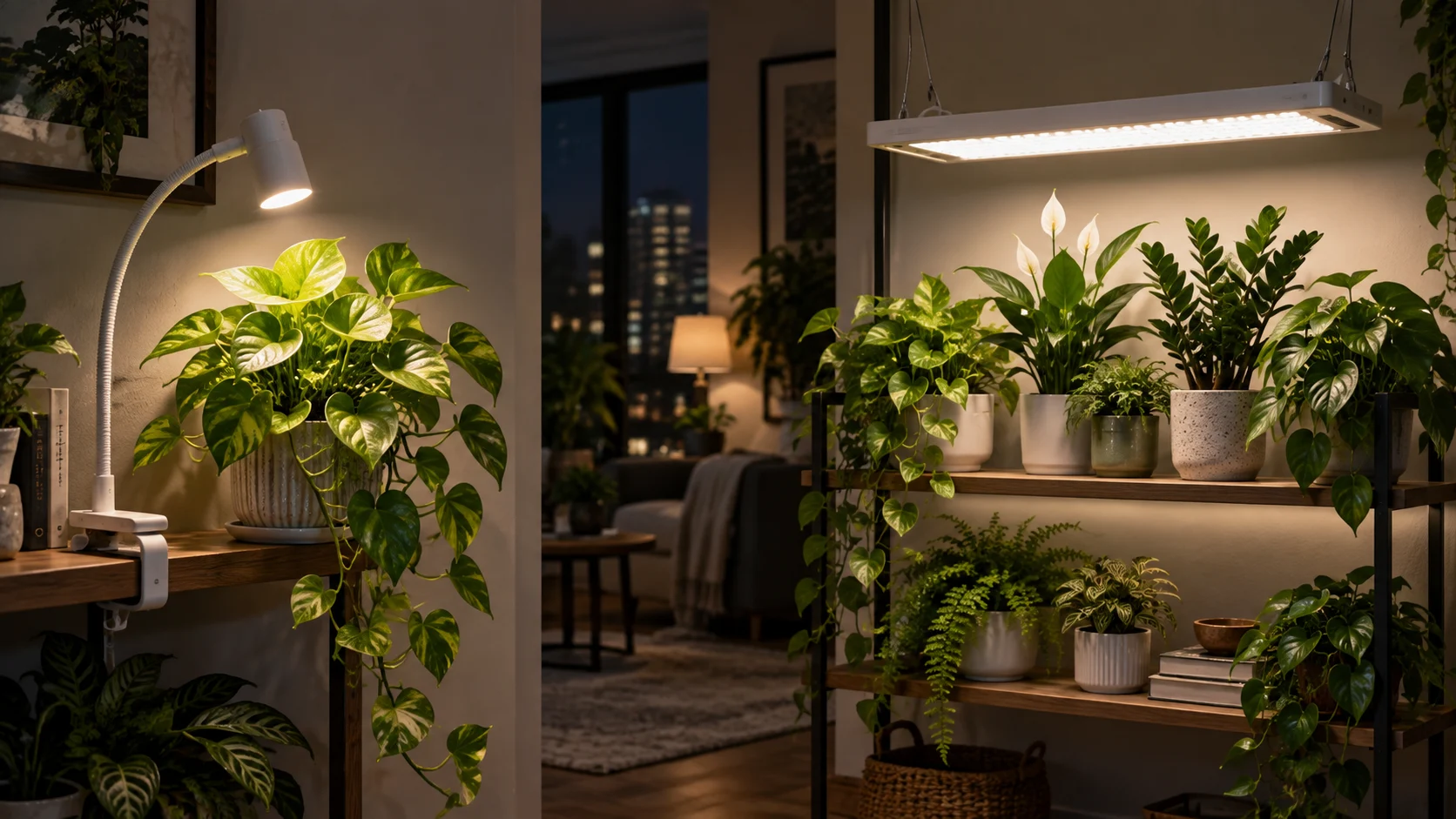
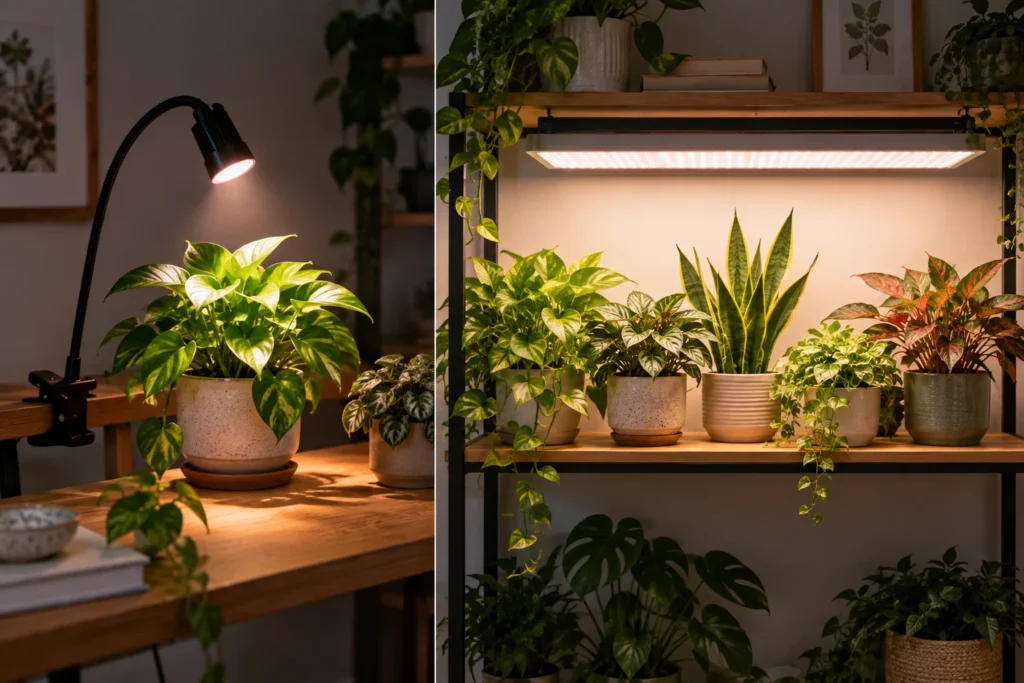
The real difference is the shape of the area each one lights, and everything else follows from it. A clip-on fixture is a small, concentrated light source on a flexible arm, so it lights a small circle intensely and falls away quickly outside it. A panel is a broad emitting surface, so it lights an area more evenly and loses less as you raise it. That makes a clip-on the natural answer for one plant or a tight group, and a panel the natural answer for several plants spread across a shelf or a table. Neither class is better. The choice is decided by how many plants you have, how they are arranged, what you can attach a fixture to, and whether the maker tells you what the fixture actually delivers.
The Differences That Matter
| Clip-on or gooseneck fixture | Full panel fixture | |
|---|---|---|
| How it attaches | Clamps to a shelf edge, a table, a headboard, a windowsill frame. No drilling, no hooks. | Hangs from hooks or chains, or mounts under a shelf. Usually needs a fixing point above the plants. |
| Area it lights | A small circle, aimed. Intensity is highest at the center and falls off quickly toward the edge. | A broader rectangle, more evenly lit across the middle, with the intensity still tailing off at the edges. |
| How fast intensity falls with height | Fast. A small source behaves closer to a point source, and moving it away costs a lot. | More gently. A broad emitting surface loses less over the same move, which is why it can sit further above a plant and still work. |
| Adjusting it | The arm. Aim it anywhere, move it in seconds, re-aim it as the plant grows. | The mounting. Chains or an adjustable bracket let you change height, but you are moving the whole fixture rather than aiming it. |
| What it suits | One plant, or two or three close together. A plant in a spot with nothing above it to hang from. Renters who cannot fix anything to the wall or ceiling. | A group of plants, a shelf, a table, a windowsill row. Anywhere you want an area lit rather than a target. |
| Where it disappoints | Covering several plants. Aim it at one and the others are at the edge of its circle, receiving much less. | Tight spaces. A panel needs some height above the plants to spread its light, so a low shelf clearance limits it. |
| Its usual failure point | The clamp and the arm. A gooseneck that will no longer hold position stops being adjustable, which was the whole point of it. | The mounting. A panel fixed permanently at one height has thrown away the strongest control you have over light level. |
Why the Small One Falls Off Faster
This is the physical difference underneath the table, and it is worth thirty seconds because it explains most of the rest.
Light spreads out as it travels. From a small, concentrated source, it spreads in every direction at once and thins out sharply, which is why a bright little fixture has to sit close to do anything useful. A broad surface behaves differently at short range: close up it lights a wide area fairly evenly, and raising it costs less than the same move would cost a bulb-style source.
Mississippi State University Extension's publication on indoor plants gives a measured example of how severe the drop can be. For two 40 watt fluorescent lamps, output measured roughly 500 foot-candles at 6 inches and about 100 foot-candles at 30 inches. A fivefold increase in distance cost about four fifths of the light, and that was with a long, non-point source. A single small head would do worse over the same distance.
The practical consequence for a buyer is simple. A clip-on has to be close. If the only place you can clamp it is two feet from the plant, you are getting a fraction of what it can do, and a panel over the same plant at the same height would deliver more. How far a grow light should sit from a plant covers how to find the right height for whatever you end up with.
The Numbers on the Box, and Why Most of Them Cannot Be Compared
This is the part that decides more purchases than the clip-versus-panel question does, and almost nobody writes it down.
Grow light packaging is full of figures, and three of the common ones tell you very little about what reaches a leaf.
Wattage. Watts describe what a fixture pulls from the wall, not what it delivers to a plant. Two fixtures at the same wattage can differ substantially in useful output, and the "equivalent to a 300 watt bulb" style of claim is not a measurement of anything. Watts do tell you honestly what the fixture costs to run, which is a real question and one our guide to grow light running costs answers.
Lumens. Lumens are weighted for human vision. Virginia Cooperative Extension makes the same point about foot-candles and lux, noting they are based on human vision and do not always translate well to plant growth. A fixture can look impressively bright to you and be a modest light to a leaf.
A PAR or PPFD figure with no distance attached. Photosynthetic photon flux density is the right quantity, because it counts the photons a plant can use arriving on a surface each second. But intensity falls off sharply as light travels, so the same fixture produces a very different PPFD at 6 inches and at 30. A PPFD number quoted without the height it was measured at is not a specification. It cannot be checked, and it cannot be compared with a competing fixture quoted at a different, unstated height.
So the question that separates a fixture you can evaluate from one you cannot is not clip or panel. It is this: does the maker publish an output figure at a stated distance, ideally at several heights? If it does, you can work out what your plant will receive at the height you can actually mount it. If it publishes a wattage and a spectrum claim and nothing else, you cannot, and no amount of reading the box will change that. That is worth treating as information about the product.
While we are at it, spectrum claims deserve less weight than they get. What full spectrum actually means on a grow light label explains why the phrase describes appearance more than it specifies performance.
Which One for Which Situation
One plant, in a spot with nothing above it. Clip-on. This is what the class exists for: a single monstera in a corner, a plant on a desk, a plant on a windowsill where a hanging fixture is not an option. Clamp it close and aim it down rather than sideways, because a light coming in at an angle produces a leaning plant.
Two or three plants standing together. Either, and the deciding factor is whether they have similar light needs. A clip-on aimed at the middle of a group gives the middle plant considerably more than the outer two. If they are all tolerant foliage plants, that may not matter. If one is a succulent, it should be the one in the middle.
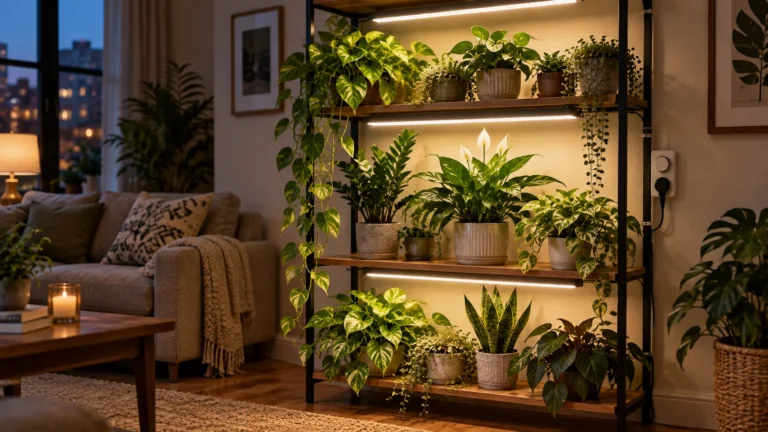
A shelf or a table of plants. Panel, or a long bar-shaped fixture, because you are lighting a rectangle rather than a point. Our simple grow light setup guide covers the three decisions that follow once you have picked a shape.
A rented flat where nothing can be fixed to the wall or ceiling. Clip-on, or a panel that clamps or stands rather than hangs. This constraint decides more real setups than any spec sheet does.
You are not yet sure the plant needs a fixture at all. Then the honest first step is not either of them. Work through whether you actually need a grow light first, because moving the plant to a brighter spot is free and is frequently a larger change than a small fixture would make.
What Neither Class Fixes
A clip-on and a panel share the same limits, and it is worth saying them plainly.
Neither compensates for being too far away. Neither makes a high light plant content in a low light level. Neither repairs the stretched growth a plant already made in a dark corner, because stretched stems do not shorten and small leaves do not grow. And neither one is doing anything at all if the timer is off, which is the failure mode nobody checks.
The measurable difference between a good setup and a poor one is almost never the fixture class. It is distance, hours and the match between the plant and the light level you can actually produce.
Frequently Asked Questions
Is a panel grow light stronger than a clip-on? Not necessarily. A panel usually lights a larger area and loses less as you raise it, but a small clip-on positioned close to a single plant can deliver more light to that plant than a weak panel hung high above it. The comparison only means something at a stated distance.
Can a clip-on grow light cover several plants? Only the ones near the middle of its circle. Intensity falls off toward the edge of the lit area, so plants at the outside receive noticeably less than the one it is aimed at. Group plants with similar needs, and put the most demanding one under the center.
Do I need a panel for a shelf, or will several clip-ons do? Several clip-ons work, and they are often easier to mount on a shelf edge. The trade is that you now have several cords, several clamps and several things to aim, and the lit area is a set of overlapping circles rather than an even rectangle.
Are panels harder to install? Usually, yes. Most are designed to hang or to mount under a shelf, which means hooks, chains or brackets. That is also their advantage, because a hanging fixture is easy to raise and lower, and height is the control you will want most.
Which one uses more electricity? Whichever draws more watts, which has nothing to do with its shape. A large panel usually draws more than a small clip-on, and it is lighting more plants for it. The figure to compare is the wattage on the label against the hours you plan to run it.