Should You Leave a Grow Light On All the Time?
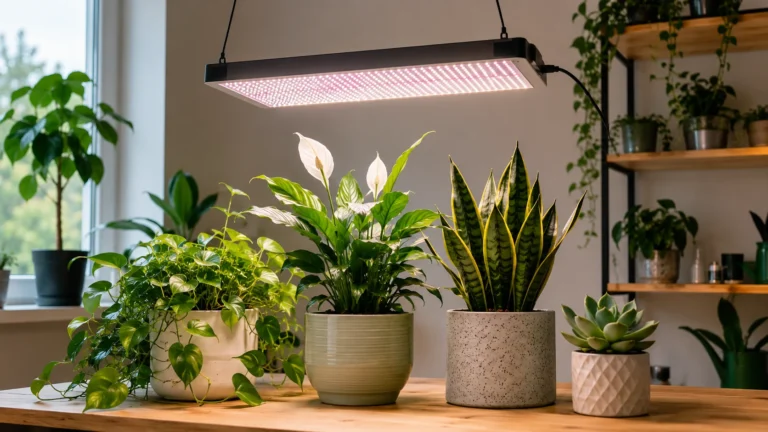
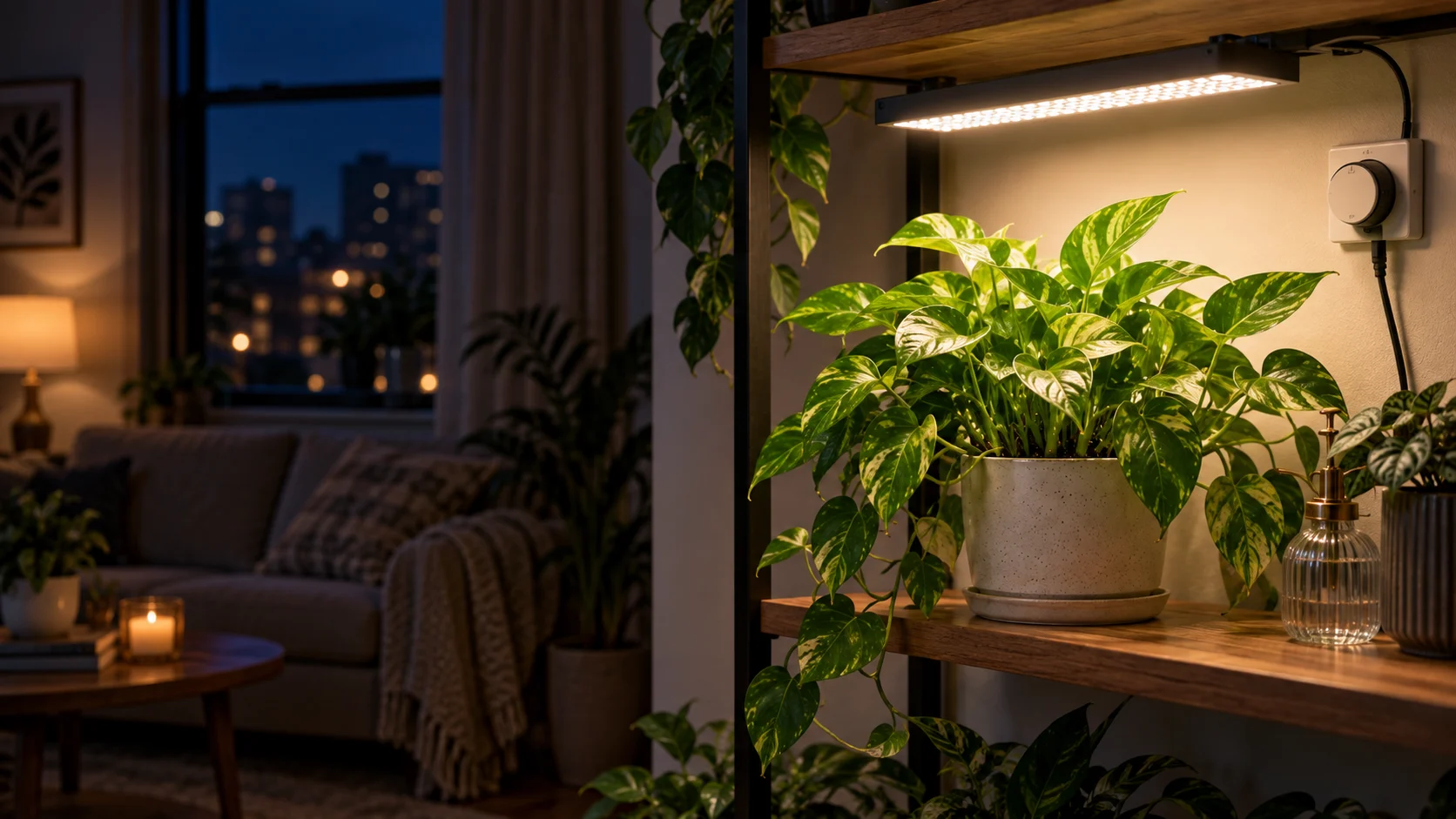
No. Leaving a grow light on all the time works against the plant rather than for it. University of Maryland Extension states it plainly: plants need some period of darkness to develop properly, so do not expose them to more than 16 hours of light. Texas A&M AgriLife's ornamental production guide gives the same 16 hour ceiling. Darkness is not downtime. It is when many succulents actually take in carbon dioxide, and it is when short-day plants like Christmas cactus and poinsettia decide whether to set flower buds at all. Put the fixture on a timer and give it 12 to 14 hours.
Two extension services, one ceiling
The recommendation is unusually consistent for a houseplant question.
University of Maryland Extension, in its guidance on low light indoors, writes: "Plants need some period of darkness to develop properly; so do not expose them to more than 16 hours of light." Texas A&M AgriLife's Light, Temperature and Humidity reference guide says plants "require some period of darkness to properly develop and should be exposed to light for no more than 16 hours per day."
Two land-grant universities, the same number, written for ordinary indoor plants rather than for a commercial greenhouse. The practical range underneath that ceiling is covered separately in our guide to how long to run a grow light each day, which works through why published ranges land at 12 to 14 hours and how to check whether your hours are actually adding up to enough light. This article answers the question sitting under it: why can't it just be all of them?
Where "more light means more growth" stops being true
The instinct is reasonable. Light drives photosynthesis, so more hours should mean more sugar, more growth, a faster plant.
It holds for a while and then it stops, for a simple reason. Photosynthesis builds sugars, but the plant has to spend them, and the spending happens continuously in a process called respiration. Growth, repair, moving nutrients around, all of it draws on the store the day put there. A plant under permanent light never gets a night, and a day that never ends is not the environment any houseplant on your shelf evolved under.
More concretely, the extra hours stop buying you much. If your fixture and its distance already deliver enough light across 12 to 14 hours to hit the published target for that kind of plant, running it another 10 hours takes away the dark period and mostly adds to what the light costs you to run without moving the plant into a different category. If it is not delivering enough, the problem is intensity or distance rather than duration, and running it forever will not fix that either.
For some houseplants, darkness is when they eat
This is the part the search results almost never mention, and it matters more for houseplant owners than for anyone else, because of what tends to be sitting under a beginner's grow light.
Cacti and many succulents run a version of photosynthesis called crassulacean acid metabolism, or CAM. In the review "Crassulacean acid metabolism (CAM) at the crossroads" in Annals of Botany (2023), Sage and colleagues describe the pattern: these plants open their stomata at night to fix carbon dioxide into malic acid, store it, then close their stomata during the day and release the stored carbon internally for photosynthesis. ASU's Ask A Biologist puts the same thing in one line: cacti "lose less water by only opening their stomata at night", and store the carbon dioxide they take in overnight as malic acid.
CAM is not a curiosity. That review counts roughly 7 percent of all vascular plants, about 18,000 species, across cacti, agaves, epiphytic orchids, bromeliads, living stones and the succulent euphorbias. Read that list against a typical indoor plant collection and you find a lot of it: the snake plant that everyone starts with, jade, aloe, most of the orchid shelf, the bromeliad someone gave you in flower.
For a plant on that list, night is not a rest period bolted on for tidiness. It is the half of the 24 hours in which the plant opens up and takes in its carbon. Removing it is not like skipping a nap. It is closer to rearranging the schedule of a creature that only eats at night, and then leaving the lights on.
Two honest qualifications. First, CAM plants are tough and adaptable, and what is established here is the mechanism, not a measured outcome for a windowsill snake plant under a 24 hour clip lamp. Second, plenty of common foliage houseplants, pothos and monstera and philodendron among them, are not CAM plants at all, so the argument does not apply to them in this form.
The bloom that never arrives
Here is the consequence people actually notice, and almost nobody connects to the light they left on.
Christmas cactus, poinsettia and kalanchoe are short-day plants. Texas A&M AgriLife's guide names all three: they "flower only when days are 11 hours or less". What triggers the buds is not really the short day, it is the long, unbroken night, and the tolerance for interruption is far tighter than people expect.
University of Georgia Extension horticulturist Paul Pugliese, writing on Christmas cactus, gives the numbers: "Fourteen hours or more of continuous darkness each night is required before flower bud set will occur", the long nights should start around the middle of September and continue "for at least six continuous weeks", and, the line worth reading twice, "as little as two hours of interrupted lighting will inhibit flower bud set."
South Dakota State University Extension makes the same point about poinsettias from the grower's side, and the detail is memorable: even walking down a greenhouse aisle at night with a flashlight can be enough to disturb the timing of a crop, and stray light can delay a crop by several weeks.
So if your Christmas cactus has never colored up, and it lives in a room where a grow light or a lamp burns into the evening or overnight, you very likely have your answer. The plant is not weak and the soil is probably fine. It has simply never been given a night long enough to count.
What leaving a grow light on all the time actually costs you, ranked by evidence
Reader instinct ranks these upside down. The frightening one is the least likely, and the boring one is the best evidenced and the most commonly experienced.
| What happens | How well documented | What it means for your plant |
|---|---|---|
| Short-day plants never bloom | Strongest. Named thresholds from UGA and Texas A&M Extension | The Christmas cactus, poinsettia or kalanchoe stays green. Two hours of interrupting light is enough to stop bud set |
| The extra hours buy nothing | Strong. A 16 hour ceiling from two extension services | Past the ceiling you are paying for light the plant is not turning into visible growth |
| Leaf chlorosis under continuous light | Documented, but in research crops | Tomato, potato and eggplant are the sensitive ones. Lettuce tolerates it. This has not been shown for ordinary foliage houseplants, so treat it as a warning rather than a prediction |
| CAM plants lose their night | Mechanism well established, effect on houseplants unmeasured | Succulents, cacti and orchids take in carbon at night. Removing the dark removes that window |
| Electricity | Certain, and small | Running 24 hours instead of 12 exactly doubles the cost of running the fixture |
| Fixture or wiring problems | Rare with a listed fixture on a proper outlet | Least likely of the six, and the only one with a consequence beyond the plant. Covered below |
The pattern is worth naming: the thing most people worry about is the thing least likely to happen, and the thing that actually happens is a plant that quietly refuses to flower.
A fixture running around the clock is an unattended appliance
Almost every page answering this question treats it as a botany question only. It is also a question about a mains-powered device that nobody is watching, so a few things are worth setting up properly. This section covers plug-in fixtures in the United States, where household circuits run at 120 volts under the National Electrical Code. Readers elsewhere should follow their own national wiring rules, which in the UK means BS 7671 and Part P.
A timer is the control, and it has its own rating. Mechanical and digital outlet timers are marked with a maximum load. A single houseplant fixture drawing tens of watts sits far below that mark, but check the number rather than assume it, especially if you plan to run several fixtures through one timer.
Extension cords are temporary. The Electrical Safety Foundation International is direct about this: an extension cord is a temporary solution and should not be used as a substitute for permanent wiring. Do not overload one, and do not run more than one appliance from a single cord. A grow light that lives in the same spot for years, fed by a cord that snakes across a room, is exactly the arrangement that guidance is warning about.
Look for a certification mark from a recognized testing laboratory, such as UL or ETL, and follow the manufacturer's instructions on clearance from curtains, fabric and anything else that traps heat. LED fixtures run cooler than the lamps they replaced, but the driver and the housing still get warm, and continuous operation means they never get a chance to cool down.
Where to stop. If the plug, cord or outlet is warm to the touch, if the fixture flickers, or if the circuit trips, unplug it and stop using it. If the fix you have in mind involves adding an outlet, wiring a fixture into a ceiling box, or opening the breaker panel, that is work for a licensed electrician rather than a plant care task, and in most of the United States it is permitted work rather than a homeowner project.
The exceptions, and why they do not transfer
Continuous light is not universally harmful, and it would be dishonest to say it is.
Some crops tolerate it. In Frontiers in Plant Science (2019), Lanoue and colleagues note that low irradiance continuous light has been shown to increase growth in lettuce, while tomato, potato and eggplant respond badly, and that "lighting longer than 18 h causes leaf injury in tomato characterized by interveinal chlorosis". Their own solution was not to leave a light on. It was to alternate red light through the day hours with blue light through the night hours, which is a spectrum-switching system, not a bulb somebody forgot about.
Growers also use continuous or near-continuous light briefly and deliberately, for example on seedlings or fresh cuttings at low intensity for a short window. That is a controlled decision with an end date, made on plants that are not flowering and are not CAM succulents.
None of that describes a houseplant on a shelf with a clip lamp above it. If you are still deciding whether you need a fixture at all, our honest walkthrough of whether you need a grow light is the better place to start, and it is worth reading the signs your plant needs more light before you buy anything.
What to do instead
The whole fix is one inexpensive device and one decision.
- Put the fixture on an outlet timer. This removes the failure mode entirely, because it removes you from the loop.
- Set it to 12 to 14 hours, staying under the 16 hour ceiling both extension services give.
- Keep the dark hours unbroken. A dark period interrupted in the middle is not the same as a dark period, especially for short-day plants.
- If you own a Christmas cactus, poinsettia or kalanchoe and you want flowers, give it 14 or more hours of continuous darkness a night from around mid-September for at least six weeks, and keep other room lighting off it during those hours.
- If the plant still looks poor after that, the answer is intensity or distance, not more hours.
FAQ
Can I leave a grow light on 24 hours a day?
You can, but you should not. University of Maryland Extension and Texas A&M AgriLife both cap indoor plants at no more than 16 hours of light a day, on the grounds that plants need a period of darkness to develop properly. Twelve to 14 hours on a timer is the practical setting.
What happens if I leave a grow light on all night?
For most foliage houseplants, one night will not do visible damage. The plant that pays immediately is a short-day plant. University of Georgia Extension reports that as little as two hours of interrupting light will inhibit flower bud set in Christmas cactus, so a light left on during the bud-setting weeks can cost you the whole bloom.
Do plants need darkness to grow?
They need it to develop properly, which is the wording both extension sources use. Darkness is when the plant spends the sugars daylight produced, and for CAM plants such as cacti, agaves, many orchids and snake plants, it is also when the stomata open and carbon dioxide comes in.
Is it cheaper to leave a grow light on all the time?
No. Cost scales directly with hours, so running a fixture for 24 hours instead of 12 doubles it. An outlet timer costs very little and pays for itself by removing the most expensive way to run a light.
Will more hours of light make my plant grow faster?
Only up to a point, and only if the intensity is adequate. Once your hours put the plant inside the published light target for its type, more hours mostly add cost. If growth is poor, look at how strong the light is and how far away it sits before you add hours.
Sources
- University of Maryland Extension, "Low Light Impacts on Indoor Plants", updated 2023-03-13. Read 2026-08-29.
- Texas A&M AgriLife Extension, Light, Temperature and Humidity, Ornamental Production reference guide. Read 2026-08-29.
- Paul Pugliese, University of Georgia College of Agricultural and Environmental Sciences, "Control light and Christmas cactus will bloom", 2018-12-20. Read 2026-08-29.
- Kristine Lang, Vaughn Reints and David Graper, South Dakota State University Extension, "Are You Photoperiodic? Poinsettias Are", updated 2025-05-29. Read 2026-08-29.
- Sage et al., "Crassulacean acid metabolism (CAM) at the crossroads", Annals of Botany, 2023. Read 2026-08-29.
- Dr. Biology, "CAM Plants", ASU Ask A Biologist, 2014-08-02. Read 2026-08-29.
- Lanoue, Zheng, Little, Thibodeau, Grodzinski and Hao, "Alternating Red and Blue Light-Emitting Diodes Allows for Injury-Free Tomato Production With Continuous Lighting", Frontiers in Plant Science, 2019. Read 2026-08-29.
- Electrical Safety Foundation International, extension cord safety guidance. Read 2026-08-29.