Watering Houseplants in Winter: Why Less Is Right
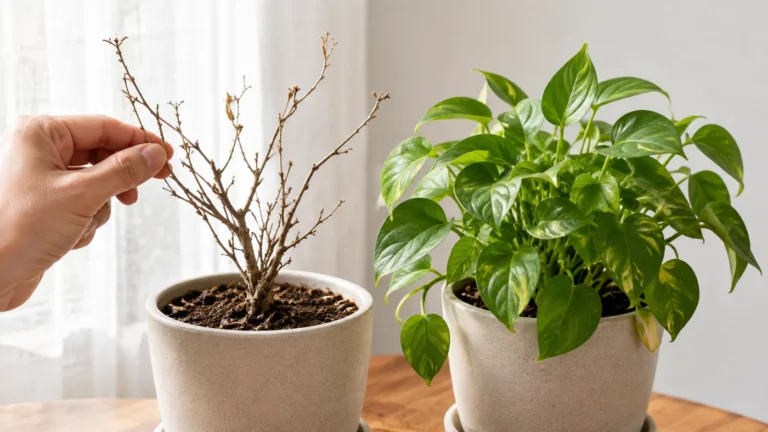
Most houseplants need less water in winter, not because the air or the water itself is cold, but because falling light levels slow growth to a near stop, a state called quiescence, and a plant that is barely growing cannot use water the way it did in summer. The trap: heated indoor air turns very dry in winter, and that dryness pushes many beginners to water more to compensate, which is backwards. The plant needs less water while the air needs more humidity, two separate problems with two separate fixes. Check the top inch of soil before every watering, not the calendar or the thermostat.
The short answer: it's light, not cold
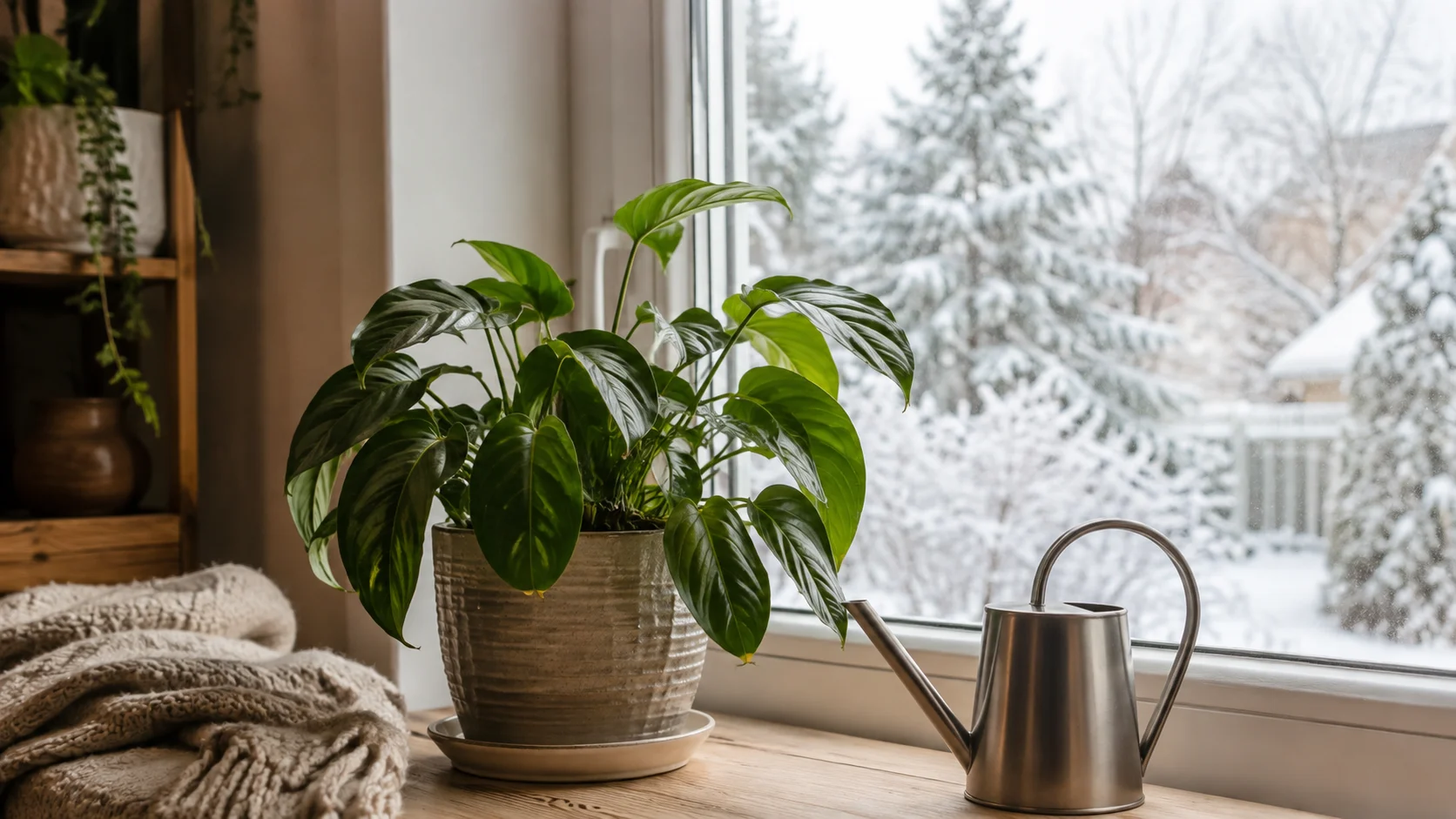
It is easy to assume a plant needs less water in winter because the house is colder, but for most homes that assumption is not really true. Central heating keeps most living rooms at a fairly stable temperature year-round, and the plant itself is not experiencing "cold" in any meaningful sense. What has genuinely changed is the sun: it sits lower in the sky, days are shorter, and the light reaching a window is weaker even at midday. As reported by University of Nebraska Extension (UNL Water), seasonal light levels have "fallen back," and for plants that spent the warmer months outdoors, the wind-driven evaporation they experienced there has also stopped entirely once they come back inside. Less usable light drives everything that follows.
What's actually happening inside the plant: quiescence
University of Vermont (UVM) Extension describes what falling daylight triggers in most houseplants as "a special kind of dormancy called quiescence," a resting period during which the plant "conserves its energy" and growth "slows considerably." Some plants take this further and drop leaves outright over winter, alocasia and caladium among them, which UVM Extension notes is a normal seasonal response the plant recovers from once spring light returns, not a sign that something has gone wrong.
A plant that has slowed its growth this way is simply not pulling water up through its roots and out through its leaves at the summer rate. Watering it on the summer schedule does not help it grow faster. It just leaves the roots sitting in wet soil for longer than they can use, which is where winter's most common houseplant problem begins.
The dry-air trap: why beginners overwater in winter
Here is the part that gets blurred together in most consumer advice, and it is the reason winter is the season most houseplants actually die from watering, not from cold.
UVM Extension puts the beginner mistake directly: "we tend to over-love our plants by giving them too much water. This is especially true in the winter." Part of why is understandable. UNL Water Nebraska notes that once a furnace is running, "indoor air can be as dry as desert air," and a plant sitting in that dry air can look stressed, curling or slightly crisping at the edges. The instinct is to reach for the watering can, since more water feels like the caring response to a plant that looks unhappy.
That instinct solves the wrong problem. Dry air pulls moisture out of leaves through the air, not out of the soil through the roots faster than usual. Adding more water to the pot does not rehydrate the leaves; it just keeps the soil wetter for longer at exactly the time the plant is using water the slowest. UVM Extension connects this pattern directly to fungus gnats becoming a problem specifically with overwatering, and root rot follows the same wet-soil path. Fungus gnats covers how to recognize and clear an infestation if this has already happened. The two problems, dry air and overwatered soil, need two completely separate fixes, not one.
Two separate fixes for two separate problems
Treat "the plant needs less water" and "the air is too dry" as unrelated facts about the same plant, because they are.
For the water side, water less often, and let the soil dry out further between waterings than it would in summer, while still watering just as thoroughly each time you do. How much water does a houseplant need covers how to make each individual watering a proper soak; what changes here is only the gap between waterings, not the method within one. What is dissolved in the water itself is a separate question again, unrelated to season: tap water vs filtered water for houseplants covers when that genuinely matters.
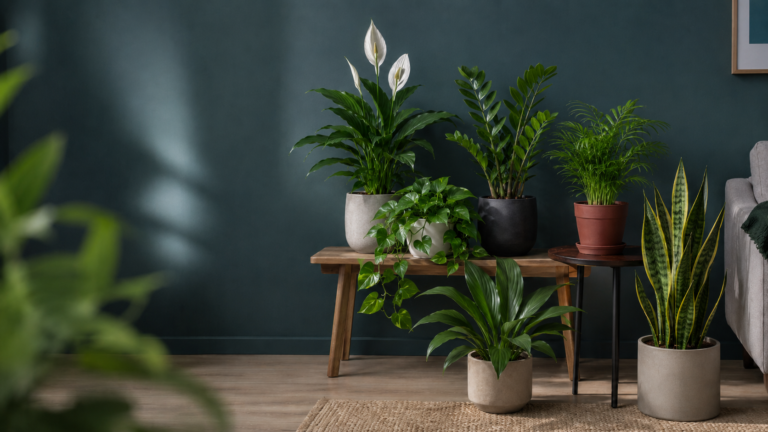
For the dry-air side, raise humidity around the plant directly rather than through the soil: group plants together so they share moisture, move humidity-loving species to a naturally damper room like a kitchen or bathroom, which UNL Water Nebraska specifically recommends, or run a humidifier nearby. None of these involve the watering can at all, which is exactly the point.
How to actually water less without guessing
The soil check does not change in winter, only what it tells you does. UNL Water Nebraska describes testing the top one inch of soil, or watching for the plant to begin wilting slightly, as the signal that it is ready for another watering, rather than watering by the calendar. As an illustration of how much the interval itself can stretch, UNL Water Nebraska gives the example of a plant that needed watering roughly daily outdoors in summer needing it "once a week or less" indoors in winter; treat that as one real example of how far the gap can widen, not a universal rule for every plant.
Illinois Extension frames the goal simply: "keep soils on the dry side, but plants should never wilt." If you are still building the habit of checking rather than scheduling in the first place, how often to water indoor plants and how to tell if your plant needs water both cover that check in more depth than this article does.
When it actually is about temperature
There is one honest exception worth naming, because it looks similar but is a genuinely different problem. A plant pushed up against a cold windowpane, sitting in a draft, or near a door that opens to freezing air can suffer real cold-stress damage, blackened or water-soaked patches, that has nothing to do with the seasonal light-driven slowdown described above. That is a placement problem, not a watering-amount problem, and cold damage on houseplants covers how to recognize and fix it. Watering less in winter is about growth slowing down everywhere in the home; cold damage is about one specific plant sitting somewhere too cold.
Before and after: what actually changes
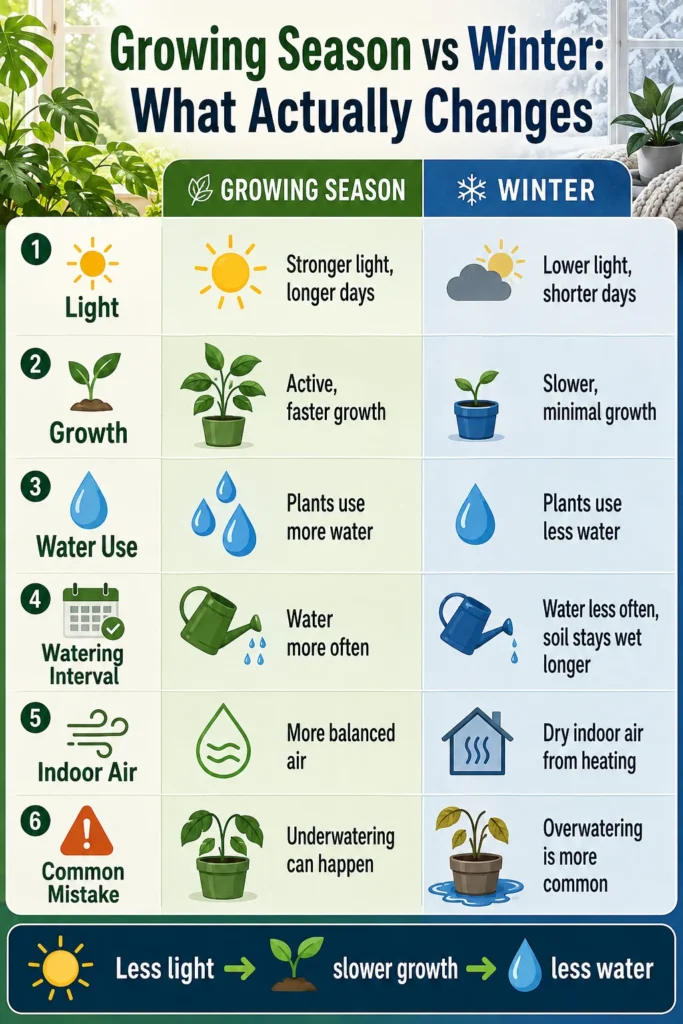
| Factor | Growing season | Winter |
|---|---|---|
| Light | Long, higher-intensity days | Short, low-angle days, even by a sunny window |
| Growth | Active | Slowed or paused (quiescence) |
| Water use | Higher | Lower |
| Watering interval | More frequent | Less frequent; each watering just as thorough |
| Indoor air | Often adequate humidity | Often very dry from heating; a separate issue |
| Common mistake | N/A | Watering more to compensate for dry air |
Frequently asked questions
Do houseplants really need less water in winter? Most do, yes. Falling light levels slow growth into a resting state called quiescence, and a plant that is barely growing uses much less water than it does during its active season.
Is it the cold that reduces how much water my plant needs? Not directly, for most homes. Central heating keeps indoor temperatures fairly stable year-round. What changes is the amount of usable light, which is what actually slows the plant's growth and its water use.
Should I increase humidity by watering more in winter? No. Watering more adds moisture to the soil, not to the air around the leaves, and can lead to root rot and fungus gnats. Raise humidity directly, through grouping plants, a humidifier, or a naturally damp room, instead.
How much less water should I give my plants in winter? There is no single number that fits every plant. Check the top inch of soil, or watch for slight wilting, before watering, and expect the gap between waterings to stretch noticeably compared to summer, sometimes by several weeks for slow-growing plants.
When does watering go back to normal in spring? As daylight lengthens and the plant resumes active growth, typically in early to mid spring depending on your climate and the species, it will start drying out faster again. Let the soil check, not the date on the calendar, tell you when that shift has actually happened.